Structural Solutions for Basements & Foundations: Complete Engineering Guide
Foundation and basement structural engineering represents one of the most critical aspects of residential construction and renovation. Whether you’re finishing an existing basement, planning a major renovation, or building from scratch, understanding the structural requirements can mean the difference between a safe, code-compliant space and a costly structural failure that compromises your entire home.
The stakes are remarkably high. Structural failures in basement and foundation systems don’t just affect the lower level—they can compromise the integrity of your entire structure, leading to repair costs that frequently exceed $40,000 to $50,000. Beyond the immediate financial impact, improper structural work can reduce your home’s value, create safety hazards, and result in failed inspections that delay or derail construction projects.
In over 15 years working with structural engineers and foundation contractors, I’ve observed that approximately 60% of basement renovation problems stem from a fundamental misunderstanding: the difference between decorative partition walls and load-bearing structural walls. Many homeowners assume that any wall framed with 2×4 lumber can be safely removed, when in reality, these walls often support critical floor beams that carry loads from upper stories.
This guide provides comprehensive technical information for homeowners, contractors, and DIY enthusiasts who need to understand basement and foundation structural requirements. We’ll cover everything from foundation types and load calculations to building codes and when professional engineering services become legally mandatory.
Understanding Foundation Types & Their Structural Requirements
The foundation system you’re working with fundamentally determines your structural approach, material requirements, and construction methods. Each foundation type has distinct engineering characteristics that affect everything from waterproofing strategies to load-bearing capacity.
Poured Concrete Foundations
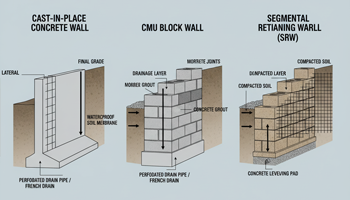
Poured concrete foundations represent the most common modern approach for basement construction. These monolithic structures offer superior strength and water resistance compared to older methods. The continuous concrete pour eliminates the weak points created by mortar joints, creating a unified structural element that better resists lateral earth pressure and hydrostatic forces.
Typical poured concrete foundation walls range from 8 to 10 inches thick for residential applications, though thickness increases based on wall height, soil conditions, and surcharge loads. The structural advantage comes from the concrete’s compressive strength combined with properly placed reinforcing steel that handles tensile forces. Modern foundation walls typically require vertical rebar at 16 to 24 inches on center, with horizontal bars providing additional crack control.
Block (CMU) Foundations
Concrete masonry unit (CMU) foundations remain prevalent in many regions, particularly in areas where skilled masons are readily available. These foundations consist of hollow concrete blocks stacked and mortared together, with reinforcing steel placed in the vertical cells and then filled with grout for structural integrity.
The engineering challenge with CMU foundations lies in the mortar joints, which represent potential weak points for both structural performance and water infiltration. Proper construction requires full mortar beds on all horizontal and vertical joints, with reinforcing bars positioned according to engineering specifications. Typical residential CMU foundation walls use 8-inch or 10-inch blocks with #4 or #5 rebar placed vertically at corners, intersections, and at regular intervals along the wall.
Slab-on-Grade vs Basement Foundations
The choice between slab-on-grade construction and full basement foundations involves significant structural and functional differences. Slab-on-grade systems place the living space directly on a concrete pad poured over prepared and compacted soil. These systems work well in warm climates where frost depth isn’t a concern and where the additional living or storage space of a basement isn’t needed.
Basement foundations extend below grade, requiring excavation, foundation walls, and a separate basement floor slab. The structural complexity increases substantially—you’re essentially creating a below-grade room that must resist soil pressure from all sides while supporting the entire structure above. The basement floor slab typically requires a gravel base for drainage, vapor barrier for moisture control, and reinforcing mesh or rebar to control cracking.
Frost Lines & Regional Building Code Variations
Frost line depth represents one of the most critical regional variables in foundation design. When soil freezes, it expands, and this frost heave can generate enormous forces capable of lifting and cracking foundations. Building codes require footings to extend below the maximum frost penetration depth for your area.
Frost line depths vary dramatically across North America. In southern states like Florida or Texas, frost depth may be zero to minimal, allowing shallow footings. In northern regions like Minnesota or North Dakota, frost lines can extend 42 to 60 inches below grade, requiring significantly deeper excavation and more extensive foundation work. Failing to account for local frost depth requirements virtually guarantees foundation movement and structural damage during the first hard winter.
Load-Bearing Wall Systems in Basement Structures
Understanding which walls actually support structural loads represents perhaps the single most important skill for basement renovation planning. This knowledge directly impacts project costs, structural safety, and code compliance.
Identifying Existing Load-Bearing Walls
Load-bearing walls in basements typically support floor joists or beams from the first floor above. Several visual clues can indicate load-bearing function, though only proper engineering analysis provides certainty. Walls that run perpendicular to floor joists above frequently carry loads. Walls positioned directly below upper-level load-bearing walls often continue the load path to the foundation. Basement walls that support steel or wood beams are definitively load-bearing.
However, visual inspection alone proves unreliable. I recall a particularly expensive lesson from a client who wanted to completely open his basement for a home theater installation. The walls he planned to demolish supported a triple LVL (laminated venous lumber) beam that carried the entire second floor load. The structural reengineering required to remove those walls cost $45,000, compared to the $8,000 it would have cost to work within the existing structural layout. This single case illustrates why professional structural assessment before any demolition is non-negotiable.
Structural Calculations for New Load-Bearing Walls
When adding new load-bearing walls in a basement—perhaps to support a new beam or to redistribute loads after removing an existing wall—proper structural calculations become mandatory. These calculations determine the appropriate wall framing (2×4 vs 2×6 studs), stud spacing, and bottom plate attachment requirements based on the loads being supported.
The calculation process starts with determining the tributary area—the portion of the structure that a particular wall supports. This involves calculating dead loads (the weight of the building materials themselves) and live loads (occupancy, furniture, snow on the roof). For residential structures, typical floor live loads range from 40 pounds per square foot for bedrooms to 50 pounds per square foot for other living areas.
Once total loads are determined, the wall framing must be sized to safely transfer these forces to the foundation. Standard 2×4 walls at 16 inches on center can typically support loads up to certain thresholds, but heavier loads require 2×6 framing or closer stud spacing. The bottom plate must be properly attached to the concrete floor using appropriate anchors—typically powder-actuated fasteners or expansion anchors at specified intervals.
Steel vs Wood Beam Headers
When removing load-bearing walls or creating new openings, the load above must be carried by a beam or header that spans the opening. The choice between steel and wood beams involves structural, economic, and practical considerations.
Steel beams (I-beams or W-beams) offer superior strength-to-size ratios, allowing longer spans or heavier loads with shallower beam depths. A steel beam might require only 8 inches of depth where an equivalent wood beam needs 14 inches, preserving valuable ceiling height in basements. Steel beams come in standardized sizes with well-documented load capacities, simplifying engineering calculations.
Wood beams, including solid sawn lumber, glulam (glued laminated timber), and LVL products, offer easier installation for contractors familiar with wood framing, simpler connections to existing wood framing, and generally lower material costs for shorter spans. However, wood beams require larger cross-sections to achieve equivalent load capacity, potentially consuming more ceiling height.
The engineering decision involves calculating the required beam capacity based on span length and applied loads, then selecting the most cost-effective option that meets structural requirements while maintaining adequate ceiling clearance and fitting within available space.
Basement Structural Framing Specifications
Proper framing of basement walls—whether for finishing an unfinished space or as part of new construction—requires attention to lumber grades, spacing standards, and attachment methods that ensure structural performance and code compliance.
Lumber Grading Requirements (2×4 vs 2×6)
Not all dimensional lumber provides equivalent structural performance. Lumber grading systems classify wood based on strength properties, with higher grades offering greater load-carrying capacity. For basement structural framing, typical specifications call for No. 2 grade or better for studs and plates.
The choice between 2×4 and 2×6 framing depends on the structural requirements and practical considerations. Standard non-load-bearing partition walls in basements typically use 2×4 framing at 16 inches on center. This provides adequate support for drywall and basic wall finishing while minimizing material costs and maximizing floor space.
However, several situations require 2×6 framing: walls supporting significant loads from above, exterior basement walls where insulation thickness requirements exceed 2×4 cavity depth, and walls where utilities like plumbing drain lines need to run within the wall cavity. The additional cost of 2×6 lumber (typically 40-50% more than 2×4) must be weighed against the functional benefits.
Spacing Standards (16″ vs 24″ OC)
Stud spacing—expressed as «on center» (OC) measurements—directly affects wall strength, material costs, and finishing requirements. The two standard spacings are 16 inches on center and 24 inches on center.
Sixteen-inch spacing represents the default standard for most residential framing, providing adequate support for drywall, creating a solid substrate for finish materials, and offering sufficient load capacity for typical residential loads. This spacing aligns with 4-foot and 8-foot sheet goods, allowing efficient material use.
Twenty-four-inch spacing reduces lumber costs and speeds framing but limits applications. Building codes typically restrict 24-inch spacing to specific situations: non-load-bearing partition walls, walls where ceiling drywall runs parallel to joists above, and locations where applied loads fall within acceptable ranges. Many contractors prefer consistent 16-inch spacing throughout a project to avoid confusion and ensure code compliance.
Bottom Plate Attachment Methods
The connection between wall bottom plates and the concrete basement floor represents a critical load path that must resist both vertical loads and lateral forces. Proper attachment prevents wall movement, maintains structural integrity, and satisfies building code requirements.
Several attachment methods meet code requirements, each with distinct advantages. Powder-actuated fasteners use a gunpowder charge to drive hardened nails through the wood plate into concrete. These fasteners offer quick installation and high pullout resistance but require proper tool operation and aren’t suitable for all concrete conditions.
Concrete expansion anchors involve drilling holes in the concrete, then installing expanding anchors that grip the hole sides as they’re tightened. These provide excellent load capacity and work reliably in most concrete conditions but require more installation time than powder-actuated fasteners.
Code-compliant spacing typically requires fasteners at 16 to 24 inches on center along the bottom plate, with additional fasteners at wall ends and intersections. The specific attachment requirements vary based on loads, wind exposure, and seismic conditions in your region.
Retaining Wall Engineering for Basement Excavations
Creating or modifying basement spaces often involves excavation work that requires retaining walls to hold back soil. These structures face significant engineering challenges from lateral earth pressure and must be properly designed to prevent failure.
Lateral Earth Pressure Calculations
Soil exerts lateral pressure against retaining walls, with magnitude depending on soil type, moisture content, wall height, and surface loads above the retained soil. Engineering calculations must account for these forces to size the wall structure appropriately.
Two primary pressure conditions affect retaining wall design: at-rest earth pressure and active earth pressure. At-rest pressure exists when the wall prevents any soil movement, generating higher loads than active pressure, which applies when the wall can deflect slightly. Most basement retaining wall designs use at-rest pressure assumptions for conservative results.
The pressure increases with depth—a wall retaining 8 feet of soil experiences far greater forces at the bottom than at the top. Additional surcharge loads from vehicles, buildings, or equipment near the wall top further increase lateral pressure and must be included in calculations. Saturated soils generate substantially higher lateral pressures than dry soils, making drainage design critical.
Drainage Requirements Behind Retaining Systems
Effective drainage behind retaining walls reduces hydrostatic pressure, prevents soil saturation, and dramatically improves wall performance and longevity. Without proper drainage, water accumulation can double or triple lateral earth pressures, overwhelming the structural design and causing wall failure.
Modern retaining wall design typically incorporates multiple drainage elements. A drainage layer of gravel or crushed stone directly behind the wall allows water to flow downward rather than building pressure against the wall face. Perforated drain pipe (typically 4-inch diameter) positioned at the wall base collects this water and directs it away from the structure to daylight or a storm sewer system.
Waterproof membrane or dampproofing on the soil-side wall face prevents water infiltration into the basement while allowing water to drain down to the collection system. The combination of these elements creates a comprehensive drainage strategy that protects both the retaining wall structure and the basement interior.
Tie-Back & Anchoring Systems
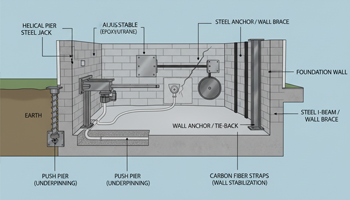
For taller retaining walls or challenging soil conditions, passive structural resistance may prove insufficient. Tie-back and anchoring systems actively resist lateral earth pressure by connecting the wall to stable soil or rock behind the failure plane.
Tie-back systems use steel cables or rods extending from the wall face back into stable soil, where they’re anchored with deadman anchors or helical piers. These systems effectively reduce the bending moment on the wall by providing intermediate support points. The design requires geotechnical analysis to ensure anchors are placed in competent soil beyond the active failure zone.
Helical anchor systems use screw-like steel shafts driven into the ground, with helical bearing plates that develop pullout resistance in the soil. These systems offer advantages for certain soil conditions and can be installed with relatively compact equipment. The engineering involves calculating the required anchor capacity based on tributary wall area and soil pressure, then sizing and spacing anchors to provide adequate resistance.
Concrete Specifications for Foundation Work
Concrete quality directly affects foundation performance, durability, and longevity. Understanding concrete specifications ensures you specify appropriate materials for each application.
PSI Requirements by Application (2,500 vs 3,000 vs 4,000)
Concrete strength is measured in pounds per square inch (PSI), indicating the compressive force the hardened concrete can withstand. Different foundation applications require different strength specifications.
For residential foundation footings and basement floor slabs, 2,500 PSI concrete typically provides adequate strength. This lower-strength mix costs less and proves perfectly suitable for applications with moderate loads and limited exposure to freeze-thaw cycles.
Foundation walls typically require 3,000 PSI concrete for improved strength and durability. The higher strength better resists lateral earth pressure, provides better resistance to cracking, and offers improved freeze-thaw durability for portions of the wall exposed to weather cycles. Most building codes specify 3,000 PSI as the minimum for structural concrete in contact with soil.
Specialized applications like garage floors subject to vehicle loads, areas requiring rapid strength gain, or situations with exposure to de-icing salts may require 4,000 PSI concrete. The higher strength provides additional safety margin and improved durability but comes at increased cost—typically 10-15% more than 3,000 PSI concrete.
Rebar Placement & Mesh Requirements
Concrete handles compressive forces well but cracks easily under tension. Reinforcing steel placed within the concrete resists these tensile forces, dramatically improving structural performance and crack control.
Foundation walls typically require vertical rebar at regular intervals—commonly #4 or #5 bars at 16 to 24 inches on center. Horizontal rebar near the top and bottom of the wall controls cracking and helps distribute loads. The specific requirements depend on wall height, soil conditions, and applied loads, with engineered designs providing exact specifications.
Basement floor slabs commonly use welded wire mesh or fiber reinforcement to control cracking. Welded wire mesh consists of steel wires arranged in a grid pattern, typically 6 inches by 6 inches with 10-gauge wire (designated 6×6-W1.4xW1.4). The mesh must be positioned in the upper third of the slab thickness to effectively control cracks—placing it on the ground before pouring provides no benefit.
Cold Weather vs Hot Weather Pouring
Temperature conditions during concrete placement and curing significantly affect strength development and final quality. Both cold and hot weather present challenges requiring special precautions.
Cold weather (below 40°F) slows the chemical reactions that cause concrete to harden and gain strength. Severely cold temperatures can freeze the water in fresh concrete, permanently damaging the internal structure and reducing final strength. Cold weather concreting requires maintaining concrete temperature above 50°F during placement and for several days afterward. This involves heated enclosures, insulated blankets, or concrete mix additives that accelerate setting and generate additional heat.
Hot weather (above 85°F) causes concrete to set too quickly, reducing working time, increasing cracking risk, and potentially reducing final strength. High temperatures and low humidity cause rapid water evaporation from the surface, leading to plastic shrinkage cracks. Hot weather precautions include cooling aggregates and mixing water, using ice in the mix, applying evaporation retarders, and continuous moist curing immediately after finishing.
Building Code Requirements for Basement Structures
Building codes establish minimum standards for structural safety, habitability, and accessibility. Understanding code requirements prevents costly revisions and failed inspections.
IRC vs IBC Applications
Two primary building codes govern residential construction in most North American jurisdictions: the International Residential Code (IRC) and the International Building Code (IBC). Understanding which applies to your project determines the specific requirements you must meet.
The IRC applies to one- and two-family dwellings and townhouses up to three stories. Most single-family basement projects fall under IRC jurisdiction, which provides prescriptive requirements for common construction scenarios. These prescriptive paths specify exact lumber sizes, spacing, and connection details for typical situations, simplifying compliance.
The IBC applies to commercial buildings, multi-family residential structures, and more complex residential projects. IBC requirements typically demand engineered designs rather than prescriptive solutions, increasing design costs but allowing more flexibility in structural approaches.
Egress Requirements
Life safety codes require adequate escape routes from basement spaces used as habitable rooms. Egress requirements mandate specific window sizes and locations or alternative escape paths like doors leading directly outside.
Basement bedrooms must have at least one egress window with minimum net clear opening of 5.7 square feet, minimum opening height of 24 inches, minimum opening width of 20 inches, and maximum sill height of 44 inches above the finished floor. These dimensions ensure an adult can escape through the window during an emergency.
Egress windows in below-grade locations require window wells with minimum horizontal dimensions of 36 inches and permanent ladder or steps if the well depth exceeds 44 inches. The window well must not be obstructed by plantings, covers that can’t be opened from inside, or other barriers that might prevent emergency escape.
Ceiling Height Minimums
Building codes specify minimum ceiling heights to ensure habitable spaces provide adequate volume and don’t feel cramped or oppressive. These requirements directly affect basement finishing feasibility in homes with lower ceilings.
The IRC requires 7-foot minimum ceiling height for habitable rooms, with some exceptions allowing 6 feet 8 inches under beams or in portions of rooms with sloped ceilings. Basement spaces that cannot meet these minimums legally cannot be used as bedrooms, living rooms, or other habitable spaces, though they can serve as storage or utility rooms.
Ceiling height measurements use finished surfaces—after drywall, drop ceilings, or other finish materials are installed. A basement with 7 feet 2 inches from concrete slab to floor joists might only provide 6 feet 10 inches of finished ceiling height after installing ½-inch drywall on the ceiling and finishing the floor, falling short of code minimums.
Structural Inspection Checkpoints
Building departments require structural inspections at specific construction stages to verify code compliance before work is covered. Missing these inspections or failing them requires costly corrections.
Foundation inspections typically occur after excavation and formwork placement but before concrete pouring. The inspector verifies footing dimensions, rebar placement, form bracing, and other structural elements match approved plans. Pouring concrete before this inspection can require extremely expensive demolition and reconstruction.
Framing inspections occur after wall, floor, and roof framing is complete but before insulation and drywall installation. The inspector checks lumber grades and sizes, member spacing, connections, beam sizing, and structural element placement. Identifying problems at this stage allows relatively simple corrections compared to discovering issues after walls are closed.
Integrating HVAC & Mechanical Loads into Structural Planning
Mechanical equipment installations in basements create structural loads that must be properly supported. Inadequate planning for these loads can compromise structural integrity and equipment performance.
Equipment Weight Considerations
Modern HVAC equipment, water heaters, and other mechanical systems can be surprisingly heavy. A typical residential furnace weighs 100 to 200 pounds, while water heaters range from 100 pounds empty to 500+ pounds when filled. Larger equipment like boilers can exceed 1,000 pounds.
These concentrated loads must be properly distributed to the supporting structure. Equipment mounted directly on concrete basement floors typically presents no structural concerns, as concrete slabs easily handle these loads. However, equipment suspended from floor joists or supported on basement walls requires engineering attention to ensure adequate capacity.
Suspended vs Floor-Mounted Systems
The choice between suspended and floor-mounted mechanical equipment affects structural requirements, installation costs, and space utilization. Suspended systems save floor space and can simplify maintenance access but create additional structural loads on ceiling framing.
Ceiling-mounted equipment loads transfer through hangers to floor joists above. Standard floor joist systems may require reinforcement to carry heavy equipment loads without excessive deflection. Typical solutions include adding supplemental joists directly beneath equipment locations, installing load-distributing channels that span multiple joists, or providing independent support structures that transfer loads to load-bearing walls or columns.
Floor-mounted equipment simplifies structural support but consumes valuable floor space in the basement. Equipment platforms must provide level, stable support, often requiring concrete pads or reinforced floor sections where equipment weight exceeds standard slab design loads.
Vibration Isolation Requirements
Mechanical equipment generates vibrations during operation that can transmit through structural connections, causing noise and comfort problems in living spaces above. Proper vibration isolation prevents these issues without compromising structural support.
Vibration isolation typically uses elastomeric pads or springs placed between equipment and mounting surfaces. These materials absorb vibration energy, preventing transmission to the building structure. However, isolation systems must be carefully designed to provide adequate support while achieving desired isolation performance.
Suspended equipment requires special attention to prevent vibration transmission through hanging cables or rigid piping connections. Flexible connectors in ductwork and piping, combined with properly designed hanging systems, minimize vibration transmission while maintaining required support strength.
Pool & Water Feature Structural Considerations
Adding pools or water features near or adjacent to basement structures creates unique engineering challenges related to hydrostatic pressure, structural loads, and waterproofing coordination.
Hydrostatic Pressure Management
Water in pools and water features generates hydrostatic pressure that increases with depth. A pool 4 feet deep exerts approximately 250 pounds per square foot at the bottom—equivalent to the load from a small building. This pressure must be resisted by properly engineered structural elements.
Pools located adjacent to basement walls apply lateral pressure similar to retained soil but with different characteristics. Water pressure acts uniformly and doesn’t benefit from soil friction, requiring robust wall design and anchoring. The pressure increases significantly with water depth, making deeper pools structurally more demanding.
Inground pools below basement level require careful coordination between pool structure and building foundation. The pool vessel itself must resist internal water pressure while the surrounding soil and foundation system must accommodate the pool’s external loads without compromising basement waterproofing or structural integrity.
Structural Reinforcement for Adjacent Pools
When pools are constructed immediately adjacent to basement walls, additional structural reinforcement often becomes necessary. The excavation for the pool removes lateral soil support from the basement wall, while pool water adds new loads once filled.
Typical reinforcement strategies include thickening the basement wall in the pool area, adding supplemental reinforcing steel to handle increased bending moments, and providing tie-back anchors that connect the basement wall to stable soil beyond the pool excavation. The specific approach depends on wall height, pool depth, soil conditions, and existing foundation design.
Structural analysis must also address potential issues if the pool is drained for maintenance while basement walls face full soil pressure from the opposite side. This loading condition can create maximum wall stresses requiring careful engineering evaluation.
Waterproofing Coordination
The intersection between pool structures and basement walls represents a critical waterproofing challenge. Water can migrate from the pool through any gaps or cracks, potentially infiltrating the basement. Proper design requires coordinated waterproofing systems that address both structures.
Waterproofing membranes must extend continuously from the basement wall into the pool structure, with properly detailed transitions that accommodate differential movement between the structures. Expansion joints, construction joints, and penetrations require special attention to maintain waterproofing integrity.
The timing of construction activities affects waterproofing success. Pool excavation often occurs after initial foundation waterproofing, requiring careful protection of existing membranes and proper integration of new waterproofing layers. Construction sequencing must be carefully planned to avoid damage to waterproofing systems during subsequent work.
Common Structural Mistakes & How to Avoid Them
Decades of observing basement projects have revealed recurring mistakes that compromise structural integrity, create safety hazards, and generate expensive repairs. Understanding these common errors helps you avoid them in your own projects.
Undersized Beams and Columns
The single most common structural error involves using beams or columns that lack adequate capacity for the loads they must support. This typically occurs when homeowners or contractors make sizing decisions based on «what looks right» or «what worked on another job» rather than proper engineering calculations.
Beam sizing depends on multiple factors: span length, supported loads, lumber species and grade, and deflection requirements. A beam that works perfectly for an 8-foot span may catastrophically fail at 12 feet, even though both «look similar.» Similarly, a column that adequately supports one floor may buckle under loads from two floors, despite appearing substantial.
The consequences of undersized structural elements range from excessive deflection (sagging floors, sticking doors and windows) to catastrophic failure. The solution is straightforward: obtain proper engineering calculations for any new beams, columns, or load-bearing elements. The modest cost of professional engineering—typically $500 to $2,000 for residential basement projects—pales compared to the repair costs from structural failures.
Improper Footing Design
Footings spread structural loads over sufficient soil area to prevent excessive settlement. Inadequate footing size or improper construction causes differential settlement, foundation movement, and structural distress throughout the building.
Common footing errors include insufficient width for column loads, inadequate depth below frost line, placing footings on disturbed or uncompacted soil, and omitting reinforcing steel where required. Each creates specific problems: undersized footings settle excessively under load, shallow footings experience frost heave during winter, and footings on poor soil continue settling unpredictably for years.
Proper footing design requires determining soil bearing capacity through testing or conservative assumptions, calculating footing area based on column or wall loads, and sizing footing thickness to resist bending without excessive reinforcing steel. For any significant structural changes, professional soil analysis and footing design prove essential.
Inadequate Drainage Systems
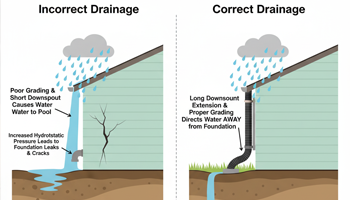
Poor drainage around foundations causes a remarkable percentage of basement problems. Building codes have evolved significantly on this issue in the past 15 years, with modern standards much more stringent than pre-2010 requirements. Older homes almost never meet current drainage standards, complicating renovation projects.
Inadequate drainage allows water to accumulate around foundation walls, increasing hydrostatic pressure, promoting water infiltration, and in freezing climates, contributing to frost damage. The effects compound over time, with minor seepage becoming major flooding and small cracks widening to structural concerns.
Effective foundation drainage requires multiple coordinated elements: proper site grading that slopes away from the foundation (minimum 6 inches drop in first 10 feet), foundation drains (perforated pipe in gravel) around the footing perimeter, waterproofing or dampproofing on exterior foundation walls, and sump pump systems to handle collected water. Renovations to older basements should address drainage deficiencies even if code doesn’t strictly require upgrades—the long-term protection justifies the investment.
Cost Analysis: DIY vs Professional Engineering
Understanding when professional engineering services are required—legally and practically—helps homeowners and contractors make informed decisions about project approach and budget allocation.
When Structural Calculations Are Legally Required
Building codes and local ordinances determine when professional engineering becomes legally mandatory. Generally, any structural modification to load-bearing elements requires engineered designs reviewed by licensed professionals.
Removing or modifying load-bearing walls always requires engineered calculations to size replacement beams, determine support requirements, and ensure adequate load paths to the foundation. Creating new openings in foundation walls for doors or windows necessitates engineering to evaluate effects on wall structural capacity and specify any needed reinforcement.
Major renovations adding significant new loads—such as creating a second-story addition above an existing basement—require comprehensive structural analysis of the entire load path from new construction down through basement structure to footings and soil. Local building departments may also require engineered designs for work exceeding certain cost thresholds, even for non-structural components.
The key point: attempting structural work that requires engineering without obtaining proper calculations and stamped drawings constitutes code violation, voids insurance coverage, creates liability exposure, and often leads to failed inspections requiring expensive corrections. The modest cost of proper engineering is non-negotiable for any serious structural work.
Liability Considerations
Liability for structural failures falls on whoever made design and construction decisions. For engineered work, this typically means the professional engineer and contractor share responsibility according to their respective roles. For non-engineered DIY work, the homeowner bears full liability.
If an undersized beam installed during your basement renovation causes structural failure years later—perhaps when you’ve sold the home—you face potential legal liability to subsequent owners who suffered damages. Even if no one is injured, property damage claims from structural failures routinely exceed $50,000 to $100,000 once you account for repair costs, temporary housing during repairs, and diminished property value.
Professional engineering provides liability protection through the engineer’s professional insurance and establishes that decisions followed accepted engineering practice. This protection proves invaluable if questions arise about structural adequacy, whether during your ownership or after sale.
Long-Term Cost Implications
The financial calculus for professional engineering often becomes clearer when viewed through a long-term lens rather than focusing solely on immediate project costs. While engineering fees add $500 to $3,000 for typical residential basement projects, the value provided extends throughout the home’s life.
Proper engineering prevents the most expensive outcome: structural failure requiring remediation. I’ve witnessed countless cases where homeowners attempted DIY structural modifications that ultimately required complete reconstruction—often costing five to ten times what professional engineering would have cost initially. The $45,000 reengineering cost for that home theater project I mentioned earlier represents just one example of this pattern.
Beyond preventing failures, engineered solutions often prove more economical than intuitive approaches. Engineers can specify optimized member sizes and layouts that use materials efficiently while meeting code requirements. A contractor working without engineering might oversize elements «to be safe,» wasting money, or undersize them and create hazards. Proper calculations identify the most cost-effective solution that meets all requirements.
Hiring the Right Professional: Engineer vs Contractor
Successfully executing basement structural work requires assembling a qualified team. Understanding the distinct roles of structural engineers and contractors helps you hire appropriately for your project.
Credentials to Verify
Structural engineers must hold valid professional engineering licenses in your state. This licensure requires completing an accredited engineering degree, passing rigorous examinations, and maintaining continuing education. Verify license status through your state’s professional licensing board—most maintain online databases searchable by name or license number.
General contractors performing structural work should hold appropriate contractor licenses as required by your jurisdiction. Many states distinguish between residential and commercial contractor licenses, with different scopes of work permitted under each. Foundation specialists and concrete contractors may hold specialized licenses that demonstrate expertise in foundation work specifically.
Insurance coverage deserves equal attention. Professional liability insurance (errors and omissions coverage) for engineers protects against design errors. General liability and workers compensation insurance for contractors provides protection against property damage and worker injuries. Request certificates of insurance directly from insurance carriers rather than relying on contractor-provided copies, which may be outdated or fraudulent.
Questions to Ask Before Hiring
Effective contractor and engineer screening involves asking targeted questions that reveal qualifications, approach, and compatibility with your project requirements. For structural engineers, inquire about their experience with similar projects, particularly basement renovations if that’s your work. Ask how they approach cost optimization—good engineers seek efficient solutions that meet requirements without unnecessary expense.
Request examples of previous foundation or basement projects they’ve engineered, ideally with photo documentation showing the work. Ask about their typical turnaround time for calculations and stamped drawings, and whether they provide construction observation services to verify that built conditions match design intent.
For contractors, ask about their experience with structural modifications specifically, not just general remodeling. Request references from projects involving structural work, and actually contact those references—many homeowners skip this crucial step. Inquire about their process for obtaining permits and scheduling inspections, and how they handle unexpected conditions discovered during demolition or excavation.
Red Flags to Watch For
Certain warning signs indicate contractors or engineers you should avoid. Be immediately suspicious of any contractor who suggests skipping engineering for structural work that clearly requires it, claims they can do structural calculations themselves without professional engineering licensure, or dismisses building permit requirements as «unnecessary paperwork.»
Engineers who seem unfamiliar with local building codes, can’t explain their design approach in understandable terms, or appear reluctant to provide sealed calculations should raise concerns. Similarly, contractors who can’t provide proof of licensing and insurance, offer prices dramatically below competitors without clear explanation, or pressure you to sign contracts immediately without time for review present significant risks.
Trust your instincts about professionalism and communication. Professionals who won’t return calls promptly during the bidding phase, show up late to site meetings without explanation, or provide vague, constantly changing cost estimates will likely create problems throughout the project. The basement structural work is too important—both for safety and finances—to proceed with anyone who raises doubts about their competence or integrity.
FAQs
Q: Can I remove a basement wall without an engineer?
A: Never remove any wall without first determining whether it’s load-bearing. If the wall supports floor joists, beams, or carries loads from upper floors, professional engineering is legally required and structurally essential. Even apparently simple partition walls may be load-bearing—60% of basement renovation problems stem from misidentifying wall function.
Q: How much does basement structural engineering cost?
A: Professional structural engineering for typical residential basement projects ranges from $500 to $3,000, depending on project complexity, regional rates, and scope of work. This modest investment prevents structural failures that routinely cost $40,000 to $50,000 or more to repair.
Q: What PSI concrete should I use for basement walls?
A: Most building codes require 3,000 PSI minimum for foundation walls in contact with soil. This provides adequate strength for lateral earth pressure, good freeze-thaw durability, and appropriate crack resistance. Basement floor slabs typically use 2,500 PSI concrete for cost savings.
Q: Do I need a permit for finishing my basement?
A: Yes, virtually all jurisdictions require building permits for basement finishing that creates habitable space. Permits ensure work meets structural, electrical, plumbing, and safety codes, including critical egress requirements for bedrooms. Working without permits risks failed future home sales and potential liability for code violations.
Q: How deep must footings go for basement additions?
A: Footings must extend below the maximum frost penetration depth for your region, which varies from zero in warm climates to 60+ inches in northern areas. Local building codes specify required depth—this represents one case where universal answers don’t exist. Failing to meet frost depth requirements guarantees foundation movement and damage.
Q: Can I install a beam myself or do I need a contractor?
A: While you can physically install a beam yourself, the design absolutely requires professional engineering to determine proper beam size, support requirements, and connections. Installation requires careful attention to load transfer details and temporary support during construction. Most building departments require licensed contractors for structural work and will not permit work done by uncertified individuals.
Need more specifics about your basement structural project? Share details about your foundation type, planned modifications, and regional location for tailored guidance addressing your exact situation.
Currently viewing
Basement & Foundation Structural

Urban Flood Mitigation
Urban Flood Mitigation and Foundation Design in Coastal Cities Coastal urban centers face mounting pressure…

Sump Pump Maintenance
Sump Pump Maintenance Guide: Annual Checklist & When to Replace [2025] Sump pump failure rates…
Window Well Drainage Systems
Window Well Drainage Systems: Prevent Basement Window Flooding Window well flooding destroys finished basements through…

Crawl Space Encapsulation Cost
Crawl Space Encapsulation Cost: Vapor Barrier Installation Guide Your roof collects hundreds of gallons of…
Gutter Drainage & Downspout Extensions
Gutter Drainage & Downspout Extensions: Prevent Foundation Water Damage Your roof collects hundreds of gallons…

Basement Dehumidifier Sizing
Basement Dehumidifier Sizing Guide: Square Footage & Moisture Level Calculator Choosing the wrong dehumidifier size…
Drylok vs Xypex vs Thoroseal
Drylok vs Xypex vs Thoroseal: Which Basement Waterproofing Paint Actually Works? Basement waterproofing paints promise…
Exterior Basement Waterproofing
Exterior Basement Waterproofing: Complete Excavation Cost & Membrane Installation Guide Exterior basement waterproofing represents the…
Best Sump Pump Systems with Battery Backup
Best Sump Pump Systems with Battery Backup When your power goes out during a severe…
French Drain vs Interior Drainage
French Drain vs Interior Drainage System: Which Protects Your Basement Better? When water threatens your…