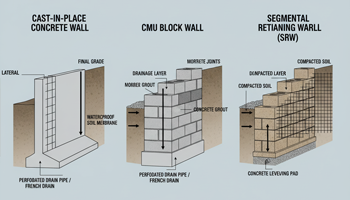
Retaining Wall Design:
Concrete vs Block vs Segmental Systems
Selecting the right retaining wall system represents one of the most consequential decisions in landscape construction and foundation engineering. The choice between poured concrete, CMU block, and segmental retaining wall (SRW) systems affects not only initial project costs but also long-term durability, aesthetic outcomes, and installation complexity.
The decision involves balancing multiple factors: wall height and the loads it must resist, soil conditions at your site, local building codes and permit requirements, available budget for both materials and installation, aesthetic preferences for your landscape design, and whether professional installation is necessary or DIY approaches are feasible. Each retaining wall system offers distinct advantages for specific applications, and understanding these differences enables informed decisions that optimize both performance and value.
After supervising hundreds of retaining wall installations across residential and commercial projects, I’ve learned that the choice between systems rarely comes down to purely technical considerations. Instead, it’s a balance between budget constraints, aesthetic goals, and installer capability. The segmental retaining wall revolution has fundamentally changed the residential market by making professional-quality installations accessible to DIY homeowners for walls up to 4 feet in height.
This comprehensive guide examines all three major retaining wall systems, comparing their engineering requirements, construction processes, cost structures, and ideal applications to help you select the optimal solution for your project.
Poured Concrete Retaining Walls
Poured concrete retaining walls represent the traditional engineered approach for structural earth retention. These monolithic structures offer unmatched strength and versatility, making them the default choice for critical applications and taller walls.
Engineering Requirements & Calculations
Poured concrete retaining walls require comprehensive engineering analysis to determine appropriate dimensions, reinforcement, and foundation requirements. The engineering process begins with calculating lateral earth pressure based on retained soil height, soil type, and surcharge loads from adjacent structures or traffic.
Engineers must design the wall to resist overturning moments that attempt to rotate the wall forward, sliding forces that try to push the wall horizontally, and bearing pressures that could cause the foundation to settle into the soil. These calculations determine minimum wall thickness—typically 8 to 12 inches for residential walls—and the required reinforcing steel pattern.
Vertical rebar placement resists bending forces from lateral earth pressure, with typical specifications calling for #4 or #5 bars at 12 to 18 inches on center. Horizontal bars control cracking and help distribute loads. The foundation footing must be sized to spread wall loads over adequate soil area, typically extending beneath the frost line with width equal to 50% to 75% of wall height.
Professional engineering becomes legally mandatory for walls exceeding certain heights—typically 4 feet in most jurisdictions, though requirements vary by location. Even for shorter walls, engineering provides essential design documentation and liability protection.
Construction Process & Timeline
Constructing poured concrete retaining walls involves multiple sequential steps, each requiring proper execution and adequate time for completion. The process begins with excavation for the wall footings, which must extend below the frost line and be placed on undisturbed or properly compacted soil.
Footing forms are installed, rebar is placed according to engineering specifications, and concrete is poured and allowed to cure for several days before proceeding. Wall forms are then erected, typically using plywood or metal forming systems braced to resist concrete pressure during pouring. Reinforcing steel is positioned within the forms per engineering drawings.
Concrete placement requires careful attention to prevent voids, segregation, or cold joints. Vibration during placement ensures concrete flows around reinforcing bars and fills the form completely. After pouring, the concrete must cure for several days before forms are stripped, with full strength developing over 28 days.
The entire process typically spans 2 to 3 weeks for residential walls, accounting for footing cure time, wall form construction, concrete placement, curing periods, and form removal. Weather conditions significantly affect the timeline—cold temperatures slow curing while hot weather may require special precautions.
Cost Breakdown (Materials + Labor)
Poured concrete retaining walls represent the most expensive option among the three systems, with costs typically ranging from $40 to $75 per square foot of wall face, or $50 to $100+ per linear foot depending on wall height. These costs include materials, labor, and engineering but can vary substantially based on regional factors and site conditions.
Material costs include concrete ($100 to $150 per cubic yard), reinforcing steel ($0.50 to $1.00 per pound), forming materials (rental or purchase), and drainage components. A typical 4-foot tall residential wall requires approximately 0.5 cubic yards of concrete per linear foot, plus footings.
Labor represents the largest cost component, encompassing excavation, form construction and placement, rebar installation, concrete placement and finishing, curing oversight, and form stripping. The skilled labor required for proper formwork and concrete placement commands premium rates.
One consistent pattern I’ve observed: homeowners chronically underestimate site preparation and excavation costs, which frequently represent 40% to 50% of total project expenses. A retaining wall project budgeted at $10,000 can easily require $4,000 to $6,000 in site work before any wall construction begins.
Pros & Cons for Different Applications
Poured concrete walls excel in specific applications where their unique characteristics provide decisive advantages. They offer the highest structural capacity of any retaining wall system, making them ideal for walls over 8 feet tall, basement excavation support where structural integrity is critical, situations requiring custom geometries or complex angles, and applications where the wall face will be covered or finished.
The monolithic construction eliminates joints that could leak or fail over time, providing superior water resistance. The design flexibility allows engineers to optimize wall dimensions for specific load conditions rather than conforming to modular constraints.
However, poured concrete walls present significant drawbacks. The high cost often proves prohibitive for residential landscaping projects. Skilled labor requirements limit DIY feasibility—this is definitively professional work. The exposed concrete surface offers limited aesthetic appeal unless additional finishing treatments are applied, adding further cost. Construction timelines extend several weeks due to multiple forming and curing stages.
Poured concrete remains the superior choice for structurally critical applications like basement walls, tall retaining structures, and situations where custom engineering proves necessary. For typical residential landscaping where walls remain under 6 feet and aesthetics matter, alternative systems often provide better value.
CMU Block Retaining Walls
Concrete masonry unit (CMU) block retaining walls offer a middle ground between poured concrete and segmental systems, combining reasonable structural capacity with more manageable construction processes.
Structural Capabilities & Height Limitations
CMU retaining walls utilize standard concrete blocks—typically 8-inch, 10-inch, or 12-inch widths—stacked and mortared together, with reinforcing steel placed in vertical cells and grouted solid for structural performance. This construction method provides good structural capacity while simplifying the construction process compared to poured concrete walls.
Structural capacity depends on block size, reinforcement pattern, and footing design. Standard 8-inch CMU walls can typically handle walls up to 4 to 5 feet in height with appropriate reinforcement. Taller walls require 10-inch or 12-inch blocks, closer rebar spacing, and more robust foundation systems. Walls exceeding 6 to 8 feet generally require engineering analysis regardless of block size.
The primary structural limitation comes from the mortared joints between blocks, which represent potential weak points for both structural performance and water infiltration. Properly constructed CMU walls with full mortar beds and appropriate reinforcement perform well, but construction quality significantly affects outcomes.
Rebar & Grout Requirements
Proper reinforcement distinguishes structural CMU retaining walls from simple garden walls. Vertical reinforcing bars are positioned in designated cells at regular intervals—typically #4 or #5 rebar at 24 to 48 inches on center for walls under 6 feet, with closer spacing or larger bars for taller walls.
The cells containing rebar must be filled with grout—a fluid concrete mixture that flows easily around reinforcing bars and fills voids completely. Grout consolidation ensures no voids remain that would compromise structural performance. Horizontal bond beam reinforcement at the wall top and at regular intervals vertically helps distribute loads and control cracking.
Foundation requirements mirror those for poured concrete walls: footings below frost depth, adequate width to prevent bearing failure, and proper reinforcement. The first course of blocks is typically mortared directly to the footing, establishing the critical connection between wall and foundation.
Installation Complexity
CMU retaining walls require skilled masonry work but avoid the complexity of concrete formwork. The construction process involves building the footing using standard procedures, allowing adequate curing time, then laying blocks with proper mortar application, maintaining plumb and level alignment, positioning reinforcing bars in designated cells, and filling cells with grout as construction progresses.
The work requires masonry skills including proper mortar mixing and application, achieving consistent joint thickness, maintaining alignment across multiple courses, and efficient grout placement to avoid voids. While less complex than forming and pouring concrete walls, CMU construction demands experience and skill beyond typical DIY capabilities.
Construction timelines prove shorter than poured concrete walls since formwork is eliminated, but still extend across multiple days. Each day’s work is limited by how high masons can safely and effectively lay blocks, with typical progress of 3 to 5 feet of height per day. Grout curing between work sessions extends overall project duration.
Cost Analysis vs Poured Concrete
CMU retaining walls typically cost $25 to $45 per square foot of wall face, or $35 to $70 per linear foot depending on height—moderately less expensive than poured concrete but significantly more than segmental systems. The cost advantage comes primarily from eliminating formwork labor and rental costs.
Material costs include concrete blocks ($2 to $4 each), mortar and grout ($8 to $15 per bag), reinforcing steel, and foundation materials. Labor costs reflect skilled masonry rates, which while substantial, typically run lower than the combined carpentry and concrete finishing skills required for formed walls.
The cost comparison favors CMU walls for moderate heights (4 to 8 feet) where structural capacity is important but the expense of poured concrete isn’t justified. For shorter walls, segmental systems prove more economical. For taller critical applications, poured concrete’s superior performance often justifies its higher cost.
Segmental Retaining Wall (SRW) Systems
Segmental retaining wall systems have revolutionized residential retaining wall construction by providing engineered performance in modular formats that dramatically simplify installation while offering extensive aesthetic options.
Interlocking Block Technology
SRW systems utilize precast concrete blocks with interlocking features that align and connect units without requiring mortar. The blocks achieve stability through their mass, setback angle, and mechanical interlock between courses. This gravity-based design relies on proper base preparation and careful installation rather than structural connections.
Most systems employ automatic setback features—lips, pins, or geometric profiles that position each course slightly behind the course below, creating the lean-back angle necessary for stability. This setback typically ranges from 0.5 to 0.75 inches per course, establishing approximately 5 to 10 degrees of batter (lean) into the retained soil.
The blocks themselves weigh 40 to 100+ pounds each depending on size and design, with this mass providing much of the wall’s resistance to overturning. Hollow cores in many designs reduce weight for easier handling while providing space for optional reinforcement in taller walls. Textured faces and color options create varied aesthetic appearances from a single structural design.
Brand Comparisons (Belgard, Anchor, Techo-Bloc)
Three major manufacturers dominate the North American SRW market, each offering distinct product lines with varying features, aesthetics, and price points. Understanding these differences helps match products to specific project requirements and budgets.
Belgard offers premium SRW systems with extensive aesthetic options including natural stone textures, multiple color blends, and diverse block profiles. Their products command higher prices—typically $8 to $15 per square foot of wall face—but provide superior appearance for high-visibility residential applications. The product line includes both standard gravity systems and grid-reinforced systems for taller walls.
Techo-Bloc positions similarly in the premium segment with emphasis on realistic stone textures and color authenticity. Their products feature sophisticated surface treatments that closely mimic natural stone. Pricing aligns with Belgard at the higher end of the market. The company offers particularly strong options for matching walls to paver patios and other hardscape elements.
Anchor provides more economical SRW solutions while maintaining reliable structural performance. Their products typically cost $5 to $10 per square foot of wall face—30% to 40% less than premium brands. While aesthetic options are more limited, Anchor blocks deliver dependable performance for utility applications, commercial projects, and budget-conscious residential installations.
Based on extensive project experience, Belgard and Techo-Bloc deliver the best premium systems when aesthetics drive decisions and budget permits. Anchor provides solid, economical solutions when appearance is secondary or budget constraints are primary. All three manufacturers engineer their products to meet industry standards for structural performance when properly installed.
DIY-Friendly Options vs Professional Installation
Segmental retaining wall systems have made professional-quality retaining wall construction accessible to capable DIYers for walls up to 4 feet in height. This accessibility stems from the mortarless construction, manageable block weights, and relatively forgiving installation tolerance compared to other systems.
Successful DIY installation requires proper base preparation—excavation to required depth, compacted gravel base 6 to 8 inches thick, and leveling the first course—careful alignment maintaining plumb, level, and consistent setback, proper backfill and compaction behind the wall, and installation of drainage components.
Manufacturers provide detailed installation guides, and many home centers offer installation classes. The typical DIY learning curve allows competent homeowners to achieve good results on their first project if they carefully follow instructions and take time to do work properly.
However, professional installation becomes advisable or required for walls exceeding 4 feet in height where building codes may mandate engineering, complex sites with challenging access or soil conditions, walls requiring geogrid reinforcement, and situations where permitting and inspections are required. Professionals complete work faster, ensure code compliance, provide installation warranties, and deliver superior results on challenging projects.
Aesthetic Flexibility & Design Options
SRW systems offer far greater aesthetic flexibility than poured concrete or CMU walls, with extensive choices in color, texture, size, and profile creating diverse visual effects from functional retaining structures.
Block faces range from smooth modern finishes to heavily textured natural stone reproductions. Premium lines offer multiple textures even within a single product, with varied block heights creating random, natural appearances. Color options extend from subtle earth tones to bold contemporary hues, with many manufacturers offering integrated color throughout the block rather than surface treatments that can wear.
Beyond straight walls, most systems accommodate curves, corners, and steps without requiring specialized blocks—standard units can be arranged in curved patterns by slightly varying joint spacing. Capping units provide finished top surfaces, with options from simple flat caps to decorative sculpted profiles.
The aesthetic advantages prove particularly important for residential projects where the retaining wall becomes a prominent landscape feature. The ability to match wall appearance to home architecture, coordinate with patio pavers, and create visually interesting features justifies SRW systems for applications where bare concrete would be unacceptable.
Height & Load Considerations for Each System
Wall height fundamentally affects system selection, engineering requirements, and regulatory compliance. Understanding how height thresholds impact each system guides appropriate choices.
Walls Under 4 Feet: Simpler Requirements
Retaining walls under 4 feet in height typically face reduced engineering and permitting requirements, making them candidates for simpler construction approaches and potentially DIY installation. Many jurisdictions allow walls under 3 to 4 feet without engineering stamps or permits, though local requirements vary—always verify with your building department.
At these heights, all three systems prove viable with each offering distinct advantages. Segmental retaining wall systems excel for residential landscaping due to aesthetic flexibility, DIY accessibility, and competitive costs. Installation complexity remains manageable for capable homeowners, and structural requirements don’t demand professional engineering in most cases.
CMU block walls work well where straight, uniform appearance is acceptable and local masonry contractors offer competitive pricing. The structural capacity easily handles loads from 3 to 4 foot height differences with standard reinforcement patterns.
Poured concrete walls prove cost-prohibitive for most residential projects at these heights unless structural requirements demand monolithic construction or the wall connects to other concrete elements like foundations or slabs. The expense and construction complexity rarely justify use at these modest heights.
Walls 4-8 Feet: Engineering Threshold
Walls in the 4 to 8 foot height range cross critical thresholds for engineering requirements and system capabilities. Most building codes require engineering analysis and stamped drawings for walls exceeding 4 feet, adding design costs and necessitating permit applications and inspections.
Segmental retaining wall systems remain viable with geogrid reinforcement—synthetic mesh layers extending back into the retained soil that dramatically increase effective wall mass and resistance to overturning. Geogrid systems can economically handle walls to 8 feet or more while maintaining aesthetic advantages. However, professional installation becomes strongly advisable as proper geogrid placement and connection prove critical to performance.
CMU block walls effectively handle this height range with appropriate block sizing and reinforcement. The 8-foot threshold approaches practical limits for standard CMU construction—taller walls strain the structural capacity of typical masonry systems and increase concerns about mortar joint integrity under higher lateral pressures.
Poured concrete walls become increasingly competitive at these heights. The structural capacity easily accommodates required loads, and the engineering costs represent a smaller percentage of total project expenses as wall size increases. For critical applications like basement walls or situations with challenging soil conditions, poured concrete provides important performance advantages.
Walls Over 8 Feet: Professional Engineering Required
Retaining walls exceeding 8 feet in height invariably require professional structural engineering regardless of system selected. The lateral earth pressures at these heights generate substantial forces that demand careful analysis and robust structural designs.
Poured concrete walls become the default choice for most applications at these heights. The structural capacity, design flexibility, and monolithic construction provide necessary performance for challenging conditions. Engineering can optimize wall dimensions, reinforcement, and foundation systems for specific load cases rather than conforming to modular constraints.
Segmental retaining wall systems with geogrid reinforcement can handle walls over 8 feet but typically require more extensive engineering, precise installation, and careful inspection. The economic advantages diminish as geogrid requirements increase and installation complexity rises.
CMU block walls approach practical limits above 8 feet. While technically feasible with heavy reinforcement and robust foundations, the construction challenges and structural concerns often favor poured concrete alternatives at these heights.
Drainage Systems by Wall Type
Proper drainage represents the single most critical factor in retaining wall longevity and performance. The most common failure mode I’ve witnessed over hundreds of installations is water accumulation behind walls—approximately 80% of retaining wall failures stem from inadequate drainage creating hydrostatic pressure that the wall wasn’t designed to resist.
Perforated Pipe Placement
All retaining wall systems require drainage collection at the wall base to prevent water accumulation. The standard approach uses 4-inch diameter perforated drain pipe positioned immediately behind the wall at footing level, surrounded by free-draining gravel.
The pipe must slope toward daylight outlets or connection points to storm drainage systems. Minimum slope of 1% (1 inch of fall per 100 feet) ensures water flows freely, with 2% to 3% slopes preferred where site conditions permit. The pipe outlets must discharge water away from the wall and downslope from the retained area.
For poured concrete and CMU walls, drainage pipes are typically positioned during foundation construction, embedded in the gravel backfill at footing level. Segmental retaining walls allow easier pipe placement since the back of the wall remains accessible during construction—the pipe is positioned on the gravel leveling pad behind the first course of blocks.
Filter Fabric Specifications
Filter fabric serves a critical function in retaining wall drainage systems, preventing soil particles from migrating into the gravel drainage layer and perforated pipe where they would gradually clog the system and eliminate its effectiveness.
Non-woven geotextile fabric rated for drainage applications should be placed behind the wall, extending from the foundation to the wall top. The fabric wraps around the gravel drainage layer, with overlapping joints preventing soil intrusion at seams. Fabric specifications should meet AASHTO M288 Class 2 or equivalent standards for filtration and drainage.
The fabric placement process involves positioning fabric against the back of the completed wall, installing gravel and drainage pipe, wrapping fabric over the gravel layer, then placing structural backfill against the fabric. This envelope configuration ensures drainage water can reach the collection pipe while filtered soil particles remain in the backfill zone.
Gravel Backfill Requirements
Clean, free-draining gravel behind retaining walls serves multiple functions: providing a flow path for water to reach the collection pipe, reducing lateral earth pressure compared to clay soils, and creating a zone that doesn’t develop hydrostatic pressure.
Typical specifications call for 12 to 18 inches of clear gravel extending from the footing to within 12 inches of finished grade behind the wall. The gravel should be clean crushed stone or pea gravel, 3/4 inch to 1.5 inches in diameter, with minimal fines that could clog voids between stones.
Proper installation requires placing gravel in lifts, typically 6 to 8 inches thick, with light compaction to settle the stone without crushing or creating fines. Over-compaction defeats the drainage purpose, so mechanical compaction should be avoided in the gravel drainage zone.
A properly designed drainage system adds $8 to $15 per linear foot to retaining wall costs but can literally double the wall’s service life by preventing the hydrostatic pressure that causes the majority of failures. This investment proves essential regardless of wall system selected.
Soil Conditions & Their Impact on Design Choice
Site-specific soil conditions fundamentally affect retaining wall performance and may determine which system proves most appropriate for your location.
Clay vs Sandy Soils
Soil type affects both the lateral pressure acting on the retaining wall and the bearing capacity available to support the foundation. These characteristics significantly impact design requirements and system selection.
Clay soils retain moisture, create higher lateral earth pressures when saturated, experience volume changes with moisture fluctuations, and provide lower bearing capacity than sandy soils. Retaining walls in clay soils face more challenging conditions requiring more robust drainage systems to prevent saturation, potentially thicker walls or closer reinforcement spacing, and wider foundations to distribute loads over adequate area.
Sandy soils drain naturally reducing hydrostatic pressure concerns, generate lower lateral earth pressures than clay, maintain relatively stable volume regardless of moisture, and offer higher bearing capacity. These favorable characteristics allow more economical retaining wall designs with simpler drainage requirements, thinner walls with standard reinforcement, and smaller foundations.
The soil classification directly affects engineering calculations for all wall systems. Sandy soils with good drainage favor all three systems while challenging clay conditions may necessitate more robust poured concrete or heavily reinforced CMU walls over segmental systems.
Expansive Soil Considerations
Expansive soils—primarily certain clay types—undergo significant volume changes with moisture fluctuations, swelling when wet and shrinking when dry. These movements generate substantial forces capable of damaging retaining walls not designed to accommodate them.
Retaining walls in expansive soil areas require special design considerations including deeper foundations extending below the active zone where seasonal moisture changes occur, more flexible systems that can accommodate some movement without failure, enhanced drainage to minimize moisture fluctuations in soil near the wall, and potential soil stabilization or replacement strategies.
Expansive soil conditions often favor segmental retaining wall systems over rigid poured concrete walls. The individual blocks can accommodate minor movements without cracking, while monolithic concrete walls may develop cracks if subjected to differential movement. However, severe expansive soil conditions may require soil modification regardless of wall system selected.
Geotechnical Reports: When Required
Geotechnical investigation and reporting becomes advisable or required when wall height exceeds 8 to 10 feet, site history includes fill placement or previous structural issues, visual evidence suggests challenging soil conditions, local geology indicates potential issues like expansive clays or weak bearing soils, or building officials require geotechnical data for permit applications.
A geotechnical report provides soil classification and engineering properties, bearing capacity recommendations for foundation design, lateral earth pressure parameters for wall design, groundwater conditions and drainage recommendations, and expansive soil potential and mitigation strategies if applicable.
The cost of geotechnical investigation—typically $1,500 to $3,500 for residential projects—proves modest compared to the cost of redesigning or reconstructing a failed retaining wall. For significant projects or challenging sites, geotechnical data transforms design from educated guessing to engineering certainty.
Building Code & Permit Requirements
Understanding regulatory requirements prevents project delays, failed inspections, and potential liability issues. Requirements vary by jurisdiction, making verification with local building departments essential.
Height Triggers for Permits
Most jurisdictions establish height thresholds that trigger permit requirements for retaining walls. Common thresholds include 3 feet in some conservative jurisdictions, 4 feet as the most common threshold nationally, or 6 feet in jurisdictions with less restrictive approaches.
The height measurement typically uses the maximum retained soil height at any point along the wall, not average height. A wall that varies from 2 feet to 5 feet in height would be evaluated based on the 5-foot maximum, potentially requiring permits even though much of the wall falls below the threshold.
Additional factors may trigger permit requirements regardless of height including proximity to property lines (setback violations), walls supporting additional loads beyond simple soil retention, and walls in areas with special hazards like seismic zones or steep slopes.
Engineering Stamp Requirements
Building permits for retaining walls typically require sealed engineering drawings prepared and stamped by a licensed professional engineer. The engineering package includes structural calculations demonstrating adequate capacity for lateral earth pressure and all load conditions, construction drawings showing wall dimensions, reinforcement details, and foundation requirements, and drainage design specifications.
The engineering requirement ensures walls receive proper structural design by qualified professionals, provides documentation for building department review and approval, establishes liability with the professional engineer for design adequacy, and creates permanent record drawings for future reference.
Engineering costs vary with project complexity but typically range from $1,000 to $3,000 for residential retaining walls under 8 feet, with costs increasing for taller or more complex projects.
Setback Regulations
Zoning regulations typically require minimum distances between retaining walls and property lines, called setbacks. Common requirements mandate walls must be set back at least equal to the wall height from property lines, or minimum absolute distances like 5 to 10 feet regardless of height.
Setback requirements serve multiple purposes including preventing structures from encroaching on neighboring properties, ensuring adequate access for construction and maintenance, providing space for drainage system outlets, and maintaining sight lines and light access for adjacent properties.
Setback violations can prevent permit approval, require project redesign, and potentially create liability issues with neighbors. Verify setback requirements before beginning design to avoid discovering halfway through the project that your planned wall location violates zoning rules.
Long-Term Durability & Maintenance
Understanding expected service life and maintenance requirements helps evaluate true lifetime costs rather than just initial installation expenses.
Lifespan Expectations by System
Properly designed and installed retaining walls can provide decades of service, though expected lifespans vary by system type and maintenance attention.
Poured concrete retaining walls offer the longest potential lifespan—50 to 100+ years when properly engineered, constructed with adequate concrete quality and reinforcement, protected with appropriate drainage systems, and maintained to address minor issues before they escalate. The monolithic construction eliminates joints that could degrade over time.
CMU block walls typically provide 40 to 75 year service life with proper construction and maintenance. The mortared joints represent potential weak points where deterioration may occur over time, particularly if water infiltration compromises mortar integrity or corrosion affects reinforcing steel.
Segmental retaining wall systems deliver 30 to 75 year lifespan depending on block quality, installation excellence, and site conditions. Premium concrete blocks with high compressive strength and air entrainment for freeze-thaw resistance perform better than economy blocks. The lack of mortar eliminates that failure mode, but the system relies on maintaining proper alignment and preventing settlement.
Common Failure Modes
Understanding how retaining walls fail helps identify maintenance needs and recognize early warning signs. The most prevalent failure mode by far involves hydrostatic pressure from inadequate drainage overwhelming the wall structure. Water accumulation behind the wall increases lateral pressure beyond design capacity, causing the wall to lean, crack, or collapse. This failure mode accounts for approximately 80% of retaining wall problems based on extensive project observation.
Additional failure modes include foundation settlement from inadequate bearing area or soil consolidation causing wall tilting, overturning from inadequate setback angle or mass, reinforcement corrosion in CMU or concrete walls where water penetration reaches steel, and freeze-thaw damage in climates with repeated freezing cycles degrading concrete or block integrity.
Maintenance Requirements
Retaining wall maintenance remains minimal for most systems but proves essential for maximizing service life. Annual inspection should examine wall alignment checking for bulging, leaning, or other movement, drainage function confirming water discharges freely from drain outlets, surface conditions noting cracks, spalling, or deterioration, and vegetation control preventing root systems from damaging wall structure.
Address any observed issues promptly—minor problems become major failures if ignored. Clean drainage outlets if flow appears restricted. Fill and seal cracks before water infiltration causes expansion. Repair surface damage before it progresses to structural concerns.
Poured concrete walls may benefit from periodic application of concrete sealer to reduce water absorption. CMU walls might require repointing deteriorated mortar joints. Segmental walls occasionally need realignment of individual blocks that have shifted slightly.
Cost Comparison: Total Project Analysis
Comprehensive cost comparison must account for all project elements, not just wall materials, to accurately evaluate relative economics of different systems.
Material Costs per Linear Foot
Direct material costs vary substantially between systems and with wall height. For a typical 4-foot tall residential retaining wall, approximate material costs per linear foot include:
Segmental retaining wall systems: $15 to $30 including blocks, base gravel, drainage pipe and gravel, filter fabric, and capping units. Premium brands (Belgard, Techo-Bloc) command higher prices while economy options (Anchor) fall toward the lower range.
CMU block walls: $20 to $35 including blocks, mortar and grout, reinforcing steel, foundation concrete, and drainage components. Material costs scale with wall height more than SRW systems due to reinforcement requirements.
Poured concrete walls: $25 to $45 including concrete for walls and footings, reinforcing steel, forming materials (rental or purchase), and drainage components. Formwork represents significant cost even for rented systems.
These material costs represent only 30% to 50% of total project costs—labor and site preparation constitute the majority of expenses for all systems.
Installation Labor Rates
Labor costs dominate total project expenses and vary dramatically between systems based on required skill levels and installation complexity.
Segmental retaining wall installation labor: $15 to $35 per linear foot for DIY-friendly walls under 4 feet when homeowners do their own work, or $30 to $60 per linear foot for professional installation. The labor involves excavation, base preparation, block placement, and backfilling—relatively straightforward work not requiring specialized trades.
CMU block wall installation labor: $40 to $70 per linear foot requiring skilled masons for proper block laying, mortar application, and grout placement. The specialized skills command premium rates, and work progresses more slowly than SRW installation.
Poured concrete wall installation labor: $50 to $90 per linear foot accounting for excavation, footing construction, formwork carpentry, reinforcing steel placement, concrete placement and finishing, and form stripping. The multi-skilled requirements and time-intensive forming process drive higher costs.
Hidden Costs to Consider
Several cost elements often surprise homeowners who focus only on visible wall costs. Site preparation and excavation can easily consume 40% to 50% of total project budgets—a consistent pattern I’ve observed across hundreds of installations. Moving and disposing of excavated soil, handling rock encountered during digging, and accessing difficult sites with limited equipment access all increase costs substantially.
Engineering fees add $1,000 to $3,000 for walls requiring professional design. Permit fees vary by jurisdiction but typically range from $200 to $800. Building department inspections may require multiple site visits, potentially delaying construction if issues are found.
Drainage system components including perforated pipe, gravel, and filter fabric add $8 to $15 per linear foot but prove essential for wall longevity. Compaction equipment rental for proper backfill installation costs $100 to $300 for typical residential projects.
Regional Considerations
Geographic location affects material selection, design requirements, and construction approaches for retaining walls.
Frost Heave in Cold Climates
Regions with significant frost penetration face additional design challenges. When water in soil freezes, it expands, generating forces capable of lifting and destroying retaining walls not properly designed for these conditions.
Foundations must extend below the frost line—the maximum depth frost penetrates in winter. Frost line depths vary from zero in warm climates to 42 to 60+ inches in northern states. Building codes specify required depths for each region, and compliance is mandatory to prevent frost damage.
Drainage becomes even more critical in freezing climates. Water trapped behind the wall can freeze and expand, generating enormous hydrostatic pressure beyond normal design loads. Proper drainage ensures water doesn’t accumulate where it could freeze.
Concrete and block materials must be air-entrained for freeze-thaw resistance. Air entrainment creates microscopic air bubbles in the concrete that provide room for freezing water to expand without generating internal pressures that cause spalling and deterioration.
Seismic Requirements
Areas with significant earthquake risk require additional design provisions to prevent retaining wall failure during seismic events. Seismic loads create dynamic forces that add to static earth pressure, potentially causing walls to fail if not designed accordingly.
Seismic design requirements typically include increased foundation size to resist sliding during ground motion, additional reinforcement to handle dynamic loading, more robust connections between wall elements, and consideration of soil liquefaction potential in certain soil types.
Local building codes in seismic zones specify required design provisions. The additional requirements increase engineering and construction costs but ensure walls can survive expected earthquake forces without failure that could damage adjacent structures or create safety hazards.
Local Material Availability
Material costs and options vary significantly by region based on local manufacturing, distribution networks, and transportation expenses. Segmental retaining wall blocks from major manufacturers are widely available throughout North America, but specific product lines vary by region. Certain premium colors or textures may require special order and additional shipping costs.
Concrete and CMU block materials are essentially universal, though specific block styles and sizes depend on local suppliers. Regional concrete mix designs adapt to local aggregate sources and climate conditions.
Contractor familiarity and competitive pricing also vary regionally. Some areas have strong masonry traditions making CMU installation economical, while others favor SRW systems. Understanding local market conditions helps identify the most cost-effective approach for your specific location.
Case Studies: When to Use Each System
Real-world applications illustrate how different retaining wall systems match specific project requirements.
Residential Landscaping Scenarios
Most residential landscaping retaining walls fall in the 2 to 5 foot height range and prioritize aesthetics alongside function. Segmental retaining wall systems dominate these applications due to their combination of adequate structural performance, extensive design flexibility, DIY accessibility for motivated homeowners, and costs that align with residential budgets.
A typical backyard terracing project with 3-foot walls stepping down a sloped yard exemplifies ideal SRW application. The homeowner can potentially install the walls themselves or hire landscape contractors rather than specialized masons. Premium Belgard or Techo-Bloc blocks in colors matching the home create an attractive landscape feature rather than merely functional retaining structure.
Curved garden walls, walls integrated with outdoor living spaces, and decorative seat walls all benefit from SRW aesthetic flexibility. The ability to match wall blocks to patio pavers creates cohesive landscape designs that unified concrete structures cannot achieve.
Commercial Applications
Commercial projects often prioritize structural performance, long service life, and minimal maintenance over aesthetic considerations. Poured concrete walls excel in many commercial applications due to their superior structural capacity, longest lifespan expectations, and lower long-term maintenance requirements.
A commercial parking lot with significant grade changes requires robust retaining structures capable of handling traffic loads at the top of walls. The structural demands, combined with potential liability concerns, typically mandate engineered poured concrete walls despite higher initial costs.
Loading docks, building entrances with below-grade access, and stormwater management structures similarly benefit from poured concrete’s structural capabilities and longevity. While initial costs exceed alternatives, the extended service life and minimal maintenance often prove more economical over 50+ year project horizons.
Basement Excavation Support
Retaining walls supporting basement excavations represent the most demanding residential application, invariably requiring engineered poured concrete or CMU construction. The structural consequences of failure—potential building collapse—eliminate consideration of lighter SRW systems regardless of aesthetic preferences.
A home addition with new basement space requires foundation walls that both support the structure above and retain surrounding soil. Poured concrete walls provide the monolithic construction, structural capacity, and waterproofing capabilities essential for this application. The walls must resist lateral earth pressure while carrying dead and live loads from upper floors—demands far exceeding typical landscaping retaining walls.
Even relatively shallow basement excavations require robust structural designs. The combination of vertical loads, lateral earth pressure, and critical consequences of failure make professional engineering and poured concrete construction the only appropriate choice.
Need more specifics about your retaining wall project? Share details about your site conditions, desired wall height, aesthetic preferences, and budget parameters for tailored recommendations on the optimal system for your specific application.
References
Currently viewing
Retaining Wall Design

Urban Flood Mitigation
Urban Flood Mitigation and Foundation Design in Coastal Cities Coastal urban centers face mounting pressure…

Sump Pump Maintenance
Sump Pump Maintenance Guide: Annual Checklist & When to Replace [2025] Sump pump failure rates…
Window Well Drainage Systems
Window Well Drainage Systems: Prevent Basement Window Flooding Window well flooding destroys finished basements through…

Crawl Space Encapsulation Cost
Crawl Space Encapsulation Cost: Vapor Barrier Installation Guide Your roof collects hundreds of gallons of…
Gutter Drainage & Downspout Extensions
Gutter Drainage & Downspout Extensions: Prevent Foundation Water Damage Your roof collects hundreds of gallons…
Basement Dehumidifier Sizing
Basement Dehumidifier Sizing Guide: Square Footage & Moisture Level Calculator Choosing the wrong dehumidifier size…
Drylok vs Xypex vs Thoroseal
Drylok vs Xypex vs Thoroseal: Which Basement Waterproofing Paint Actually Works? Basement waterproofing paints promise…
Exterior Basement Waterproofing
Exterior Basement Waterproofing: Complete Excavation Cost & Membrane Installation Guide Exterior basement waterproofing represents the…
Best Sump Pump Systems with Battery Backup
Best Sump Pump Systems with Battery Backup When your power goes out during a severe…
French Drain vs Interior Drainage
French Drain vs Interior Drainage System: Which Protects Your Basement Better? When water threatens your…