
Foundation Repair Cost By Problem Type & Home Size
Foundation damage is one of the most serious—and expensive—structural issues a homeowner can face. But here’s what most articles won’t tell you: the «average cost» figures you see online are fundamentally misleading. If you’re dealing with anything beyond minor cosmetic cracks, your real starting point is likely $8,000–$12,000, not the $5,100 national average you’ll find elsewhere.
This guide breaks down actual 2025 foundation repair costs by problem type, home size, and repair method. You’ll find specific price ranges, regional variations, hidden expenses most contractors don’t mention upfront, and insider strategies that can save you 25–40% on the same work.
Whether you’re dealing with hairline cracks, bowing basement walls, or severe settlement requiring full underpinning, you’ll know what to expect—and what to watch out for.
Foundation Repair Cost Overview
National Average: $5,100 (Range $2,200–$8,100)
The widely cited national average of $5,100 includes everything from simple crack sealing to major structural repairs. This creates a skewed picture because minor cosmetic repairs ($500–$2,500) pull the average down significantly. Only 15–20% of foundation repair jobs actually fall into this minor category.
If you need structural work involving piers, underpinning, or bowing wall stabilization, expect your baseline to start between $8,000 and $12,000. These structural repairs account for 50–55% of all foundation repair jobs and represent the true middle ground of foundation work.
Regional Cost Variations by State/Metro Area
Location dramatically impacts foundation repair pricing. Here’s the reality check for major markets in 2025:
Texas (Dallas-Fort Worth, Houston, Austin): Add 15–25% to national averages. Expansive clay soils that swell and shrink with moisture changes create an epidemic of foundation issues. A job that costs $10,000 nationally runs $11,500–$12,500 in Texas markets.
California (Bay Area, Los Angeles): Add 30–50% due to higher labor costs and seismic building requirements. Expect $13,000–$15,000 for work that costs $10,000 elsewhere.
Florida: Add 10–20% due to high water table complications and humidity-related challenges.
Midwest and Southeast: Generally track within 5% below to 10% above national averages, making these regions closest to the baseline figures.
Inflation Impact: 2023–2025 Price Trends
Foundation repair costs have increased 18–25% since 2022. Labor shortages, rising material costs (especially steel), and increased demand have all contributed. A repair quoted at $12,000 in 2022 now costs $14,000–$15,000 for the identical work.
This inflation trend shows no signs of reversing through 2025, making timely repairs more cost-effective than waiting.
Insurance Coverage Reality Check
Here’s the hard truth: most homeowner’s insurance policies do not cover foundation repairs. Standard policies exclude damage from settling, shrinking, or expanding soils—the primary causes of foundation problems.
Insurance typically covers foundation damage only when it results from a sudden, covered peril like:
- Burst pipes causing immediate structural damage
- Fire or explosion
- Vehicle impact
- Certain natural disasters (depending on your policy)
Gradual settlement, soil movement, and poor drainage are considered maintenance issues. Always review your policy specifics, but don’t count on insurance to cover your foundation repair bill.
Foundation Repair Costs by Problem Type
Understanding your specific foundation problem is the first step to estimating costs accurately. Here’s a three-tier framework that reflects real-world pricing dynamics.
Minor Crack Repair: $500–$2,500
Epoxy injection pricing: $300–$800 per crack for non-structural hairline cracks. Epoxy creates a rigid bond that prevents moisture intrusion but doesn’t accommodate further movement.
Polyurethane foam injection costs: $400–$1,200 per crack. Polyurethane foam expands to fill voids and remains flexible, making it better for areas with minor ongoing movement.
Surface sealing and waterproofing: $500–$2,000 depending on linear footage. This addresses cosmetic cracks and prevents moisture penetration but provides no structural reinforcement.
Reality check: Only 15–20% of foundation repair jobs fall into this category. If your cracks are wider than 1/4 inch, show signs of recent expansion, or appear at corners and doorways, you’re likely looking at structural issues requiring more extensive repairs.
Moderate Settlement Repairs: $4,000–$12,000
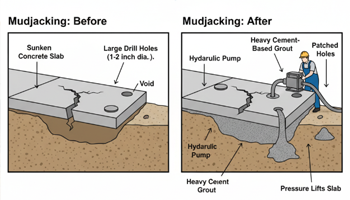
Slabjacking/mudjacking pricing: $3,000–$7,000 for typical residential applications. This traditional method pumps cement-based slurry beneath sunken concrete to lift it. Effective for settlement under 2 inches.
Polyurethane foam leveling costs: $4,000–$10,000. This modern alternative uses expanding foam that’s lighter than concrete slurry and cures faster. Better for areas with weak soils that can’t support heavy materials.
Partial piering (4–8 piers): $6,000–$24,000. When settlement affects a specific section of your foundation, targeted pier installation provides permanent support. At $1,500–$3,000 per push pier installed, a 6-pier job runs $9,000–$18,000.
Reality: 50–55% of foundation repair jobs fall into this moderate category. This tier addresses structural concerns that, while significant, haven’t progressed to critical failure.
Major Structural Repairs: $10,000–$30,000+
Full underpinning (10–20 piers): $15,000–$60,000. When settlement affects an entire foundation perimeter, you need comprehensive pier support. A typical 1,800-square-foot home requiring 12 piers runs $18,000–$36,000.
Bowing wall stabilization: $8,000–$25,000. Basement walls bowing inward from soil pressure require steel I-beams ($800–$1,500 each) or wall anchors ($600–$1,200 each). A severely bowed wall (3+ inches of deflection) might need 6–8 beams plus anchors, totaling $15,000–$20,000.
Foundation replacement costs: $20,000–$100,000+. In extreme cases where existing foundation integrity is compromised beyond repair, complete replacement becomes necessary. This involves jacking up the home, removing old foundation, and installing new—rarely needed but extraordinarily expensive.
Reality: 25–30% of foundation repair jobs reach this major category. These are the situations where homeowners face truly significant investments, making financing options critical.
Waterproofing & Drainage: $3,000–$10,000
Exterior waterproofing with membrane installation: $4,000–$15,000 depending on foundation perimeter. This involves excavating around the foundation, applying waterproof membrane, and installing drainage systems.
Interior waterproofing systems: $3,000–$7,000. Less invasive than exterior work, interior systems manage water that’s already penetrated, using sump pumps and interior drains.
French drain installation: $2,000–$6,000 for 50–100 linear feet. Proper drainage prevents water accumulation that contributes to foundation problems.
Cost Factors That Impact Your Quote
Understanding what drives foundation repair pricing helps you evaluate quotes intelligently and identify where you have negotiation leverage.
Home Square Footage & Foundation Size
Larger homes require more materials and labor hours. A 1,200-square-foot home might need 6–8 piers for full perimeter support, while a 3,000-square-foot home could require 15–20 piers for equivalent coverage.
The industry standard: one pier per 6–8 linear feet of affected foundation. If your quote specifies significantly denser pier placement, request justification. An independent structural engineer report ($500–$1,200) can validate whether pier counts are appropriate or over-specified.
Foundation Type (Slab vs. Pier-and-Beam vs. Basement)
Slab foundations: Generally less expensive to repair when damage is minor. Foam injection and slabjacking work well. Major repairs requiring piering run $8,000–$20,000.
Pier-and-beam foundations: More accessible for repairs, often requiring less excavation. Costs run 10–20% below slab foundation repairs for equivalent structural work.
Basement foundations: Most expensive to repair due to interior finishing considerations, deeper excavation requirements, and water management complexity. Add 20–40% to baseline repair costs.
Soil Conditions & Geotechnical Challenges
Expansive clay soils (common in Texas, Oklahoma, Colorado) swell when wet and shrink when dry, creating continuous foundation stress. Repairs in these areas require deeper piers (12–15 feet vs. 8–10 feet standard) and more robust systems, adding 15–30% to costs.
Sandy soils require different pier types—helical piers perform better but cost $1,800–$3,500 each vs. $1,500–$3,000 for push piers.
A soil report ($500–$3,000) identifies these challenges before work begins, ensuring the chosen solution matches your ground conditions.
Access & Excavation Requirements
Foundation areas beneath decks, finished basements, or tight landscaping require hand excavation rather than equipment, increasing labor costs 30–50%. Interior piers (installed from inside your home) add $500–$1,000 per pier due to working constraints.
Geographic Location & Cost of Living
Labor rates vary significantly by region. What costs $75/hour for foundation specialists in Kansas might run $125/hour in San Francisco. Material costs remain relatively consistent nationally, but labor accounts for 40–60% of total job cost.
Seasonal Demand Fluctuations
Foundation repair demand peaks in spring (March–June) when temperature changes make foundation movement most visible. Contractors’ schedules fill up, and pricing reflects high demand.
The insider secret: schedule repairs in September–October. Post-summer, pre-winter timing sees demand drop 30–40%. The same contractor who quotes $18,000 in May might price identical work at $13,500 in September—a 25% savings just for timing.
Foundation Repair Cost by Home Size
Home size correlates directly with foundation repair costs, though foundation type and problem severity matter more than square footage alone.
Small Homes (<1,500 sq ft): $3,000–$8,000
Typical scenarios:
- Minor crack repairs and waterproofing: $3,000–$5,000
- Moderate settlement with 4–6 piers: $6,000–$12,000
- Localized structural issue: $5,000–$8,000
Small homes offer some cost advantages: shorter foundation perimeters, fewer piers needed, and less excavation. However, per-square-foot costs may actually be higher since minimum labor and equipment costs don’t scale down proportionally.
Medium Homes (1,500–2,500 sq ft): $5,000–$15,000
This represents the majority of residential foundation repair work. Typical scenarios:
- Crack repair and minor settlement: $5,000–$8,000
- Partial foundation piering (6–10 piers): $9,000–$25,000
- Bowing wall stabilization: $8,000–$15,000
Most contractors optimize their crews and equipment for homes in this range, sometimes offering the best per-unit value.
Large Homes (2,500–4,000 sq ft): $10,000–$25,000
Foundation repair complexity increases significantly:
- Multiple problem areas common
- 10–16 piers typical for comprehensive repairs
- Interior finishing repairs more extensive
Expect $12,000–$20,000 for moderate structural repairs and $20,000–$35,000 for major underpinning projects.
Estate Homes (4,000+ sq ft): $20,000–$50,000+
Large luxury homes face unique challenges:
- Foundation perimeters exceeding 300 linear feet
- 20+ piers for full support systems
- Higher-end interior finishes requiring specialist restoration
- Landscaping and hardscaping restoration costs
A comprehensive foundation repair on a 5,000-square-foot home can easily reach $40,000–$60,000 when all associated costs are included.
Hidden Costs & Additional Expenses
The quoted foundation repair price rarely tells the complete financial story. Budget for these additional expenses that contractors often don’t include in initial estimates.
Structural Engineer Reports: $500–$2,000
Before major foundation work, an independent structural engineer assessment is non-negotiable. This report:
- Identifies root causes of foundation damage
- Specifies appropriate repair methods
- Validates contractor pier counts and methods
- Provides documentation for potential future home sales
Cost: $500–$1,200 for residential assessments, up to $2,000 for complex situations or large homes. This investment can save $3,000–$6,000 by preventing over-specification of repairs.
Soil Testing & Geotechnical Analysis: $500–$3,000
In areas with known problematic soils (expansive clay, loose sandy soils, high water tables), a geotechnical report guides solution selection. Skip this in challenging soil areas, and you risk choosing inadequate repair methods that fail within years.
Costs: $500–$1,500 for standard residential analysis, $2,000–$3,000 for comprehensive geotechnical engineering reports.
Permits & Inspection Fees: $200–$1,500
Most municipalities require permits for structural foundation work. Permit costs vary widely:
- Small cities/rural areas: $200–$500
- Suburban municipalities: $400–$800
- Major metropolitan areas: $800–$1,500
Some contractors include permits in quotes; others don’t. Always clarify upfront.
Landscaping Restoration: $1,000–$5,000
Foundation repair destroys landscaping. Excavation tears up:
- Flower beds and decorative plantings
- Sprinkler systems
- Pavers and walkways
- Retaining walls
Budget $1,500–$4,000 for typical landscaping restoration. Extensive hardscaping or mature landscaping can push costs to $8,000+.
Interior Repairs (Drywall, Flooring): $2,000–$10,000
Foundation leveling creates new stress points inside your home:
- Drywall cracks reappear or worsen as the foundation lifts
- Tile floors crack from movement
- Door frames require adjustment
- Baseboards need replacement
Typical interior repair costs: $2,000–$5,000 for basic drywall and paint. Homes with extensive tile, custom finishes, or significant leveling can see interior restoration costs of $8,000–$15,000.
Plumbing Adjustments: $500–$2,000
Rigid plumbing pipes (especially older cast iron or galvanized steel) stress during foundation lifting. Expect to pay for:
- Pipe inspections post-leveling
- Potential leak repairs
- Stress-point reinforcement
These hidden costs add 15–30% to your quoted foundation repair price. A $15,000 foundation repair quote can become a $20,000 total project.
Cost by Foundation Repair Method
Different foundation problems require different solutions. Here’s what each major repair method costs in 2025.
Push Pier Installation: $1,500–$3,000 per pier
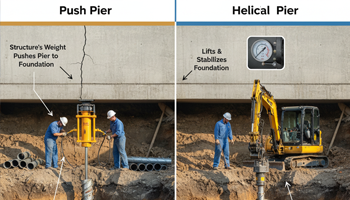
Push piers (also called resistance piers) use the weight of your home to drive steel shafts deep into stable soil. Material cost per pier: $280–$450. Contractor pricing: $1,500–$3,000 installed.
That’s a 3–7x markup over materials. Before you balk, understand that this pricing includes:
- Skilled labor (2–3 workers per crew)
- Hydraulic equipment rental
- Excavation and restoration
- Engineering calculations
- Warranty coverage
Typical residential jobs need 8–12 piers. Total cost: $12,000–$36,000 for comprehensive foundation stabilization.
Helical Pier Installation: $1,800–$3,500 per pier
Helical piers (screw piles) feature helical plates that screw into the ground like giant screws. They work better than push piers in:
- Sandy or loose soils
- High water table conditions
- Locations where driving resistance is inadequate
Higher cost reflects more complex manufacturing and installation requirements. Expect $1,800–$3,500 per pier installed, making an 8-pier job $14,400–$28,000.
Carbon Fiber Straps: $400–$800 per strap
For bowing basement walls with less than 2 inches of deflection, carbon fiber straps provide an economical stabilization option. These high-strength straps bond to the wall with epoxy, preventing further inward movement.
Cost per strap installed: $400–$800. A typical residential basement needs 3–5 straps, totaling $1,200–$4,000. This method stops progression but doesn’t reverse existing bowing.
Steel I-Beam Installation: $800–$1,500 per beam
Severely bowed walls (2+ inches of deflection) require steel I-beams for structural reinforcement. Beams are installed vertically against the basement wall, anchored to the basement floor and the floor joists above.
Cost per beam: $800–$1,500 installed. Severely compromised walls might need 6–8 beams, running $4,800–$12,000. Often combined with wall anchors for comprehensive stabilization.
Wall Anchors: $600–$1,200 per anchor
Wall anchor systems use earth anchors buried several feet outside the foundation. Steel rods connect the exterior anchors to interior wall plates, pulling the bowed wall back toward its original position.
Cost per anchor: $600–$1,200 installed. A basement wall typically requires 4–6 anchors, totaling $2,400–$7,200. This method can actually straighten walls over time, unlike straps or beams that only prevent further movement.
How to Save Money on Foundation Repairs
Foundation repairs are expensive, but strategic planning can reduce costs by 25–40% without compromising quality or durability.
Off-Season Scheduling (Late Summer/Fall)
September and October represent the sweet spot for foundation repair pricing. Here’s why:
- Demand drops 30–40% after summer
- Contractors’ schedules have openings
- Weather remains workable (before winter freeze)
- Year-end budget goals create negotiation leverage
The same contractor who quotes $18,000 in May (peak season) might price identical work at $13,500–$14,500 in September. That’s $3,500–$4,500 in savings just for timing.
Avoid the peak season rush (March–June) when foundation movement becomes most visible and contractors charge premium rates.
Multiple Quote Strategy & Negotiation Tips
Always obtain 3–5 quotes from different contractors. But here’s the insider approach:
Get an independent structural engineer report first ($500–$1,200). Show this report to contractors when requesting quotes. This creates accountability—contractors can’t over-sell pier counts or unnecessary repairs when an engineer has already specified the solution.
Use the engineer report to negotiate: When one contractor quotes 14 piers and another quotes 18 piers for the same problem, the engineer report reveals which is accurate. This transparency typically saves $3,000–$8,000 in over-specified materials.
Cash payment discount: Offer to pay cash (or check) instead of credit card to save contractor 3% processing fees. Many contractors will pass half this savings to you—a 1.5% discount on a $20,000 job saves $300.
Package multiple issues: If you need both foundation piering and waterproofing, getting both from one contractor often yields 10–15% savings versus splitting the work.
DIY Feasibility for Minor Repairs
Some foundation maintenance tasks are DIY-friendly:
Hairline crack sealing: Epoxy injection kits cost $40–$80 at home improvement stores. For non-structural cosmetic cracks (less than 1/4 inch wide, no active movement), DIY sealing saves $300–$500 per crack.
Drainage improvements: Installing gutters, extending downspouts, and regrading soil away from foundation prevents future problems. DIY cost: $200–$500. Professional installation: $1,500–$3,000.
Minor slab settling (less than 1 inch): Polyurethane foam kits for small slabs cost $150–$300. Professional foam leveling: $1,500–$3,000.
Do NOT DIY: Structural repairs, pier installation, major bowing walls, or anything requiring engineering calculations. The risk of improper repair outweighs any savings.
Preventive Maintenance to Avoid Major Costs
The best foundation repair savings come from preventing problems:
Maintain consistent soil moisture: Soaker hoses or irrigation systems around foundation perimeters prevent soil shrinkage. Annual cost: $100–$300 in water. Prevents: $8,000–$15,000 in settlement repairs.
Control drainage: Keep gutters clean, extend downspouts 6–10 feet from foundation, maintain proper yard grading. Annual maintenance cost: $200–$400. Prevents: $5,000–$12,000 in water-related foundation damage.
Foundation watering (for expansive clay soils): During drought, water around foundation perimeter maintains stable soil conditions. Summer watering cost: $50–$150. Prevents: $10,000–$20,000 in differential settlement.
Tree management: Large trees near foundations (within 20 feet) create soil moisture competition. Tree removal ($500–$2,000) prevents future foundation movement ($8,000–$15,000 in repairs).
What NOT to Skimp On
Some foundation repair elements demand full investment:
Structural engineer assessment: Non-negotiable for major repairs. The $800 cost prevents $5,000+ in over-specified or incorrect repairs.
Warranty coverage: Minimum 10-year warranty on structural repairs, preferably 25-year transferable warranty. Lifetime warranties sound impressive but often contain restrictive clauses. A legitimate 25-year transferable warranty adds 15% to costs but protects your investment.
Soil report in problematic areas: In regions with expansive clay, high water tables, or loose sandy soils, a $500–$3,000 geotechnical report ensures the repair method matches your specific soil conditions.
Proper pier depth: Piers must reach stable soil—typically 8–15 feet deep depending on location. Contractors who stop piers at shallow depths (to save time/money) risk repair failure within 3–5 years.
The difference between a $14,000 repair done right and a $22,000 repair comes down to information, timing, and strategic decision-making—not compromising on critical elements.
Financing Options for Foundation Repairs 2025
Foundation repairs rarely fit comfortably in monthly budgets. Understanding financing options—and their real-world approval rates—helps you plan effectively.
Contractor Financing Programs (0% Intro Offers)
Many foundation repair contractors offer in-house financing through third-party lenders. Common terms:
- 0% interest for 12–18 months
- Deferred interest (if not paid off, retroactive interest applies)
- 8.99%–12.99% APR after promotional period
The catch: Approval rates average only 40–50%. Credit score requirements typically demand 680+ FICO scores. If denied, you’ll need backup financing arranged quickly to lock in contractor scheduling.
Strategy: Apply for contractor financing but have alternative financing ready. Don’t rely solely on contractor finance approval.
Home Equity Loans & HELOCs
For homeowners with equity, home equity products offer competitive rates:
Home Equity Loans (fixed rate, lump sum):
- Current rates: 7.5%–9.5% (October 2025)
- Tax-deductible if used for home improvements
- Predictable monthly payments
- Good for known repair costs
HELOCs (variable rate, line of credit):
- Current rates: 7.5%–9.0% variable
- Draw what you need, when you need it
- Tax-deductible
- Better for phased repairs or uncertain final costs
Approval requirements: 15%–20% equity minimum, 660+ credit score, debt-to-income ratio under 43%.
Personal Loans & Credit Cards
When home equity isn’t available:
Personal loans:
- Current rates: 9%–15% APR (depending on credit)
- Unsecured (no collateral risk)
- Fixed payments, 3–7 year terms
- Approval in days
Credit cards:
- Last resort option
- Rates: 18%–24% APR typical
- Only viable if you have 0% balance transfer offers
- Risk: High ongoing interest if not paid quickly
Strategy: Avoid high-interest debt for foundation repairs if possible. A $15,000 repair at 20% interest costs $3,000+/year in interest alone.
FHA 203(k) Renovation Loans
If you’re purchasing a home needing foundation repair, or refinancing:
FHA 203(k) loans allow you to finance both purchase price and repair costs in a single mortgage. Foundation repairs qualify if:
- Repair costs are documented by engineering reports
- Contractors provide detailed estimates
- Work makes home livable/safe
Current FHA rates run 6.5%–7.5%, significantly better than personal loans or credit cards for substantial repairs.
Limitation: Only available during purchase or refinance, not for existing homeownership situations.
The financing sweet spot: Home equity products (if available) offer the best rates and tax benefits. For homeowners without equity, contractor 0% offers (if approved) beat personal loans. Avoid credit card debt except in true emergencies.
FAQs
How much does foundation repair cost for a 1,500 sq ft house?
For a typical 1,500 square foot home, expect $5,000–$15,000 depending on problem severity. Minor crack repairs run $3,000–$6,000, moderate settlement with 6–8 piers costs $9,000–$18,000, and major structural issues can reach $15,000–$25,000. Foundation type and soil conditions influence the final cost.
Is foundation repair covered by homeowners insurance?
Rarely. Standard homeowners insurance excludes damage from settling, soil shrinkage, or poor drainage—the most common causes. Insurance typically covers foundation damage only from sudden covered events like burst pipes, fires, or vehicle impacts. Always check your specific policy, but don’t count on insurance coverage.
How much does foundation piering cost per pier?
Push piers cost $1,500–$3,000 each installed. Helical piers run $1,800–$3,500 per pier. A typical residential repair needs 8–12 piers, totaling $12,000–$36,000. Geographic location, soil conditions, and required pier depth influence per-pier pricing.
What’s the cheapest foundation repair method?
For minor cracks, epoxy injection ($300–$800 per crack) is most economical. For small settlement areas (under 1 inch), polyurethane foam injection ($400–$1,200) costs less than piering. However, «cheapest» doesn’t mean best—undersized repairs fail quickly. Match the repair method to problem severity, not just budget.
Can I finance foundation repairs?
Yes, through multiple options: contractor 0% financing (40–50% approval rate), home equity loans/HELOCs (7.5%–9.5% rates), personal loans (9%–15% rates), or FHA 203(k) loans during purchase/refinance. Home equity products offer the best rates for homeowners with available equity.
How much does it cost to fix bowing basement walls?
Carbon fiber straps for walls bowing under 2 inches cost $1,200–$4,000 (3–5 straps at $400–$800 each). Steel I-beams for severe bowing (2+ inches) run $4,800–$12,000 (6–8 beams at $800–$1,500 each). Wall anchor systems cost $2,400–$7,200 (4–6 anchors at $600–$1,200 each). Combination approaches for severely compromised walls can reach $15,000–$25,000.
When is the best time of year for foundation repair?
September–October offers the best pricing—25% lower than peak season (March–June). Demand drops after summer, contractors have schedule openings, and weather remains workable. The same repair quoted at $18,000 in May might cost $13,500–$14,500 in early fall.
Do I need a structural engineer report before foundation repair?
For major repairs, absolutely. A structural engineer report ($500–$1,200) identifies root causes, specifies appropriate repairs, and validates contractor pier counts. This investment typically saves $3,000–$6,000 by preventing over-specification of materials and ensures repairs address actual problems, not just symptoms.
Need more specifics? Tell me your foundation type, problem symptoms, geographic location, and home size for tailored guidance on expected costs and repair approaches for your situation.
References
Currently viewing
Foundation Repair Cost


Foundation Inspection Checklist
Foundation Inspection Checklist: What to Look for Before Buying a Home Buying a home is…
Concrete Foundation vs Pier & Beam
Concrete Foundation vs Pier & Beam: Repair Cost Differences When foundation problems arise, one of…

Foundation Settlement Warning Signs
Foundation Settlement Warning Signs: When to Call a Structural Engineer You’ve noticed a crack in…

Bowing Basement Wall Repair
Bowing Basement Wall Repair: Carbon Fiber vs Steel I-Beams If you’ve noticed your basement walls…
Slabjacking vs Mudjacking
Slabjacking vs Mudjacking vs Polyurethane Foam Leveling Your concrete driveway has sunk three inches. The…
Push Piers vs Helical Piers
Push Piers vs Helical Piers: Foundation Underpinning When your home’s foundation starts settling, the choice…

Foundation Crack Repair
Foundation Crack Repair: Epoxy vs Polyurethane Injection Complete Guide Foundation problems strike fear into homeowners…

Foundation Repair
Foundation Repair Guide: Systems, Costs & Decision Framework Foundation problems strike fear into homeowners for…