
Push Piers vs Helical Piers: Foundation Underpinning
When your home’s foundation starts settling, the choice between push piers and helical piers isn’t just a technical decision—it’s a strategic one that can save or cost you thousands. Most contractors will recommend whatever system they specialize in, but the truth is more nuanced. After installing over 3,000 piers across both systems, I’ve developed a framework that cuts through the sales pitch and focuses on what actually matters for your specific situation.
Foundation underpinning isn’t one-size-fits-all. The pier system that works perfectly for your neighbor’s two-story colonial might be completely wrong for your split-level ranch, even if you’re experiencing identical settlement patterns. Soil composition, structure weight, access constraints, and budget all play critical roles in determining which system will deliver the best long-term results.
This guide breaks down both push piers (steel resistance piers) and helical piers (screw piles) with the kind of insider perspective you won’t get from contractors who only install one type. You’ll learn how to self-diagnose which system matches your situation, understand the real cost differences beyond the initial quote, and identify red flags that suggest a contractor is pushing the wrong solution.
By the end, you’ll have a decision matrix that considers your home’s weight, soil conditions, site access, and budget—giving you the confidence to have informed conversations with foundation contractors and avoid the 30% of installations where homeowners get the wrong pier system.
Foundation Underpinning Fundamentals
What is Foundation Underpinning & When is it Needed?
Foundation underpinning is the process of strengthening and stabilizing an existing foundation by extending its support to deeper, more stable soil layers or bedrock. This becomes necessary when the original foundation can no longer adequately support the structure due to soil movement, settlement, or deterioration.
You need underpinning when you notice specific warning signs: doors and windows that stick or won’t close properly, diagonal cracks in drywall (especially above door frames), gaps between walls and ceilings or floors, tilting chimneys, or visible foundation cracks wider than a quarter-inch. These symptoms indicate differential settlement—when one part of your foundation settles more than another.
Not all foundation issues require piering. Minor cosmetic cracks or seasonal movement often need simple monitoring. But when settlement is active, progressive, or has caused structural damage, underpinning becomes essential to prevent further deterioration and preserve your home’s value.
How Piers Transfer Load to Stable Soil/Bedrock
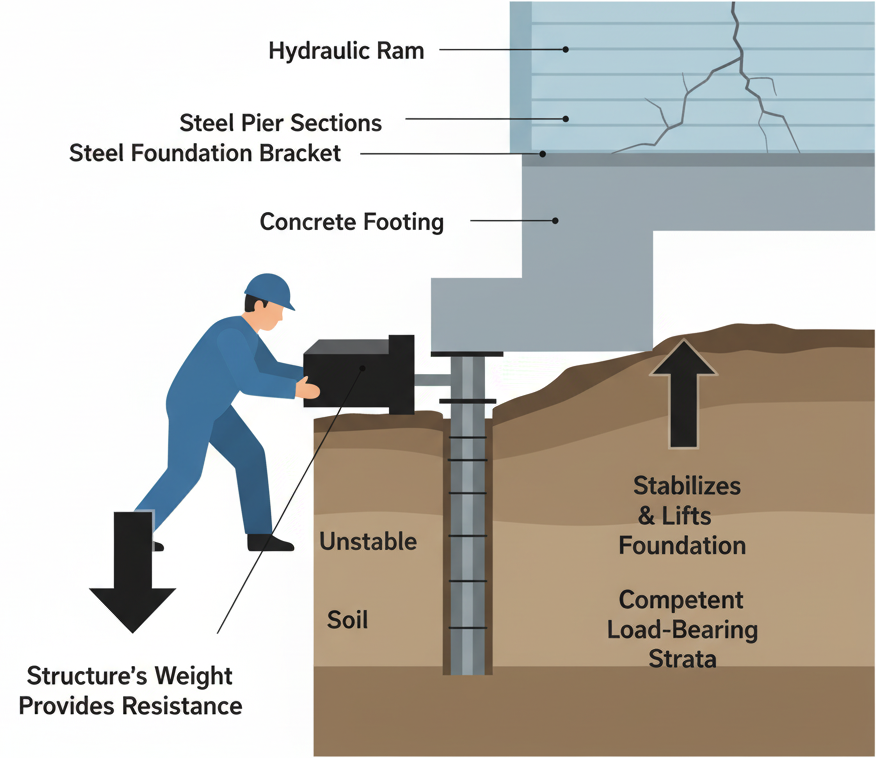
The engineering principle behind both push piers and helical piers is load transfer—redirecting your home’s weight from unstable, settling soil to deeper, competent bearing strata. Think of it like bypassing a weak link in a chain by connecting directly to a stronger section further down.
When soil near the surface compresses, dries out, or erodes, it loses its ability to support the foundation load. Piers penetrate through these problematic layers until they reach soil with adequate bearing capacity or bedrock. Once installed, steel brackets connect the pier to your existing foundation, creating a new load path that bypasses the weak surface soil entirely.
The critical difference between pier types lies in how they achieve this depth and how they engage with the soil. Push piers rely on end-bearing capacity (resistance at the bottom tip), while helical piers use a combination of end-bearing and the mechanical advantage of helical plates that «grab» multiple soil layers along their depth. Both methods work, but they excel in different conditions.
Settlement Patterns That Require Piering Solutions
Differential settlement—where one section of your foundation drops relative to another—is the primary indicator for piering. This typically occurs at corners, where additions meet original structures, or along one side of a building where soil conditions vary.
Uniform settlement, where the entire structure settles evenly, rarely causes structural damage and typically doesn’t require piering. The problem arises when settlement is localized. A two-inch drop at one corner while the rest of the foundation remains stable creates stress that masonry and framing weren’t designed to handle.
Common settlement patterns include corner drop (often from downspout drainage concentrating water), perimeter settlement (expansive clay soils shrinking during dry periods), and isolated bay or addition settlement (often due to inadequate original footing depth). Each pattern requires strategic pier placement—typically every 6-8 feet along the affected area, not necessarily under the entire foundation.
Cost vs. Benefit: Piering vs. Full Foundation Replacement
Foundation piering costs between $1,500-$3,000 per pier installed, with most residential projects requiring 8-15 piers, putting total costs in the $15,000-$40,000 range. Full foundation replacement starts at $75,000 for a modest home and easily exceeds $150,000 for larger structures.
The cost-benefit analysis heavily favors piering for localized settlement. Piering is minimally invasive, completed in 2-5 days, and allows you to remain in your home during installation. Foundation replacement requires complete structural support, potential relocation, extensive excavation, and months of construction disruption.
However, piering has limitations. If more than 60% of your foundation perimeter requires support, if you’re dealing with severe structural deterioration beyond settlement, or if you’re planning major additions or second-story construction, full replacement might be more economical long-term. The break-even point typically occurs when you need more than 20 piers—at that point, replacement deserves consideration.
Push Piers (Steel Resistance Piers) Explained
Push Pier Design & Components (Brackets, Tubes, Hydraulics)
Push piers consist of three primary components: a steel foundation bracket, cylindrical steel pier sections (typically 3-foot segments), and hydraulic rams that drive the installation. The bracket attaches directly to the foundation footing and becomes the permanent load-transfer point.
The steel tubes are hollow-section piping, typically with a 2-7/8 inch outer diameter and varying wall thickness (usually 0.276 inches for residential applications). The bottom section features a beveled or bullet-point tip designed to penetrate soil and push aside obstructions. Each pier can support 50,000-70,000 pounds when properly installed to refusal.
The installation bracket is the critical component that differentiates push pier systems. Foundation Supportworks and RAM JACK use slightly different bracket designs, but all function by creating a mechanical connection between the new pier and the existing foundation footing. The bracket must bear against undisturbed soil beneath the footing to prevent undermining during installation.
Installation Process: How Weight Drives Depth
Push pier installation uses your home’s weight as the driving force—a concept called «resistance piering.» Contractors excavate to expose the foundation footing, attach the bracket, and then use hydraulic cylinders to push pier sections into the ground. The house’s own weight provides the resistance necessary to drive the pier deeper.
As each 3-foot section reaches capacity, installers add another section and continue pushing. This process continues until the pier reaches refusal—the point where it can no longer penetrate due to hitting bedrock or extremely dense soil. Refusal is measured by hydraulic pressure; when pressure spikes and the pier stops advancing, you’ve reached adequate bearing capacity.
Here’s the insider reality: this process is relatively foolproof, which is why many contractors prefer it. Less experienced crews can install push piers successfully because the system itself provides feedback. However, this «advantage» has a downside—the pushing force can create stress points in older foundations, particularly those built with concrete block. I’ve witnessed micro-fractures in 1950s block foundations where the pushing process created problems that didn’t exist before.
Ideal Applications: Heavy Structures & Deep Bedrock
Push piers excel in specific scenarios. Three-story structures, commercial buildings, or homes with heavy brick/stone exteriors generate sufficient weight to efficiently drive piers to depth. The heavier the structure, the more effective push pier installation becomes.
Bedrock within 25 feet of the surface is push pier territory. When competent bearing strata is relatively shallow, push piers reach it quickly and efficiently. They’re also the superior choice in extremely tight spaces—narrow gaps between houses, limited crawl space height, or situations where equipment access is severely restricted.
The system works best in relatively uniform soil conditions where obstructions are minimal. Large rocks, old foundation debris, or tree roots can deflect push piers laterally, though experienced installers can usually work around these challenges by repositioning slightly or pre-drilling problem areas.
Load Capacity & Depth Limitations
Properly installed push piers offer exceptional load capacity. Residential systems typically rate for 50,000-70,000 pounds per pier, with commercial systems exceeding 100,000 pounds. This capacity depends entirely on reaching adequate bearing strata—the pier itself is strong, but it’s only as good as what it’s resting on.
Depth limitations become problematic in certain soil profiles. If competent bearing soil or bedrock exceeds 40 feet deep, push pier installation becomes increasingly difficult. The deeper you go, the more pier sections required, increasing costs and complexity. Additionally, very deep installations accumulate more friction along the pier shaft, which can lead to misleading refusal readings before truly adequate depth is reached.
The practical depth sweet spot for push piers is 15-30 feet. Shallower installations may not bypass problematic soil layers, while deeper installations face diminishing returns on the weight-driven installation method. If preliminary soil testing indicates bearing strata beyond 40 feet, helical piers typically become the more reliable choice.
Installation Timeframe & Site Disruption
A typical residential push pier installation for 8-12 piers takes 2-3 days. Day one involves excavation and bracket attachment, day two focuses on pier driving and lift/stabilization, and day three handles backfill and site restoration. Favorable conditions and experienced crews can complete smaller projects in a single long day.
Site disruption is moderate. Excavation creates soil piles that need staging area, and heavy equipment requires access to each pier location. Landscaping within 3-4 feet of the foundation will be disturbed. Noise and vibration are significant during hydraulic pressing—neighbors will notice, though it’s far less disruptive than pile-driving or auger drilling.
Weather affects push pier installation less than helical systems. Light rain doesn’t stop work, though heavy saturation can delay backfill. Frozen ground in northern climates requires thawing equipment or delays until spring. The excavation, however, leaves your foundation exposed to weather until completed, so scheduling during stable weather conditions is wise.
Helical Piers (Screw Piles) Explained
Helical Pier Design: Shaft & Helix Plates
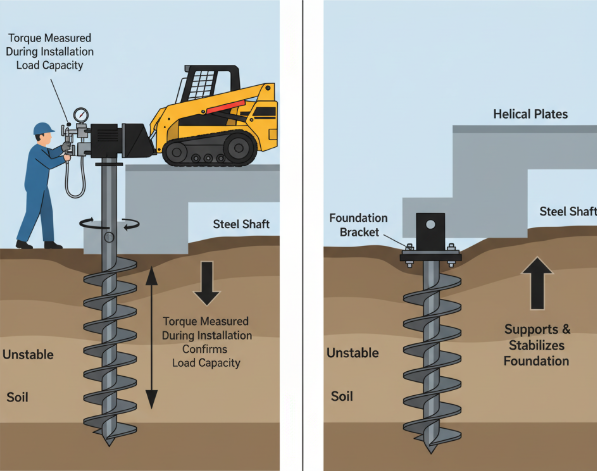
Helical piers (also called screw piles or helical anchors) consist of a central steel shaft with one or more helical-shaped bearing plates welded at specific intervals. The design resembles a large screw—hence the name. Lead sections feature the helix plates, while extension shafts connect to achieve required depth.
The helical plates range from 8 to 14 inches in diameter for residential applications, with plate spacing calculated based on soil type and load requirements. Multiple plates (typically 2-4 on residential systems) distribute load across several soil layers rather than relying on a single bearing point. This multi-plate design creates redundancy—if one plate encounters weak soil, others compensate.
Shaft sizes vary by manufacturer and application. GoliathTech and AB Chance use different shaft dimensions and configurations, but typical residential systems use 1.5 to 2.875-inch diameter round or square shafts. The shaft-to-plate welding and overall steel quality differentiate premium systems from budget alternatives. RAM JACK’s helical systems, for example, use thicker steel and more robust welding procedures, justifying their 25-30% price premium.
Installation Process: Torque-Driven System
Helical pier installation uses mechanical torque rather than structural weight. A hydraulic drive head—essentially a powerful motor—rotates the pier into the ground like screwing in a wood screw. The helical plates cut into soil, pulling the pier downward with minimal soil displacement.
Installation requires continuous torque monitoring. As the pier advances, torque values are measured and recorded at regular intervals (typically every foot). Rising torque indicates increasing soil density and bearing capacity. The installation continues until predetermined torque values are achieved at the required depth, confirming adequate load-bearing capacity.
This is where contractor expertise becomes critical. The torque-to-capacity relationship isn’t a simple formula—it varies by soil type, plate configuration, and installation method. A properly trained crew uses torque gauges, not «feel,» and provides a detailed torque log for every pier. If your contractor doesn’t offer this documentation, you’re looking at a major red flag. I’ve seen countless installations where crews «felt» sufficient torque rather than measuring it, resulting in recurrent settlement within 3-5 years.
Ideal Applications: Light-Medium Structures & Versatility
Helical piers are technically superior for 70% of residential applications. Single and two-story homes, additions, decks, and light commercial structures fall perfectly into helical pier’s capacity range. The system doesn’t require the structure’s weight for installation, making it ideal for light buildings or new construction.
Versatility is helical piers’ greatest strength. They work in variable soil conditions, can be installed at angles to reach stable soil beneath problem areas, and allow precise depth control. If you encounter an unexpected obstruction or utility line, you can adjust the installation angle or location far more easily than with push piers.
For older homes with concrete block or fragile foundations, helical piers eliminate the stress-inducing pushing force. This makes them invaluable for historic structures or homes where foundation integrity is questionable. The installation process is gentler, reducing the risk of installation-related damage.
Torque Measurement & Load-Bearing Verification
Torque measurement provides real-time verification of pier capacity—a significant advantage over push piers’ less precise refusal method. The relationship between installation torque and load capacity is established through empirical data and engineering analysis specific to each helical system.
Most residential helical pier systems use a torque correlation factor of 10-12 feet per pound of torque to pounds of capacity. For example, if your pier is installed to a final torque of 3,000 foot-pounds, the projected capacity is approximately 30,000-36,000 pounds. Engineers can specify exact torque requirements based on calculated loads, and installers can verify achievement of those requirements during installation.
This verification process requires proper equipment. Digital torque indicators, not guesswork, must record values. A complete installation report should include: pier location, depth achieved, final torque reading, date and time, and installer signature. This documentation becomes invaluable if settlement issues arise later—it proves the installation met engineered specifications.
Angular Installation Capabilities
One of helical piers’ most valuable features is the ability to install at angles. While push piers must be installed essentially vertical (slight deviations possible), helical piers can be installed at angles up to 45 degrees from vertical in many cases.
This angular capability solves numerous field challenges. Need to underpin a corner but there’s a utility line directly below? Install at an angle to reach stable soil while avoiding the obstruction. Need to support a retaining wall or counteract lateral forces? Angled helical piers can be engineered to resist both vertical and horizontal loads.
The installation process for angled piers requires more skill and specialized equipment. The drive head must maintain consistent torque while managing the angular installation, and the bracket system must accommodate the non-vertical load transfer. This added complexity explains part of the cost premium for helical systems—you’re paying for engineering flexibility and skilled installation.
Direct Comparison: Push Piers vs Helical Piers
Installation Requirements (Space, Access, Equipment)
Push piers require minimal space above ground but demand heavy hydraulic equipment positioned near each pier location. The pressing rams and pressure pumps are substantial, requiring truck-mounted or trailer-mounted systems. Access for this equipment—typically 8-10 feet of clearance width—can be challenging in tight urban lots or backyard installations.
Helical piers need less ground-level space for equipment but require vertical clearance for the drive head and shaft extensions. Installation rigs vary from compact skid-steer mounted units (fitting through 36-inch gates) to truck-mounted torque motors for larger projects. The modular nature of helical equipment often provides better access solutions for challenging sites.
Excavation differs significantly. Push piers require deeper, wider excavations to expose the footing and provide working room for brackets and rams. Helical installations need smaller excavations—just enough to expose the starting point and allow bracket attachment after the pier is installed. This means less soil removal, smaller spoil piles, and faster site restoration with helical systems.
Weight-Bearing Capacity & Structural Support
Both systems offer adequate capacity for residential applications, but they achieve it differently. Push piers excel in maximum load scenarios—their end-bearing design can support exceptional weight when driven to bedrock or very dense soil. Commercial buildings and heavy three-story structures often favor push piers for this reason.
Helical piers distribute load across multiple bearing plates, creating a more forgiving system in variable soil conditions. If the deepest plate encounters a weak layer, shallower plates continue supporting the load. This redundancy provides more consistent performance in unpredictable soil profiles.
The practical difference for most homeowners is minimal. Both systems easily support typical residential loads of 20,000-40,000 pounds per pier. The choice rarely comes down to pure capacity—it’s about installation method, soil conditions, and site constraints. The myth that push piers are «stronger» is contractor sales talk, not engineering reality.
Soil Condition Suitability
Push piers demand a distinct end-bearing layer—bedrock or extremely dense soil that provides clear refusal. They work excellently in areas with shallow bedrock or predictable soil profiles where borings confirm competent bearing strata at achievable depths. Clay soils, particularly dense clay, provide good resistance for push pier installation.
Helical piers adapt to variable conditions. Layered soils, sandy conditions, mixed profiles, or uncertain geology favor helical systems. The torque measurement provides continuous feedback about soil conditions throughout the installation depth. If you encounter unexpected soft layers, you simply install deeper until adequate torque is achieved in better soil.
Problematic soils like very loose fill, peat, or muck challenge both systems. However, helical piers generally perform better in these conditions because plate design generates bearing capacity across wider areas. Push piers in weak soil can punch through without generating adequate resistance, potentially requiring extreme depths to reach refusal.
Installation Speed & Complexity
Push piers install faster in ideal conditions—experienced crews can complete a typical residential project in 2-3 days. The process is straightforward: excavate, bracket, push, lift, backfill. Less can go wrong, and field modifications are limited.
Helical piers take 20% longer on average, typically 3-4 days for comparable projects. The additional time comes from torque monitoring, more precise depth control, and the need to document installation parameters. However, this «extra» time represents thorough engineering verification, not inefficiency.
Complexity favors push piers for straightforward projects but reverses when complications arise. Obstructions, utilities, tight access, or unusual conditions all favor helical piers’ adaptability. A push pier that hits an obstruction at 15 feet might require abandonment and relocation. A helical pier encountering the same obstacle can often adjust angle or position mid-installation.
Noise, Vibration & Neighbor Impact
Push pier installation generates significant hydraulic noise and substantial ground vibration. The pressing process creates a steady, rhythmic pounding sensation that transmits through soil to adjacent properties. It’s not pile-driving intensity, but neighbors will notice and potentially complain.
Helical pier installation is quieter—more like heavy drilling than pounding. The hydraulic drive motor produces steady noise, but vibration is minimal. For urban installations, townhomes, or situations where neighbor relations matter, helical piers create less conflict. Some municipalities have noise ordinances that favor helical systems.
Indoor disruption differs as well. Push pier lifting can cause sudden pops and cracks inside as the structure shifts. Helical lifting is generally smoother and more controlled, reducing the unsettling sounds that alarm homeowners during foundation work. This isn’t a technical advantage, but it significantly impacts the customer experience.
Aesthetic & Space Considerations
Both systems require permanent foundation brackets visible in crawl spaces or basements. Push pier brackets are typically larger and more prominent due to the need to accommodate hydraulic pressing equipment. Helical brackets are more compact, though still noticeable.
Exterior impact is minimal for both when properly restored, but push piers require larger excavations that disturb more landscaping. Mature plants, hardscaping within 3-4 feet of the foundation, and decorative elements near foundation walls face greater risk with push pier installations.
For basements being finished or already finished, helical piers offer slight advantages. The smaller brackets and cleaner installation process make them easier to box-in or hide during finishing work. Push pier brackets’ larger footprint and sometimes awkward positioning can complicate finishing plans.
Cost Analysis: Push Piers vs Helical Piers 2025
Material Cost per Pier ($1,500-$3,000 Range)
Material costs alone for push piers range from $800-$1,500 per pier, depending on depth achieved and system brand. A typical installation to 20 feet depth costs approximately $1,000 in materials. Deeper installations increase costs proportionally as more pier sections are required.
Helical pier materials cost $1,000-$1,800 per pier for comparable capacity installations. The higher baseline cost reflects more complex manufacturing—welding helical plates to shafts requires more labor than producing straight pipe sections. Premium systems like RAM JACK or GoliathTech can reach $2,000+ in materials alone.
The 15-20% material cost premium for helical piers is consistent across manufacturers and regions. This gap narrows slightly on very deep installations where push piers require many sections, but helical systems almost always cost more in raw materials. Budget-conscious homeowners often cite this difference, but materials represent only 40-50% of total project costs.
Installation Labor Costs
Labor costs for push pier installation range from $500-$1,000 per pier, averaging $700 for standard residential work. A two-person crew can typically install 4-6 push piers per day in favorable conditions, making labor costs predictable and relatively economical.
Helical pier installation labor runs $700-$1,200 per pier, approximately 20-30% higher. The premium reflects specialized equipment operation, required torque documentation, and generally higher skill requirements. Experienced helical pier installers command higher wages than push pier crews, and rightly so—the precision required justifies the cost.
Total installed costs therefore break down to: push piers $1,500-$2,500 per pier, helical piers $1,800-$3,000 per pier. On a typical 10-pier residential project, expect $18,000-$25,000 for push piers versus $22,000-$30,000 for helical piers. The $3,000-$5,000 difference on average projects represents the premium for technical superiority and adaptability.
Total Project Cost by Home Size
Small homes or localized repairs requiring 6-8 piers cost $12,000-$20,000 with push piers, $15,000-$24,000 with helical piers. These projects typically address corner settlement or small addition stabilization. Cost difference is minimal in this range—$3,000-$4,000—making the technical advantages of helical systems worth serious consideration.
Medium homes with broader settlement requiring 10-15 piers run $20,000-$37,500 for push piers, $25,000-$45,000 for helical piers. This is the most common residential project size, and the $5,000-$7,500 helical premium becomes a significant decision factor. However, if soil conditions are variable or unknown, that premium often proves wise.
Large homes or severe settlement requiring 18+ piers can exceed $45,000 with push piers, $55,000+ with helical piers. At this project scale, the cost difference becomes substantial enough that push piers may be chosen even when helical systems would be technically preferable. It’s also the point where homeowners should seriously evaluate full foundation replacement as an alternative.
Long-Term Value & ROI Comparison
Both systems provide comparable long-term value when properly installed. Properly engineered push piers last 50+ years with zero maintenance. Helical piers offer similar longevity. Neither system degrades significantly in typical soil conditions, and both use corrosion-resistant steel adequate for the buried environment.
The ROI difference appears in two areas: precision of lift and reduced future risk. Helical piers’ controlled installation typically delivers more precise leveling, which translates to less cosmetic repair work post-installation. If your goal includes restoring door/window operation and minimizing drywall repair, helical systems often deliver better results.
Home resale value benefits from either system, but name recognition matters. RAM JACK installations carry cachet with home inspectors and real estate agents, potentially worth the 25-30% premium if you plan to sell within five years. Generic or lesser-known systems (even if technically sound) lack this market recognition. Foundation Supportworks systems offer middle-ground recognition—respected by professionals without the RAM JACK premium.
Manufacturer & System Comparisons
RAM JACK Push Pier & Helical Systems
RAM JACK dominates the premium foundation repair market, offering both push pier and helical pier systems. Their push piers use heavy-duty brackets and high-grade steel, with installations backed by transferable warranties that appeal to home sellers and buyers. The brand commands 25-30% premium pricing but delivers corresponding quality and reputation.
Their helical systems feature robust shaft-to-plate welding and above-average corrosion protection. RAM JACK’s network of franchised installers maintains consistent quality standards, though this also means limited negotiation flexibility on pricing. For homeowners prioritizing resale value or working with skittish lenders/buyers, RAM JACK’s name recognition justifies the premium.
The company provides extensive documentation, engineering support, and warranty service. Their warranties transfer to subsequent homeowners, adding tangible value during property sales. If budget allows, RAM JACK represents the «safe choice» that avoids second-guessing or buyer resistance during real estate transactions.
Foundation Supportworks (Supportworks) Products
Foundation Supportworks supplies systems to a network of independent contractors, creating a middle-ground between premium brands and generic systems. Their push piers and helical piers meet rigorous engineering standards without the RAM JACK price tag—typically 10-15% less for comparable specifications.
The quality difference between Foundation Supportworks and premium brands is minimal in materials but can vary in installation quality since individual contractors maintain different standards. Research the specific installer, not just the product brand. A top-tier contractor using Foundation Supportworks often delivers results equal to average RAM JACK franchises.
Foundation Supportworks’ market position makes it ideal for homeowners seeking proven systems without premium branding costs. Their engineering support and product warranties are solid, and the systems perform excellently when properly installed. Many of the best foundation contractors I’ve worked with prefer Supportworks products for their value-to-quality ratio.
ECP (Earth Contact Products) Solutions
ECP focuses primarily on helical pier and anchor systems, offering extensive product lines for both residential and commercial applications. Their helical systems feature excellent engineering and competitive pricing, typically 5-15% below Foundation Supportworks for comparable capacity.
The company emphasizes technical support and engineering services, making them popular with structural engineers and architects who specify foundation solutions. ECP’s product documentation is thorough, and their load tables are conservative—meaning rated capacities are reliable and often conservative rather than optimistic.
ECP systems lack the consumer brand recognition of RAM JACK but earn respect from professionals who value engineering over marketing. For homeowners working with structural engineers or seeking technically optimal solutions at fair prices, ECP products deserve strong consideration. Installation quality depends entirely on the contractor, as ECP sells through distributors rather than maintaining franchise networks.
GoliathTech Helical Pile Systems
GoliathTech specializes exclusively in helical pier systems, dominating the Canadian market and growing rapidly in the United States. Their systems feature unique shaft designs and plate configurations optimized for various soil conditions. The company’s focus on a single technology results in continuous innovation and refinement.
GoliathTech installations include comprehensive torque documentation and soil analysis as standard practice, not optional extras. Their installer network undergoes extensive training, and quality control is generally excellent. Pricing falls in the mid-to-upper range—above generic systems but typically below RAM JACK.
The limitation is availability—GoliathTech doesn’t operate nationwide yet. In regions where they’re established (primarily northern states and Canada), they represent an excellent choice for helical pier projects. Their cold-climate experience makes them particularly valuable in freeze-thaw conditions.
AB Chance (Helical Anchors/Piers)
AB Chance (now Hubbell Power Systems) invented helical anchor technology for utility applications and maintains the longest track record in the industry. Their systems are engineered for heavy commercial and utility work but scale down to residential applications. Quality and engineering are exceptional; brand recognition among contractors is high.
AB Chance pricing reflects industrial-grade construction—these systems are built beyond residential requirements, which translates to higher costs without proportional benefit for typical homes. They excel in commercial applications, heavy structures, or situations where engineering calculations demand documented, proven performance.
For residential work, AB Chance systems are often overkill unless specific engineering requirements justify them. However, in regions prone to expansive soils, seismic activity, or coastal exposure, the over-engineering provides legitimate value. The systems will outlast the structure they support—which isn’t necessary but isn’t a disadvantage either.
Choosing the Right Pier System for Your Home
Decision Matrix: Structure Weight Assessment
Calculate your structure’s weight to determine if push piers are even viable. A simple estimation method: multiply your home’s square footage by 50-70 pounds per square foot. A 2,000 square foot single-story home weighs approximately 100,000-140,000 pounds. Distribute this across needed piers to verify adequate pushing force per pier.
Push piers become efficient at 8,000+ pounds per pier during installation. Lighter structures generate insufficient force to drive piers to adequate depth. If your calculation shows less than 6,000 pounds per pier, helical systems are mandatory. Between 6,000-10,000 pounds per pier, either system works but helical is usually better. Above 15,000 pounds per pier, push piers become attractive.
Three-story homes, brick/stone exterior construction, and commercial buildings almost always generate sufficient weight for push pier efficiency. Single-story ranch homes, lightweight construction, or areas requiring many closely-spaced piers often fall below optimal push pier weights. This simple calculation eliminates roughly 40% of installations from push pier consideration before even evaluating soil or access factors.
Soil Testing & Geotechnical Reports
Professional soil testing provides the single most valuable data point for pier selection. A geotechnical boring reveals soil layering, depth to competent bearing strata, groundwater levels, and potential complications like buried debris or expansive clays. This costs $800-$1,500 but can save thousands in mis-applied pier selection.
Push piers require identifiable bearing strata—the boring should show dense soil or bedrock at achievable depths (under 40 feet preferably). If the boring reveals variable layers, soft strata beyond 30 feet, or uncertain conditions, helical piers become the lower-risk choice.
Without formal testing, evaluate soil type from neighboring properties, local geological surveys, or nearby construction projects. Rocky regions with shallow bedrock favor push piers. Areas with deep sandy or clayey profiles, coastal plain regions, or river valleys typically favor helical systems. Your local building department often has general soil maps that provide guidance, though project-specific testing is always preferable.
Access Restrictions & Property Constraints
Map your property constraints before requesting quotes. Measure gate widths, overhead clearance under eaves or overhangs, distance from pier locations to nearest truck access, and any underground utilities that require location before digging. These physical constraints often dictate pier selection regardless of other factors.
Push pier equipment requires 8-10 feet of clearance width and direct access to each pier location. Hydraulic hoses limit working distance from the pump to about 50 feet. Backyard installations on lots with 4-foot side yards may be impossible with standard push pier equipment. Helical systems offer more compact installation rigs, including mini-skid-steer mounted torque motors that fit through 36-inch gates.
Tight crawl spaces favor helical systems due to smaller bracket profiles and less invasive installation. Interior installations (inside basements) are rare but when necessary, almost always use helical piers due to equipment size and installation method. If your property has mature landscaping, underground sprinklers, or decorative hardscaping within 3 feet of foundation walls, helical systems’ smaller excavations cause less damage.
Budget Considerations & Financing
Set realistic budget expectations: quality foundation piering costs $1,500-$3,000 per pier installed. Quotes significantly below this range indicate insufficient depth, inferior materials, or inexperienced installation—all eventually leading to failure and re-work costs. Quotes significantly above suggest unnecessary pier count or premium pricing without corresponding value.
The $3,000-$5,000 helical premium on typical projects represents 15-20% additional cost. Financing changes this calculation—spreading $25,000 over 60 months at 7% APR costs $495/month, while $30,000 costs $594/month. That $99 monthly difference may be negligible compared to the technical advantages helical systems provide.
Request itemized quotes showing per-pier costs, allowing accurate comparison. Beware contractors who quote only total project costs—this obscures the actual pier count and makes comparison difficult. A legitimate quote specifies: number of piers, estimated depth per pier, brand of system used, warranty terms, and payment schedule. If a contractor won’t provide this breakdown, eliminate them from consideration.
Installation Process & Timeline
Pre-Installation: Excavation & Bracket Placement
Day one focuses on excavation and preparation. Contractors locate utilities, mark pier positions, and begin hand-digging to expose the foundation footing. This precision excavation requires care—damaging utilities or undermining the foundation creates problems before piering even begins. Expect excavations 2-3 feet wide and deep enough to expose the bottom of the footing (typically 3-4 feet below grade).
For push piers, brackets attach to the footing before piering begins. The bracket must bear against undisturbed soil beneath the footing, requiring careful excavation technique. Contractors often place gravel or steel plates to distribute bracket bearing pressure. For helical piers, excavation exposes the starting point, but brackets attach after pier installation.
This preparation phase determines installation quality. Rushed excavation, insufficient footing exposure, or poor bracket positioning causes problems throughout the project. Quality contractors spend proportionally more time on preparation than installation—it’s not exciting, but it’s critical. If your crew seems to rush through excavation to get to the «real work,» that’s a red flag.
During Installation: Monitoring & Adjustments
Push pier installation involves driving sections sequentially while monitoring hydraulic pressure. Installers add 3-foot sections, press to capacity, and evaluate resistance. Rising pressure indicates increasing soil density. Sudden pressure spikes suggest refusal—either bedrock contact or extremely dense soil. The goal is consistent, high pressure maintained over several feet of depth, not just a single spike.
Helical pier installation requires continuous torque monitoring and recording. Every foot of advance gets documented with torque readings. Rising torque is positive; falling torque indicates weaker layers requiring continued installation. Final torque values must meet or exceed engineered specifications before installation is complete.
Both systems require field judgment. Unexpected obstructions, varying soil conditions, or equipment issues demand experienced decision-making. Quality contractors problem-solve rather than forcing inadequate installations. If a pier hits obstruction at 12 feet, abandoning and repositioning beats forcing it and hoping for the best. This judgment separates professional installations from marginal ones.
Post-Installation: Lifting, Stabilization & Backfill
After all piers reach adequate depth, the lifting phase begins. Hydraulic jacks gradually raise the foundation, redistributing weight from settled areas to newly installed piers. This isn’t an instant process—quality contractors lift slowly over hours, allowing the structure to adjust gradually. Rushing this phase risks additional cracking or structural stress.
Stabilization is the often-misunderstood aspect. Many homeowners expect «restoration to original level,» but reputable contractors promise «stabilization and maximum practical lift.» The difference is crucial. Stabilization stops settlement; lifting attempts to reverse it. Complete restoration is often impossible without risking structural damage from over-lifting. Realistic expectations are 70-90% of lost elevation restored, with 100% stabilization guaranteed.
Backfill happens last, after the foundation has been given time to settle onto the new piers (usually several hours or overnight). Quality backfill uses excavated soil replaced in lifts and compacted every 6-8 inches to prevent future settling. Some contractors use stone backfill around piers before topping with soil. The area should be graded to direct water away from the foundation.
Expected Timeline: 2-5 Days for Average Home
A typical residential project with 10-12 piers requires 2-4 days from start to finish. Day one covers excavation and preparation. Day two involves pier installation. Day three handles lifting, stabilization verification, and backfill. Larger projects or complications extend this timeline, while small repairs (4-6 piers) can sometimes complete in 2 days.
Weather impacts scheduling significantly. Rain delays backfill and can create safety hazards in excavations. Extreme cold complicates hydraulics and makes soil excavation difficult. Summer’s dry soil sometimes aids installation; winter’s frozen ground impedes it. Spring and fall typically offer optimal installation conditions.
The timeline doesn’t include pre-work (permits, utility locates, soil testing) or post-work (landscaping restoration, cosmetic repairs). From first contact to project completion, budget 2-3 weeks for scheduling, preparation, installation, and site restoration. Rush jobs increase error risk—foundation work should never be rushed.
Common Problems & Solutions
Push Pier Issues: Over-Pushing & Foundation Damage Risk
Over-pushing is the most common push pier problem—using excessive hydraulic pressure that creates stress fractures in the foundation. Block foundations are particularly vulnerable. The force required to drive piers deep enough can generate localized pressure that exceeds the foundation’s structural capacity. I’ve seen this create problems worse than the original settlement.
Recognizing over-pushing requires monitoring foundation integrity during installation. New cracks appearing during pressing, unusual popping sounds, or visible block movement all indicate excessive force. Quality contractors reduce pressure at first signs of distress, potentially abandoning that location and repositioning. Contractors pushing regardless of foundation feedback are creating future insurance claims.
The solution involves pre-installation assessment of foundation integrity. Fragile block foundations, heavily deteriorated concrete, or previous foundation repairs all suggest push pier risks. In these cases, helical piers eliminate the pushing force while still providing necessary stabilization. Sometimes the «cheaper» system (push piers) costs more when you factor in foundation reinforcement needed to withstand installation forces.
Helical Pier Issues: Torque Variations & Depth Challenges
Inconsistent torque readings during helical installation indicate variable soil conditions requiring interpretation. If torque drops significantly at depth, continued installation is necessary even if initial targets seemed met. Stopping at inadequate depth because «it felt good» leads to pier settlement—recurrence of the original problem.
The torque-to-capacity correlation assumes certain soil conditions. If actual soil differs significantly from assumptions, the correlation becomes unreliable. This is why geotechnical data is valuable—it allows engineers to select appropriate correlation factors. Without soil data, conservative assumptions and extra depth provide safety margins.
Depth challenges arise when adequate torque requires deeper installation than anticipated. Since helical piers connect in sections (typically 5-7 feet), additional depth means additional cost. Reputable contractors address this through contingency pricing: «8 piers to 25 feet, with additional cost for sections beyond 30 feet if required.» This protects both parties from unexpected depth requirements discovered during installation.
When Hybrid Systems are Necessary
Some situations benefit from combining both pier types on a single project. Corner installations with limited access might use helical piers while center span locations with better access and heavier loads use push piers. This hybrid approach optimizes each system’s strengths for specific locations.
Hybrid systems require more complex engineering and careful load balancing. Different pier types have slightly different settlement characteristics under load. Mixing systems on a continuous foundation wall requires analysis to ensure uniform support. Most residential projects don’t justify this complexity, but commercial or complex residential structures sometimes benefit.
The primary hybrid scenario: new construction foundation for additions. The original house might be supported on push piers, while a lighter addition uses helical piers. This avoids requiring the addition to achieve weight thresholds for push pier efficiency while maintaining overall structural stability.
Warranty Coverage & Performance Guarantees
Warranty terms vary dramatically between contractors and manufacturers. Lifetime transferable warranties sound impressive but read the fine print. Many only cover pier structural integrity (which rarely fails), not settlement recurrence (the actual concern). Meaningful warranties cover both the piers and proper stabilization of the structure.
Typical warranties guarantee: no further settlement in the piered area, pier structural integrity for stated period (25 years to lifetime), and repair or adjustment if settlement recurs. They exclude: settlement in non-piered areas, cosmetic damage from initial settlement, foundation deterioration unrelated to piering, and damage from subsequent site modifications.
Warranties without engineering verification are marketing, not protection. Push pier warranties should reference hydraulic pressure charts confirming adequate depth. Helical pier warranties should include torque logs for every pier. Without documentation, warranty claims become he-said/she-said arguments. Insist on complete installation documentation at project completion—it’s your insurance policy.
FAQs
How deep do push piers need to go to reach bedrock?
Push piers must reach bedrock or extremely dense soil that provides refusal resistance to the hydraulic pressing force. Typical residential installations achieve this at 15-30 feet depth, though this varies dramatically by geology. Coastal regions with deep sandy soils might require 40+ feet, while areas with shallow bedrock (Rocky Mountain foothills, parts of New England) might hit refusal at 8-12 feet. The pier installation continues until hydraulic pressure indicates refusal—you can’t predetermine exact depth without geotechnical borings.
Can helical piers lift and level a house like push piers?
Yes, helical piers can lift and level structures comparably to push piers. Both systems use hydraulic jacks to raise foundations after pier installation. The lifting process is nearly identical—the difference is in how piers achieve bearing capacity, not how they transfer loads upward. Helical piers often provide more controlled lifting due to their torque-verified capacity, though experienced contractors achieve similar results with either system. The realistic expectation for both systems is 70-90% restoration of lost elevation, with some permanent deformation remaining.
Which is stronger: push piers or helical piers?
Both systems offer adequate strength for residential applications with properly installed units supporting 50,000-70,000 pounds. Push piers may have slight advantages in absolute maximum load situations (very heavy structures, commercial buildings) when driven to bedrock. Helical piers distribute loads across multiple plates, creating redundancy that performs better in variable soil conditions. For typical residential applications, properly installed systems of either type provide equivalent long-term capacity. The choice should be based on installation method, soil conditions, and site constraints rather than pure strength comparisons.
How much do helical piers cost per foot installed in 2025?
Helical pier costs aren’t typically calculated per linear foot because depth requirements vary by project. Total installed costs range from $1,800-$3,000 per pier for residential applications, with typical installations reaching 20-30 feet depth. Breaking this down yields approximately $60-$100 per linear foot, but this is misleading since fixed costs (mobilization, brackets, labor) don’t scale linearly with depth. Budget for total pier cost based on your project’s estimated pier count, not per-foot calculations. Very deep installations (40+ feet) may incur additional costs for extra shaft sections.
Can push piers be installed in tight crawl space areas?
Push piers can be installed in crawl spaces with minimum 4-5 feet of clearance height, though conditions are challenging and labor costs increase. The hydraulic rams and pier brackets require sufficient vertical space for installation. Extremely tight crawlspaces (under 3 feet) may be impossible with standard push pier equipment. Helical piers generally adapt better to tight spaces due to smaller equipment footprints, though very restricted areas challenge both systems. Interior basement installations are rare but when necessary almost always use helical piers due to equipment size constraints.
What torque requirements indicate proper helical pier load bearing?
Helical pier torque requirements are project-specific based on engineered loads and soil conditions. General residential applications typically require final installation torque of 2,500-5,000 foot-pounds. Using a conservative torque correlation factor of 10 feet per pound, this translates to 25,000-50,000 pounds capacity per pier. However, these values must be engineered for specific projects—don’t accept generic torque targets. Your contractor should provide engineered specifications showing required torque for your installation, and installation logs documenting that these values were achieved at adequate depth.
Do RAM JACK helical piers cost more than generic systems?
RAM JACK systems typically cost 25-30% more than generic or mid-tier helical pier systems. On a 10-pier residential project, this translates to $5,000-$8,000 additional expense. The premium pays for: brand recognition valuable during property sales, transferable warranties, franchised installer standards, and slightly heavier-duty materials. For homeowners planning to sell within 5 years, RAM JACK’s reputation may justify costs through reduced buyer resistance. For long-term homeowners, mid-tier brands like Foundation Supportworks or ECP offer comparable technical performance at lower cost.
What is the typical failure rate of foundation pier systems?
Properly installed foundation pier systems have extremely low failure rates—under 2% experience structural failure or significant settlement recurrence over 20+ years. However, this statistic depends entirely on «properly installed.» Inadequate depth, incorrect pier selection for soil conditions, insufficient pier count, or poor installation practices dramatically increase failure rates. The failures I’ve witnessed typically involve: helical piers installed without proper torque verification (stopping too shallow), push piers in weak soil that never achieved true refusal, or insufficient pier count leaving unsupported foundation sections that continue settling.
Need more specifics? Share your home’s size, foundation type, visible symptoms, and geographic region for tailored guidance on which pier system best matches your situation.
References
Currently viewing
Push Piers vs Helical Piers
Foundation Inspection Checklist
Foundation Inspection Checklist: What to Look for Before Buying a Home Buying a home is…
Concrete Foundation vs Pier & Beam
Concrete Foundation vs Pier & Beam: Repair Cost Differences When foundation problems arise, one of…

Foundation Settlement Warning Signs
Foundation Settlement Warning Signs: When to Call a Structural Engineer You’ve noticed a crack in…

Bowing Basement Wall Repair
Bowing Basement Wall Repair: Carbon Fiber vs Steel I-Beams If you’ve noticed your basement walls…
Slabjacking vs Mudjacking
Slabjacking vs Mudjacking vs Polyurethane Foam Leveling Your concrete driveway has sunk three inches. The…

Foundation Repair Cost
Foundation Repair Cost By Problem Type & Home Size Foundation damage is one of the…

Foundation Crack Repair
Foundation Crack Repair: Epoxy vs Polyurethane Injection Complete Guide Foundation problems strike fear into homeowners…

Foundation Repair
Foundation Repair Guide: Systems, Costs & Decision Framework Foundation problems strike fear into homeowners for…