
Slabjacking vs Mudjacking vs Polyurethane Foam Leveling
Your concrete driveway has sunk three inches. The patio slopes toward your house instead of away. Your garage floor looks like a skateboard park. You need concrete leveling, but here’s where it gets confusing: contractors throw around terms like «mudjacking,» «slabjacking,» «foam jacking,» and «polyjacking» interchangeably, each claiming their method is best.
The truth? Polyurethane foam is objectively superior in 80% of residential applications—but that doesn’t automatically make it the right choice for your specific project. This guide cuts through the industry bias to help you choose based on your budget, timeline, soil conditions, and longevity expectations.
You’ll learn exactly what each method costs, how long each lasts in real-world conditions (not marketing claims), and most importantly, which situations demand polyurethane versus when traditional mudjacking delivers better value.
Concrete Leveling Fundamentals
What Causes Concrete Slabs to Sink & Settle
Concrete slabs don’t sink because the concrete itself fails—they sink because the soil beneath them shifts, compacts, or erodes. Common causes include:
Poorly compacted fill soil: New construction often uses backfill that wasn’t properly compacted. Over time, this loose soil consolidates under the concrete’s weight, creating voids and causing settlement.
Soil erosion from water: Rain, downspouts, and poor drainage wash soil out from under slabs. Even small water flows can erode enough material over years to create significant voids.
Expansive clay soils: Clay soils swell when wet and shrink when dry. This cyclical movement stresses concrete, causing cracks and allowing water penetration that accelerates erosion underneath.
Tree root activity: Large trees near concrete extract moisture from soil, causing shrinkage and settlement. Roots can also physically displace soil as they grow.
Natural soil consolidation: Some soils—especially organic-rich topsoils—naturally compact over time under load, gradually settling and creating voids.
Void Formation & Soil Erosion Under Slabs
Voids form through a progressive cycle: small cracks allow water penetration, water erodes soil particles creating tiny voids, concrete settles into voids creating larger cracks, more water enters, and erosion accelerates. What starts as a hairline crack becomes a six-inch void over several years.
The pattern typically follows high-traffic edges first (driveway aprons, walkway edges), areas near downspouts, and low spots where water pools. Once void formation begins, it rarely stops without intervention.
Why Leveling is Better Than Replacement (Cost & Time)
Concrete replacement costs $6–$12 per square foot—double to triple the cost of leveling methods. A 200-square-foot driveway section replacement runs $1,200–$2,400 versus $600–$1,600 for mudjacking or $1,000–$3,000 for polyurethane foam leveling.
Beyond cost, replacement requires:
- Complete demolition and removal (1–2 days)
- New base preparation and compaction
- Concrete pouring and finishing
- 7-day cure before use (28 days for full strength)
- Total project timeline: 2–3 weeks
Leveling methods restore functionality in hours or days, not weeks, with zero demolition mess.
When Leveling Won’t Work: Replacement Indicators
Leveling cannot fix every concrete problem. Replace rather than level when:
Severe cracking: If the slab has shattered into multiple pieces or has cracks wider than one inch, the structural integrity is compromised. Leveling lifts broken pieces but doesn’t restore strength.
Deteriorating concrete: Spalling (surface flaking), exposed aggregate, or crumbling edges indicate concrete degradation beyond leveling’s scope.
Inadequate thickness: Slabs less than 3.5–4 inches thick lack sufficient strength for injection leveling without risk of cracking during the lifting process.
Massive settlement: Sections that have dropped more than 6–8 inches often indicate catastrophic base failure. Leveling might lift the slab, but without addressing the underlying cause, rapid re-settlement follows.
Mudjacking (Traditional Slabjacking) Explained
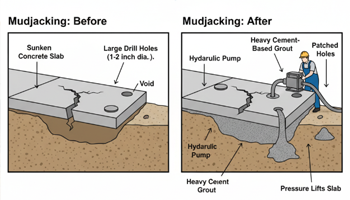
Mudjacking—also called slabjacking—has been the concrete leveling standard for over 50 years. The method pumps a cement-based slurry beneath sunken slabs to fill voids and hydraulically lift concrete back to grade.
Mudjacking Process: Slurry Composition & Injection
The mudjacking slurry typically contains:
- Portland cement (binding agent)
- Sand or crushed limestone (bulk filler)
- Water (mixing agent)
- Sometimes fly ash or bentonite clay (for flow characteristics)
Ratios vary by contractor, but typical mixtures produce material weighing 100 pounds per cubic foot—roughly two-thirds the weight of solid concrete. The slurry consistency resembles thick pancake batter.
The process: contractors drill 1.5–2 inch diameter holes through the concrete at strategic points, insert injection hoses, and pump slurry into voids beneath the slab. As voids fill, hydraulic pressure lifts the concrete. Operators monitor lift in real-time, stopping when the slab reaches proper grade.
Equipment Requirements: Pumps & Hoses
Mudjacking requires substantial equipment:
- Mixing tanks (200–500 gallon capacity)
- High-volume pumps (50–100 PSI capacity)
- Heavy-duty hoses (2–3 inch diameter)
- Drilling equipment for injection holes
The equipment typically mounts on trailers or trucks. Setup requires yard access for truck positioning, limiting use in tight spaces.
Hole Size & Spacing (1.5–2 inches)
The 1.5–2 inch injection holes are mudjacking’s most visible aesthetic impact. Contractors typically drill holes every 4–6 feet, depending on void size and distribution. After injection, holes are patched with concrete or polymer-modified patching compound.
Quality contractors texture-match patches to surrounding concrete. Budget contractors use standard gray concrete that remains visible. This aesthetic difference alone can justify polyurethane’s smaller holes for high-visibility areas.
Curing Time & Weight Limitations (100 lbs/cubic ft)
Mudjacking slurry requires 24–72 hours to cure sufficiently for normal use. Light foot traffic may be possible after 8–12 hours, but vehicle traffic should wait the full cure period.
The 100 pounds per cubic foot weight matters significantly. If your slab settled because of weak, poorly compacted soil, adding substantial weight can accelerate future settlement. This creates a cycle: mudjacking temporarily fixes the problem but makes the underlying condition worse.
Expected Lifespan: 2–5 Years Typical
Industry marketing claims 5–10 year mudjacking lifespans. Real-world data from warranty callbacks and re-work rates tells a different story: 2–5 years is more realistic, depending heavily on:
- Soil stability (stable soil trends toward 5 years, unstable toward 2)
- Drainage conditions (good drainage extends life, poor drainage shortens it)
- Original settlement cause (if root cause persists, lifespan decreases)
Re-work rates for mudjacking average 35–45%, meaning more than one-third of mudjacking jobs require additional work within five years.
Polyurethane Foam Leveling (Polyjacking) Explained
Polyurethane foam leveling—marketed as «polyjacking,» «foam jacking,» or «PolyLevel»—represents the modern evolution of concrete leveling. This method injects expanding polyurethane foam beneath slabs, filling voids and lifting concrete with remarkable precision.
Polyurethane Foam Chemistry: Two-Part Reaction
Polyurethane concrete leveling uses a two-component system:
- Isocyanate (Component A)
- Polyol resin (Component B)
When mixed, these components undergo an exothermic chemical reaction, generating heat and producing rapid expansion. The reaction reaches completion in 5–15 minutes, creating rigid, closed-cell foam.
The foam’s closed-cell structure makes it virtually waterproof and prevents moisture absorption that could compromise stability. This characteristic proves critical in wet-soil conditions where mudjacking slurry can wash out.
Expansion Process: 2–40x Volume Growth
Polyurethane foam expands 2–40 times its liquid volume, depending on the specific formulation. Concrete leveling applications typically use medium-density foams with 15–25x expansion ratios, balancing lift power with controllability.
The expansion occurs rapidly but predictably, allowing experienced operators to inject precisely measured amounts for controlled lifting. Over-injection—pumping too much foam—causes excessive lift and potential slab cracking, though this occurs in only 2–3% of jobs with proper operator training.
Installation: Small Injection Holes (5/8 inch)
Polyurethane injection requires only 5/8-inch diameter holes—about the size of a dime. These small holes are far less visible than mudjacking’s 1.5–2 inch holes, especially after patching.
Typical hole spacing: 3–4 feet, depending on void distribution. The smaller hole size preserves concrete aesthetics on driveways, patios, and other visible surfaces where appearance matters.
Ultra-Lightweight: 2–4 lbs per Cubic Foot
Polyurethane foam weighs just 2–4 pounds per cubic foot—roughly 25 times lighter than mudjacking material. This dramatic weight difference matters enormously for weak or unstable soils.
Where mudjacking adds 100 pounds per cubic foot of additional weight stressing already-compromised soil, polyurethane adds negligible load. For settlement caused by poor soil compaction or weak subgrade, polyurethane becomes the only viable long-term solution.
Rapid Cure: 15 Minutes to Full Use
Polyurethane foam cures to full strength in 15 minutes. This rapid cure time means:
- Driveways can handle vehicle traffic within 15 minutes
- Commercial properties minimize downtime
- Project completion occurs in hours, not days
For time-sensitive commercial applications, the rapid cure has quantifiable value. A retail location losing $5,000 per day in revenue saves $15,000–$20,000 by choosing polyurethane’s same-day completion over mudjacking’s multi-day cure requirement.
Expected Lifespan: 10–20+ Years
Polyurethane foam leveling lasts 10–25 years in real-world applications—significantly longer than mudjacking’s 2–5 year typical lifespan. Re-work rates average just 5–10%, meaning 90–95% of polyurethane jobs remain stable long-term.
The extended lifespan stems from:
- Minimal weight on soil (no additional load stress)
- Waterproof characteristics (no washout in wet conditions)
- Chemical stability (closed-cell foam doesn’t degrade underground)
- Superior compressive strength (resists re-compression under load)
Stone Slurry Grout Leveling (The Middle Ground)
Stone slurry grout represents a hybrid approach between traditional mudjacking and polyurethane foam. This method uses crushed limestone as the primary aggregate with reduced water content compared to standard mudjacking.
Crushed Limestone-Based Mixture
The stone slurry mixture contains:
- Crushed limestone aggregate (provides bulk)
- Portland cement (binding agent)
- Minimal water content (creates denser mixture)
This formulation produces material with higher compressive strength than traditional mudjacking while maintaining lower cost than polyurethane foam.
Compressive Strength Advantages
Stone slurry grout achieves compressive strengths between traditional mudjacking and polyurethane foam. The denser mixture resists re-compression better than standard mudjacking slurry, extending functional lifespan to 5–10 years versus 2–5 years for standard mudjacking.
Application & Best Use Cases
Stone slurry grout works best for:
- Medium-term solutions where 5–10 year lifespan suffices
- Budget-conscious projects where standard mudjacking seems inadequate
- Stable soil conditions that don’t require polyurethane’s ultra-light weight
Pricing falls between mudjacking and polyurethane: $7–$10 per square foot versus $3–$8 for mudjacking and $5–$15 for polyurethane.
Head-to-Head Comparison Matrix
| Factor | Mudjacking | Stone Slurry Grout | Polyurethane Foam |
|---|---|---|---|
| Cost per sq ft | $3–$8 | $7–$10 | $5–$15 |
| Material weight | 100 lbs/cubic ft | 80–90 lbs/cubic ft | 2–4 lbs/cubic ft |
| Cure time | 24–72 hours | 24–48 hours | 15 minutes |
| Injection hole size | 1.5–2 inches | 1.5–2 inches | 5/8 inch |
| Expected lifespan | 2–5 years | 5–10 years | 10–25 years |
| Re-work rate | 35–45% | 20–30% | 5–10% |
| Best for weak soil | No | Marginal | Yes |
| Wet conditions | Poor | Fair | Excellent |
| DIY feasibility | Possible | Difficult | No |
Cost Comparison: Mudjacking vs Polyurethane
Per square foot pricing (2025):
- Mudjacking: $3–$8 per square foot
- Stone slurry grout: $7–$10 per square foot
- Polyurethane foam: $5–$15 per square foot
The cost spread within polyurethane reflects quality differences. Commercial-grade polyurethane systems (HMI, Alchemy Polymers, NCFI) with 60–100 PSI compressive strength command $12–$15 per square foot. Budget contractors using spray-insulation-grade foam (20–30 PSI strength) charge $5–$8 per square foot—one-third the strength at similar prices. Always ask for foam specifications and compressive strength ratings.
Installation Speed & Cure Time
Mudjacking: 2–4 hours installation, 24–72 hours cure before normal use. Total project timeline: 3 days typical.
Polyurethane: 1–3 hours installation, 15 minutes cure to full use. Total project timeline: same day.
For residential projects, the time difference matters primarily for convenience. For commercial applications, the rapid cure has direct financial value—minimizing business interruption and lost revenue.
Weight Impact on Unstable Soil
This factor often determines method viability rather than just preference:
Stable, well-compacted soil: Weight difference matters less. Both methods work adequately.
Weak, poorly compacted soil: Mudjacking’s 100 pounds per cubic foot materially worsens the underlying problem. Settlement often recurs within 8–18 months. Polyurethane’s 2–4 pounds per cubic foot adds negligible stress, making it the only viable long-term solution.
If your original settlement resulted from poor soil compaction or erosion, polyurethane becomes mandatory, not optional.
Durability & Re-Settlement Rates
Real-world data from warranty callbacks:
Mudjacking:
- 35–45% require re-work within five years
- Average functional lifespan: 2–5 years
- Re-settlement typically occurs gradually over seasons
Polyurethane:
- 5–10% require re-work within five years
- Average functional lifespan: 10–25 years
- Re-settlement rare when properly installed
The durability gap stems from polyurethane’s waterproof properties (no washout), minimal weight (no additional soil stress), and superior compressive strength (resists re-compression).
Hole Size & Aesthetic Impact
Mudjacking holes: 1.5–2 inches diameter, highly visible even after patching. Quality contractors use polymer-modified patching compound with texture matching, adding $2–$3 per square foot but dramatically improving appearance.
Polyurethane holes: 5/8 inch diameter (dime-sized), far less visible. Standard patching produces acceptable results on most surfaces.
For driveways, patios, and walkways where aesthetics matter, polyurethane’s small holes justify the cost premium for many homeowners.
Environmental Conditions: Wet vs Dry Applications
Mudjacking in wet conditions: Performs poorly. Active groundwater movement literally washes slurry away over time. Total failures can occur within 6 months in high-water areas with poor drainage.
Polyurethane in wet conditions: Actually benefits from moisture. The isocyanate component reacts with water, and the closed-cell structure prevents moisture absorption. Polyurethane works excellently in wet soils, high water tables, and areas with drainage challenges.
If your settling occurred in areas with visible moisture problems, drainage issues, or near downspouts, choose polyurethane.
Cost Analysis 2025
Mudjacking: $3–$8 per Square Foot
Typical project costs:
- Small patio (100 sq ft): $300–$800
- Driveway section (200 sq ft): $600–$1,600
- Large driveway (400 sq ft): $1,200–$3,200
- Garage floor (500 sq ft): $1,500–$4,000
Geographic variations:
- Midwest/Southeast: $3–$5 per square foot
- Texas/Southwest: $4–$6 per square foot
- Coastal markets: $6–$8 per square foot
Polyurethane Foam: $5–$15 per Square Foot
Typical project costs (using mid-range $10/sq ft average):
- Small patio (100 sq ft): $500–$1,500
- Driveway section (200 sq ft): $1,000–$3,000
- Large driveway (400 sq ft): $2,000–$6,000
- Garage floor (500 sq ft): $2,500–$7,500
Quality matters: Budget contractors at $5–$8 per square foot often use inferior foam grades. Premium contractors at $12–$15 per square foot use commercial-grade systems with 60–100 PSI compressive strength and transferable warranties.
Ask specific questions:
- What foam manufacturer? (HMI, Alchemy Polymers, NCFI are premium brands)
- What compressive strength rating?
- What warranty coverage?
Total Project Costs by Application (Driveway, Patio, Garage)
Driveway apron (100 sq ft):
- Mudjacking: $300–$800
- Polyurethane: $500–$1,500
- Replacement: $600–$1,200
Full driveway (400 sq ft):
- Mudjacking: $1,200–$3,200
- Polyurethane: $2,000–$6,000
- Replacement: $2,400–$4,800
Patio slab (250 sq ft):
- Mudjacking: $750–$2,000
- Polyurethane: $1,250–$3,750
- Replacement: $1,500–$3,000
Garage floor (500 sq ft):
- Mudjacking: $1,500–$4,000
- Polyurethane: $2,500–$7,500
- Replacement: $3,000–$6,000
ROI Analysis: Cost vs. Longevity
Here’s where total cost of ownership changes the calculation:
Example: 200 sq ft driveway section, 10-year ownership
Mudjacking approach:
- Initial repair: $800–$1,200
- Re-work in year 4: $800–$1,200
- Possible second re-work in year 8: $800–$1,200
- Total 10-year cost: $2,400–$3,600
- Hassle factor: 2–3 separate projects
Polyurethane approach:
- Initial repair: $2,000–$2,800
- Re-work needed: Unlikely ($0)
- Total 10-year cost: $2,000–$2,800
- Hassle factor: One project, done
Winner on ROI: Polyurethane saves $400–$800 over a decade while eliminating the hassle of repeated repairs. For projects where longevity matters, polyurethane delivers superior value despite higher upfront cost.
Best Applications for Each Method
Choosing the right method depends on your specific situation, not just which method sounds better in theory.
When to Choose Mudjacking (Budget Projects, Temporary Fixes)
Mudjacking makes financial sense when:
Large, low-stakes projects: 500+ square feet of decorative patio where 3–5 year lifespan is acceptable. If you’re planning a backyard renovation in five years anyway, paying premium for 20-year durability offers no additional value.
Ultra-tight budgets: With a $1,200 total budget for 150 square feet, mudjacking at $5–$6 per square foot ($750–$900) leaves room for other priorities. Polyurethane at $10–$12 per square foot ($1,500–$1,800) exceeds budget.
Stable soil with resolved drainage: If settlement resulted from a one-time event (broken water line that’s been repaired, tree removal that resolved root issues), and soil is now stable, mudjacking’s shorter lifespan becomes less concerning.
Aesthetic indifference: For backyard workshops, dog runs, or utility areas where appearance doesn’t matter, spending premium for small injection holes makes no sense.
When to Choose Polyurethane (Long-Term, High-Traffic, Wet Conditions)
Polyurethane becomes non-negotiable in these scenarios:
Weak or unstable soil: If original settlement came from poor compaction, erosive soil, or ongoing soil movement, adding mudjacking’s 100 pounds per cubic foot worsens the problem. Polyurethane’s 2–4 pounds per cubic foot is the only viable long-term solution.
High-traffic or weight-bearing surfaces: Driveways used by trucks, commercial loading areas, garage floors with heavy equipment. Polyurethane’s superior compressive strength and lightweight properties prevent re-compression under repeated heavy loads.
Time-sensitive projects: Commercial properties that cannot close for 24–72 hours benefit from polyurethane’s 15-minute cure. The literal dollar value of avoided lost revenue ($5,000–$20,000) dwarfs the material cost premium.
Wet conditions and drainage problems: Polyurethane reacts with moisture (it’s a feature, not a bug). Areas with high water tables, poor drainage, or visible moisture problems will see mudjacking wash out predictably. Polyurethane’s waterproof, closed-cell structure performs excellently in wet conditions.
High-visibility areas: Front driveways, main walkways, pool decks, and other prominent surfaces justify polyurethane’s aesthetic advantage from smaller injection holes.
Long-term property ownership: If you plan to stay in your home 10+ years, polyurethane’s extended lifespan and minimal re-work rate deliver superior total cost of ownership.
Hybrid Approaches: Bulk Fill + Precision Lift
An insider strategy for maximizing value on large void projects:
Use mudjacking to fill 80% of massive voids (bulk fill at lower cost), then use polyurethane foam for the final precision lift and void sealing. This hybrid approach can save 30–40% compared to all-polyurethane while delivering better long-term performance than all-mudjacking.
Best application: Large garage floors or extensive driveway sections with significant voids (4+ inches deep) where bulk material consumption would make all-polyurethane prohibitively expensive.
Process: Mudjacking fills deep voids first, polyurethane completes final leveling and seals against future water intrusion.
Commercial vs. Residential Considerations
Commercial applications almost always favor polyurethane:
- Rapid cure minimizes business interruption
- Higher traffic demands superior durability
- Re-work disruptions create disproportionate costs
- Professional appearance matters for customer-facing businesses
Residential applications allow more flexibility:
- Longer acceptable cure times reduce polyurethane’s advantage
- Budget constraints carry more weight
- Aesthetic preferences vary by location (front vs. back)
- Future home sale plans influence longevity requirements
DIY Feasibility & Professional Requirements
Can You DIY Mudjacking? (Equipment Rental Options)
Mudjacking equipment rental exists, making DIY technically possible for determined homeowners:
Equipment needs:
- Pump/mixer unit: $200–$400 per day rental
- Heavy-duty drill for injection holes
- Hoses and fittings
- Materials (cement, sand, water): $100–$300
DIY challenges:
- Equipment weighs 300–500 pounds (requires truck/trailer)
- Mixing proper slurry consistency requires experience
- Pump operation demands pressure management skills
- Over-lifting risks cracking slabs
- Hole patching quality affects appearance
Realistic DIY assessment: Feasible for small projects (under 100 square feet) with stable soil conditions and forgiving aesthetics (garage floors, utility areas). Not recommended for driveways, patios, or any high-visibility application.
Potential savings: $500–$1,500 on materials and labor, but factor in equipment rental, time investment (full weekend typical), and risk of mistakes.
Why Polyurethane Requires Professional Equipment
Polyurethane foam leveling demands specialized equipment not available for rental:
Professional equipment costs:
- Two-component proportioning unit: $15,000–$30,000
- Heated hoses (foam requires precise temperature): $2,000–$5,000
- Specialized injection guns: $1,500–$3,000
- Safety equipment and protective gear
The equipment investment puts DIY polyurethane out of reach for homeowners. Even if equipment were available, the chemical reaction timing, expansion control, and injection techniques require professional training.
Safety Considerations & Chemical Hazards
Mudjacking safety concerns: Relatively minimal. Standard concrete mixing safety applies—dust masks, gloves, eye protection. The hydraulic pump requires pressure awareness to prevent injuries.
Polyurethane safety concerns: Significant. The two-component system involves chemicals requiring careful handling:
- Isocyanates can cause respiratory sensitization
- Exothermic reaction generates heat (burn risk)
- Improper mixing ratios create unpredictable expansion
- Requires protective equipment (respirator, chemical-resistant gloves, eye protection)
Professional contractors carry required safety certifications, insurance, and training that homeowners lack.
Quality Control & Warranty Implications
Professional installation advantages:
- Warranty coverage (10–25 years typical for quality contractors)
- Insurance protection against property damage
- Quality control throughout injection process
- Documented materials and methods
- Recourse if problems develop
DIY implications:
- Zero warranty coverage
- Homeowner assumes all liability for mistakes
- Future buyers may question DIY quality
- Re-sale appraisals may penalize DIY repairs
For projects where long-term performance matters or future home sale is anticipated, professional installation with warranty coverage provides substantial value beyond labor savings.
Common Problems & Solutions
Understanding failure modes helps you evaluate contractor quality and recognize problems early.
Mudjacking Failures: Washout & Erosion
Washout failure: Active groundwater movement literally washes mudjacking slurry away over time, creating new voids. This failure pattern appears 6–18 months post-installation in areas with poor drainage or high water tables.
Signs of washout:
- Gradual re-settling in same location
- Water seepage at slab edges
- Soft or spongy feeling when walking on slab
- Visible water during rainy periods
Prevention: Before mudjacking in wet conditions, address drainage issues first. Install French drains, extend downspouts, improve yard grading. If drainage problems persist, choose polyurethane instead.
Solution when it happens: Re-injection works temporarily but doesn’t solve the root cause. Either fix drainage or switch to polyurethane for permanent resolution.
Polyurethane Over-Lifting Issues
Over-lifting: Occurs when operators inject too much foam, causing slabs to lift excessively. This creates edge cracking, broken control joints, and potential structural damage.
Incidence rate: 2–3% of jobs with proper operator training, higher with inexperienced contractors.
Prevention: Vet contractors thoroughly:
- Ask about years of experience specifically with polyurethane (not just general concrete work)
- Request references from recent projects
- Look for manufacturer certifications (HMI, Alchemy Polymers, NCFI provide training programs)
- Verify insurance coverage for property damage
Signs of over-lifting:
- Slab raised above surrounding grade
- New cracks radiating from injection points
- Broken control joints
- Doors or windows no longer function properly
Solution: Reputable contractors repair over-lift damage at their expense. This underscores the importance of contractor selection and adequate insurance verification.
Voids Not Properly Filled
Both methods can fail when operators don’t properly fill all voids, leaving gaps that allow future settlement.
Mudjacking void-fill issues: Thick slurry may not flow into all void spaces, especially narrow gaps or areas with obstructions. Incomplete filling leaves unsupported slab sections.
Polyurethane void-fill issues: Operators must inject enough foam to reach void perimeters. Inadequate foam volume leaves gaps at void edges.
Detection methods:
- Post-installation testing by tapping slab (hollow sound indicates voids)
- Thermal imaging (temperature differentials reveal void patterns)
- Probe testing through injection holes before final patching
Quality contractors: Use ground-penetrating radar or systematic probing to map voids before and after injection, ensuring complete fill.
How to Evaluate Quality After Installation
Immediate checks (within 24 hours):
- Slab should be level with adjacent sections (within 1/4 inch tolerance)
- No visible cracks radiating from injection points
- Injection holes properly patched and texture-matched
- No evidence of material seepage at slab edges
Short-term monitoring (1–3 months):
- No re-settling or movement
- Drainage patterns remain appropriate (water flows away from structures)
- No new cracks developing
- Slab feels solid underfoot (no hollow sound when tapped)
Long-term success indicators:
- Stability through multiple seasonal cycles
- No recurring settlement patterns
- Maintained level grade
- Drainage continues functioning properly
Document the installation with photos and keep all warranty paperwork. Quality contractors provide detailed documentation of materials used, void locations, injection volumes, and warranty terms.
Manufacturer & Product Guide
Polyurethane Systems: HMI, Alchemy Polymers, NCFI
Leading commercial-grade systems:
HMI (Hydro Mobile Inc.): Industry leader in polyurethane foam systems. HMI foams feature 60–100 PSI compressive strength, closed-cell structure, and excellent waterproofing properties. Premium pricing but exceptional performance and contractor support.
Alchemy Polymers: Specialty manufacturer focusing exclusively on concrete lifting applications. Alchemy’s formulations optimize expansion control and cure characteristics specifically for slab leveling. Strong reputation among professional contractors.
NCFI (North Carolina Foam Industries): Diverse foam manufacturer with robust concrete lifting product line. NCFI systems balance performance and cost-effectiveness, popular among mid-market contractors.
Warning about inferior products: Some contractors use spray-insulation-grade polyurethane foams that cost less but deliver 20–30 PSI compressive strength—one-third that of commercial-grade systems. These inferior foams fail prematurely under load.
Always ask contractors:
- What foam manufacturer do you use?
- What compressive strength rating?
- Can you provide product specification sheets?
Legitimate contractors readily provide this information. Evasive answers suggest inferior products.
Equipment Providers: Professional vs. Contractor-Grade
Professional-grade equipment: Used by established concrete leveling specialists. Features precise two-component proportioning, heated hoses for temperature control, and advanced injection guns for controlled foam delivery. Equipment investment: $20,000–$50,000+.
Contractor-grade equipment: Lower-cost systems ($10,000–$20,000) with less precise controls. Adequate for experienced operators but less forgiving of technique errors.
Equipment quality correlates with installation quality. Contractors using professional-grade systems typically deliver more consistent results with fewer callbacks.
Quality Certifications & Industry Standards
Industry organizations:
- Concrete Raising Association: Trade organization providing best practices and certification programs
- Concrete Foundations Association: Broader organization covering foundation and concrete repair standards
Manufacturer certifications: HMI, Alchemy Polymers, and NCFI offer training and certification programs for contractors using their systems. Certified contractors demonstrate product knowledge and installation technique proficiency.
What to request from contractors:
- Manufacturer training certificates
- Industry association memberships
- Liability insurance (minimum $1 million coverage)
- Warranty documentation (written, not verbal)
- References from recent projects (within 6 months)
Quality contractors willingly provide credentials. Those who resist or make excuses raise red flags.
FAQs
Is polyurethane foam leveling better than mudjacking?
Polyurethane is objectively superior in 80% of applications—it lasts longer (10–25 years vs. 2–5 years), weighs far less (2–4 lbs vs. 100 lbs per cubic foot), cures faster (15 minutes vs. 24–72 hours), and works better in wet conditions. However, mudjacking costs less upfront and remains viable for budget-constrained projects with stable soil where 3–5 year lifespan is acceptable.
How much does mudjacking cost per square foot in 2025?
Mudjacking costs $3–$8 per square foot in 2025, varying by region and project size. Midwest and Southeast markets trend toward $3–$5 per square foot, while coastal markets reach $6–$8 per square foot. A typical 200 square foot driveway section costs $600–$1,600 for mudjacking.
How much does polyurethane concrete lifting cost?
Polyurethane foam leveling costs $5–$15 per square foot, with quality determining price. Budget contractors using inferior foam charge $5–$8 per square foot, while premium contractors with commercial-grade systems (60–100 PSI compressive strength) charge $12–$15 per square foot. Always verify foam specifications and compressive strength ratings.
Can I DIY mudjacking my driveway?
DIY mudjacking is technically possible with rented equipment ($200–$400 per day) but challenging. Equipment weighs 300–500 pounds, mixing proper slurry consistency requires experience, and over-lifting risks cracking slabs. DIY makes sense only for small projects (under 100 square feet) in low-visibility areas like garage floors or utility spaces. Professional installation includes warranty coverage and proper quality control.
How long does foam jacking last?
Polyurethane foam leveling lasts 10–25 years in real-world conditions with a re-work rate of only 5–10%. Longevity depends on soil stability, installation quality, and foam grade. Commercial-grade polyurethane systems from manufacturers like HMI, Alchemy Polymers, and NCFI deliver the longest lifespans. Budget foam formulations may fail sooner.
What causes mudjacking to fail?
Mudjacking fails primarily from three causes: washout (groundwater erodes the cement slurry), additional soil settlement from the material’s heavy weight (100 lbs per cubic foot), and incomplete void filling. Mudjacking in areas with poor drainage or weak soil sees failure rates of 35–45% within five years. Proper drainage and stable soil conditions extend mudjacking lifespan.
Is polyurethane foam safe under concrete?
Yes, polyurethane foam is safe for concrete leveling applications. The closed-cell structure prevents moisture absorption and chemical degradation. UV degradation concerns are irrelevant since foam remains beneath concrete, protected from sunlight. Quality commercial-grade foams are chemically inert once cured and pose no environmental or structural concerns.
Should I choose mudjacking or polyurethane for my garage floor?
For garage floors, choose based on soil conditions and expected use. If soil is weak or poorly compacted, polyurethane’s ultra-light weight (2–4 lbs per cubic foot) prevents re-settlement that mudjacking’s heavy weight (100 lbs per cubic foot) would cause. For high-traffic garages with heavy equipment or vehicle storage, polyurethane’s superior compressive strength justifies the premium. If soil is stable and budget is constrained, mudjacking works adequately.
Need more specifics? Tell me your concrete type, settlement extent, soil conditions, and budget range for tailored guidance on which leveling method matches your situation.
References
Currently viewing
Slabjacking vs Mudjacking
Foundation Inspection Checklist
Foundation Inspection Checklist: What to Look for Before Buying a Home Buying a home is…
Concrete Foundation vs Pier & Beam
Concrete Foundation vs Pier & Beam: Repair Cost Differences When foundation problems arise, one of…

Foundation Settlement Warning Signs
Foundation Settlement Warning Signs: When to Call a Structural Engineer You’ve noticed a crack in…

Bowing Basement Wall Repair
Bowing Basement Wall Repair: Carbon Fiber vs Steel I-Beams If you’ve noticed your basement walls…

Foundation Repair Cost
Foundation Repair Cost By Problem Type & Home Size Foundation damage is one of the…
Push Piers vs Helical Piers
Push Piers vs Helical Piers: Foundation Underpinning When your home’s foundation starts settling, the choice…

Foundation Crack Repair
Foundation Crack Repair: Epoxy vs Polyurethane Injection Complete Guide Foundation problems strike fear into homeowners…
Foundation Repair
Foundation Repair Guide: Systems, Costs & Decision Framework Foundation problems strike fear into homeowners for…