
Basement Moisture Testing:
Before Starting Renovation Projects
Moisture testing represents the single most overlooked yet critical step in basement renovation projects—a $150 to $300 investment that can prevent $20,000 to $50,000 in catastrophic failures. Despite its fundamental importance, countless homeowners and contractors skip comprehensive moisture testing, proceeding with basement finishing based on visual inspection alone, only to discover months or years later that invisible moisture has destroyed flooring, created mold growth, or voided material warranties.
The devastating reality: I’ve witnessed $40,000 to $60,000 basement renovations completely destroyed by moisture issues that would have been detected with $200 in professional testing before work began. The pattern repeats with depressing regularity—beautiful new flooring buckles and warps, freshly installed drywall develops mold behind surfaces, expensive engineered wood delaminates, and manufacturers deny warranty claims because required moisture testing wasn’t performed or documented.
Understanding basement moisture requires recognizing that virtually all basements have some level of moisture present. The critical question isn’t «is there moisture?» but rather «are moisture levels within acceptable limits for the materials I plan to install?» Different flooring types, wall finishes, and building materials tolerate vastly different moisture levels, with hardwood flooring requiring drier conditions than luxury vinyl plank, and some materials proving completely unsuitable for typical basement moisture conditions regardless of testing.
This comprehensive guide examines basement moisture sources and mechanisms, explains testing methods from simple tape tests to sophisticated humidity probing, provides specific acceptance criteria for different renovation materials, and establishes timing protocols ensuring tests capture worst-case moisture scenarios rather than temporarily favorable conditions. Whether planning DIY basement finishing or hiring contractors, understanding moisture testing proves essential for protecting substantial renovation investments and ensuring long-term performance.
Why Moisture Testing Is Non-Negotiable
Basement moisture testing transitions from recommended best practice to absolute requirement when considering the financial stakes and failure consequences involved in modern basement renovations.
Cost of Moisture-Related Failures
Moisture-induced failures generate expenses far exceeding original renovation costs. Complete flooring removal and replacement typically costs $8 to $15 per square foot for materials and labor—meaning a 1,000 square foot basement requires $8,000 to $15,000 for remediation. Mold remediation adds $2,000 to $10,000 depending on extent and affected materials. Subfloor repair or replacement contributes another $3 to $7 per square foot. Wall finishing removal and replacement adds $4 to $8 per square foot for affected areas.
Beyond direct repair costs, moisture failures create additional expenses including temporary housing during remediation if mold poses health hazards, furniture and belongings storage or replacement if damaged, lost value from renovation investment that must be completely redone, and legal fees if disputes arise with contractors or material suppliers over responsibility.
The cumulative costs routinely exceed $30,000 to $60,000 for comprehensive moisture-related failures in typical residential basements—ten to twenty times the cost of proper testing before beginning work. No renovation decision offers clearer cost-benefit analysis than moisture testing.
Timing in Renovation Process
Moisture testing must occur before purchasing materials and beginning installation—not after discovering problems once expensive materials have been installed. The testing should precede flooring purchases since test results may indicate certain flooring types prove unsuitable. Testing before framing and insulation installation ensures moisture levels won’t compromise these systems. Results should be obtained before contractors begin work, preventing disputes about responsibility for discovered moisture issues.
Critical timing consideration: test when the basement experiences worst-case moisture scenarios—typically spring after snowmelt or early summer during high humidity periods. Passing tests during these challenging conditions provides confidence that moisture levels remain acceptable year-round. Testing during dry winter months when basement dehumidifiers have been running continuously may produce artificially favorable results that don’t represent normal conditions.
Understanding Basement Moisture Sources
Basement moisture originates from multiple sources, each creating distinct characteristics and requiring different assessment approaches.
Condensation vs Infiltration vs Seepage
Condensation forms when warm, humid air contacts cold basement surfaces, creating water droplets on walls, floors, and pipes. This moisture source is atmospheric rather than groundwater-based, typically worse during summer when humid outdoor air enters cool basements. Condensation manifests as water droplets, damp surfaces during humid weather, and musty odors without visible water entry.
Infiltration occurs when water penetrates through cracks, gaps, or porous concrete, entering basements from surrounding soil. Active leaks are visible during or after rain, showing as damp spots, trickles, or standing water at specific locations. Infiltration typically worsens during wet seasons or after heavy precipitation.
Seepage represents slower water migration through concrete pores and microscopic cracks, creating persistent dampness without obvious leak sources. Concrete naturally absorbs moisture from surrounding soil through capillary action, transmitting it inward where it evaporates into basement air or accumulates in materials. Seepage creates persistently damp areas, efflorescence (white mineral deposits), and elevated moisture meter readings without visible water entry.
Understanding which moisture source affects your basement helps determine whether testing alone suffices or whether moisture remediation must precede any finishing work.
Seasonal Moisture Variations
Basement moisture levels fluctuate seasonally, with spring typically bringing maximum moisture from snowmelt saturating soil, raising water tables, and overwhelming drainage systems. Summer contributes high humidity creating condensation on cool surfaces even when liquid water infiltration remains minimal. Fall usually brings moderate conditions as precipitation decreases and humidity drops. Winter often shows lowest moisture levels as frozen ground limits infiltration and dry air reduces condensation.
These seasonal patterns mean testing during favorable winter conditions may miss moisture problems that appear during challenging spring or summer periods. Proper testing timing accounts for seasonal variations, testing during periods of typical or elevated moisture rather than exceptional dryness.
Signs of Active Moisture Problems
Visual indicators suggest moisture problems warranting careful testing and potentially remediation before finishing. Look for efflorescence (white crystalline deposits on concrete indicating water evaporation), rust stains or discoloration on concrete suggesting water presence, musty or earthy odors indicating mold growth or persistent dampness, visible mold or mildew on existing materials, and previous water staining or tide marks showing past moisture events.
Additional warning signs include condensation on pipes, walls, or windows during humid weather; damp or cool-feeling concrete despite warm ambient conditions; deterioration of existing materials like cardboard boxes, wood, or fabric stored in the basement; and peeling paint or delaminating finishes on existing walls.
Any of these indicators warrant comprehensive moisture testing and potential remediation before proceeding with finishing work, since active moisture problems will destroy new materials regardless of quality or installation expertise.
Simple Tape Test Method
The plastic sheet tape test provides quick, inexpensive screening for obvious moisture problems, though it lacks the quantification necessary for warranty protection or material selection decisions.
Materials Needed
The tape test requires only plastic sheeting (18 to 24 inches square), duct tape or painter’s tape for securing edges, and optional marking pen for labeling. Total cost: approximately $5 for materials sufficient for multiple test locations.
This minimal investment makes the tape test valuable for initial screening before investing in more sophisticated testing methods. However, its limitations mean it cannot replace quantitative testing for serious renovation projects.
Step-by-Step Process
Execute the tape test by cleaning and drying a test area approximately 2 feet square, removing all surface moisture, dust, and debris. Cut plastic sheet slightly larger than the test area. Tape all four edges securely to the concrete, creating airtight seal with no gaps. Mark the test location and installation date for tracking.
Wait 24 to 48 hours without disturbing the plastic. After waiting, carefully remove the plastic and immediately inspect both the plastic sheet and the concrete beneath. The test reveals moisture presence through condensation on the plastic’s underside (moisture evaporating from concrete and condensing on plastic), visible dampness on the concrete surface (moisture accumulating where evaporation is prevented), or completely dry conditions on both plastic and concrete (indicating either no moisture problem or insufficient test duration).
Interpreting Results
Test result interpretation follows straightforward logic. Heavy condensation or standing water beneath plastic indicates serious moisture problems requiring remediation before any finishing work. Light condensation or dampness suggests moderate moisture that may exceed acceptable levels for sensitive materials like hardwood flooring. Completely dry conditions after 48 hours suggest moisture levels may be acceptable, though quantitative testing remains necessary for warranty protection.
The critical limitation: the tape test reveals moisture presence or absence but provides no quantification. A slightly damp concrete floor might fall within acceptable limits for some materials while exceeding limits for others—the tape test cannot distinguish these scenarios.
Limitations of This Method
The tape test serves as screening tool rather than definitive assessment. It cannot quantify moisture levels necessary for comparing to material manufacturer specifications, doesn’t satisfy flooring warranty requirements requiring specific test methods and documentation, and may miss borderline moisture conditions where finishing might succeed or fail depending on exact levels.
Environmental factors affect results—ambient humidity, concrete temperature, and recent weather influence outcomes, potentially creating false positives or negatives. The test also provides only snapshot assessment at a specific time rather than understanding moisture behavior over seasons or varying conditions.
Use the tape test for initial screening costing almost nothing, but never rely on it alone for significant renovation decisions or material selection.
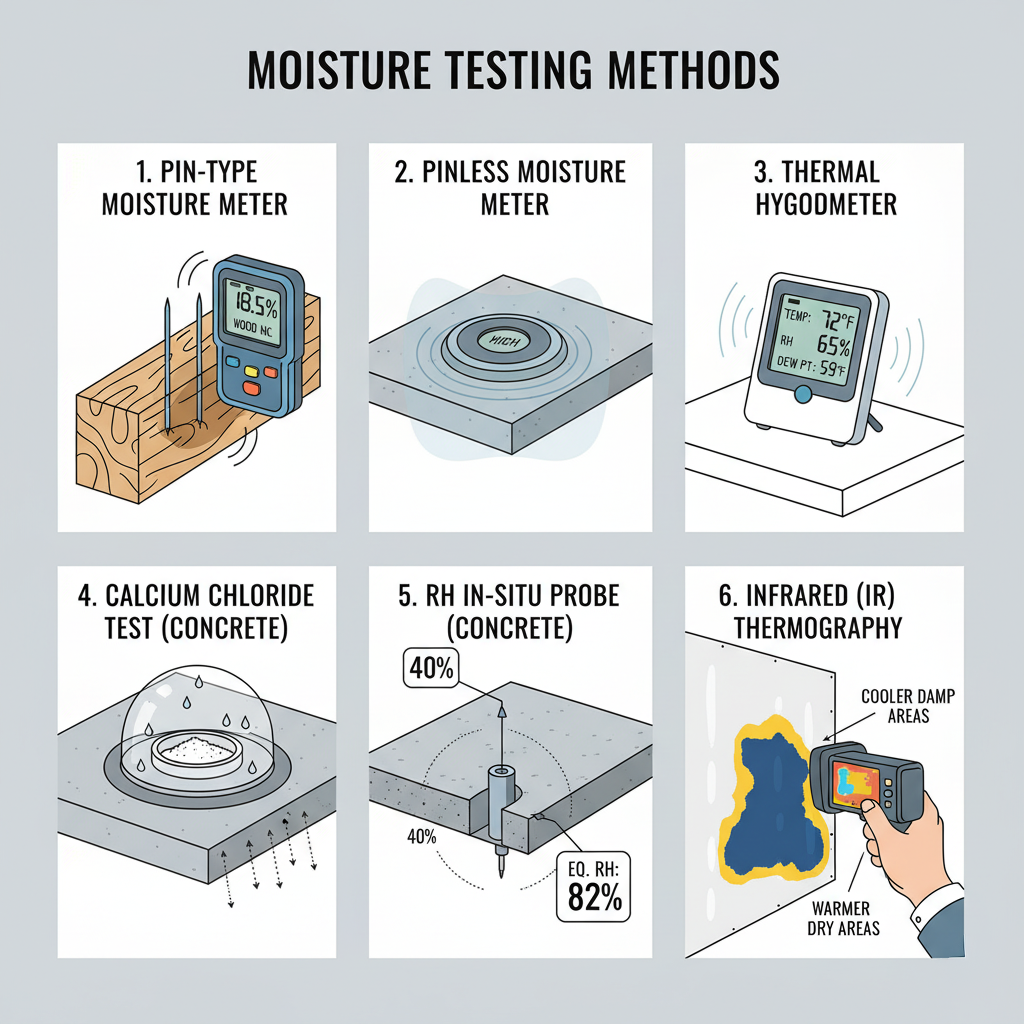
Calcium Chloride Test (ASTM F1869)
The calcium chloride moisture vapor emission test provides quantitative measurement recognized by flooring manufacturers and satisfies most warranty requirements, making it the gold standard for basement moisture assessment.
How the Test Works
The calcium chloride test measures moisture vapor emission rate—the amount of water vapor passing through concrete over specific time periods. Small containers of calcium chloride—a desiccant that absorbs moisture from air—are sealed against the concrete surface. Over 60 to 72 hours, moisture evaporating from concrete is absorbed by the calcium chloride, with the weight gain measured to calculate emission rate.
The measurement units—pounds per 1,000 square feet per 24 hours—indicate how much moisture the concrete emits, allowing comparison to manufacturer specifications for different flooring materials. This quantitative approach provides the documentation manufacturers require for warranty coverage and enables informed material selection based on actual conditions.
Equipment & Test Kit Options
DIY calcium chloride test kits cost $40 to $80 and include pre-weighed calcium chloride containers, plastic domes for sealing containers to concrete, putty or tape for creating airtight seals, and instructions for conducting tests and calculating results. Multiple kits are necessary for testing several locations—typical basements require 3 to 5 test locations depending on size.
Professional testing services charge $200 to $400 for comprehensive basement assessment, providing calibrated equipment, proper test execution, and certified documentation that carries more weight for warranty claims or disputes. The professional investment proves worthwhile for high-value renovations or when documentation requirements demand certified results.
Test Duration & Conditions
Calcium chloride tests require 60 to 72 hours of sealed contact between the test kit and concrete, with environmental conditions maintained relatively stable during testing. Avoid testing during unusual weather extremes or immediately after running dehumidifiers, since results should reflect typical rather than optimized conditions.
Multiple test locations provide better assessment than single tests, since moisture levels vary across basement floors. Place tests in areas showing visible moisture evidence, locations where flooring will be installed, and representative areas throughout the basement even if they appear dry.
Acceptable Moisture Vapor Emission Rates
Material manufacturers specify maximum acceptable emission rates for their products. Common thresholds based on extensive project experience include:
Hardwood flooring: Less than 3 pounds per 1,000 square feet per 24 hours
Laminate and engineered wood: Less than 4 to 4.5 pounds per 1,000 square feet per 24 hours
Carpet: Less than 3 to 5 pounds per 1,000 square feet per 24 hours (varies by carpet type and adhesive)
Luxury Vinyl Plank (LVP): More tolerant than wood, typically acceptable up to 5 to 8 pounds per 1,000 square feet per 24 hours
Tile and stone: Generally moisture-tolerant with no specific limits for properly installed ceramic or porcelain tile
These benchmarks represent typical requirements, though specific products may impose more or less stringent standards. Always verify manufacturer specifications for materials you plan to install.
Relative Humidity Testing (ASTM F2170)
In-situ relative humidity testing provides the most accurate moisture assessment by measuring conditions within the concrete slab rather than surface emissions.
In-Situ Probe Method
The in-situ probe method involves drilling holes into concrete slabs, inserting humidity sensors at specified depths (typically 40% of slab thickness), and measuring relative humidity after equilibration periods. This approach directly measures conditions within the concrete where flooring adhesives and materials will interact, providing more relevant data than surface measurements.
The method requires drilling multiple holes, inserting sleeve bushings for humidity probes, waiting for conditions to equilibrate (typically 24 hours), then measuring relative humidity using calibrated electronic probes. Professional-grade testing equipment costs thousands of dollars, making this primarily a professional service rather than DIY option.
Professional Testing Equipment
In-situ RH testing requires specialized equipment including calibrated relative humidity probes ($500 to $2,000 each), drill bits and hole preparation tools, sleeve bushings for protecting test holes, and data logging equipment for documenting results. The equipment investment plus training requirements explain why this testing typically involves professional services rather than homeowner execution.
Interpretation of RH Levels
Relative humidity readings provide direct indication of moisture conditions, with most flooring manufacturers specifying maximum acceptable levels:
Hardwood flooring: Less than 75% RH typically required
Laminate and engineered wood: Less than 80% RH for most products
LVP and resilient flooring: More tolerant, often acceptable to 85% to 90% RH
Carpet: Varies by adhesive type but generally requires less than 80% RH
Higher RH readings indicate more moisture present in concrete, increasing risk of flooring failures, adhesive breakdown, and mold growth. The quantitative RH data enables precise material selection and informs decisions about whether moisture mitigation is necessary before installing flooring.
When This Test Is Required
In-situ RH testing becomes required or advisable for high-value installations where investment justifies premium testing costs, new concrete slabs less than one year old where moisture levels remain uncertain, warranty requirements for some premium flooring products, and disputed or borderline cases where calcium chloride testing produced inconclusive results.
For most residential basement renovations, calcium chloride testing provides adequate assessment at reasonable cost. RH testing offers additional precision when stakes or requirements justify the added expense.
Concrete Moisture Meter Testing
Handheld moisture meters provide quick assessment capabilities useful for screening and spot-checking, though they cannot replace standardized testing for warranty purposes.
Pin-Type vs Pinless Meters
Pin-type moisture meters use electrodes penetrating material surfaces, measuring electrical resistance between pins to infer moisture content. These meters work well for wood and some building materials but prove less effective for concrete where depth of measurement remains uncertain and readings can be affected by concrete composition.
Pinless meters use electromagnetic signals penetrating materials without surface damage, measuring moisture content in the signal path. For concrete applications, pinless meters offer advantages including no surface damage from pin holes, ability to scan large areas quickly, and consistent depth measurement.
Depth Measurement Capabilities
Moisture varies with depth in concrete slabs—surface moisture may differ substantially from conditions deeper in the slab where flooring materials and adhesives will interact. Quality moisture meters specify penetration depth, with most handheld units measuring 1/2 inch to 1 inch below surfaces.
This shallow measurement limitation means meter readings may not capture moisture conditions affecting flooring performance, particularly in thicker slabs where surface drying doesn’t indicate interior moisture levels. Meters provide valuable screening but cannot replace standardized testing methods for final material selection decisions.
Brand Recommendations (Tramex, Delmhorst, Wagner)
Several manufacturers produce quality concrete moisture meters. Tramex offers pinless meters specifically designed for concrete applications, with models ranging from $300 to $800 providing relative moisture readings useful for screening. Delmhorst produces both pin-type and pinless meters serving concrete and wood applications, with concrete-specific models costing $400 to $900.
Wagner Meters specializes in moisture measurement with excellent reputation for accuracy and customer support. Their handheld meters range from $300 to $700, offering good value for contractors and serious DIYers. The company also produces in-situ RH testing equipment for professionals requiring ASTM-compliant testing.
For homeowners conducting one-time basement assessments, meter rental or professional testing services may prove more economical than equipment purchase. Contractors and property managers who test regularly justify meter investments that pay for themselves across multiple projects.
Professional vs DIY Testing
Understanding when DIY testing suffices and when professional assessment becomes necessary helps allocate testing budgets appropriately while ensuring adequate moisture characterization.
When DIY Tests Are Sufficient
DIY moisture testing proves adequate for modest renovations with tolerant materials, initial screening before deciding whether professional assessment is warranted, tight budgets where testing costs must be minimized, and situations where results fall clearly within acceptable ranges without borderline readings.
Homeowners with basic technical competence can execute tape tests and calcium chloride testing successfully, achieving results sufficiently reliable for common renovation scenarios. The key requirement: careful attention to test protocols and honest interpretation of results rather than wishful thinking about borderline moisture levels.
When Professional Assessment Required
Professional moisture testing becomes necessary or advisable for high-value renovations exceeding $20,000 where testing costs represent small percentages of total investment, installations of expensive materials like hardwood flooring requiring precise moisture assessment, warranty requirements explicitly demanding professional testing and certification, borderline or inconsistent DIY test results where expert interpretation is needed, and legal or insurance considerations where certified testing provides important documentation.
Professional services provide calibrated equipment, experienced interpretation, and certified documentation that carries weight in warranty claims or disputes. The modest premium over DIY testing—typically $200 to $400 for professional service versus $80 to $150 for DIY materials—proves worthwhile when stakes are high.
Cost Comparison
Cost analysis for basement moisture testing spans wide ranges:
DIY tape test: $5 to $10 for materials testing 3 to 5 locations
DIY calcium chloride testing: $80 to $150 for kits testing 3 to 5 locations
DIY moisture meter purchase: $300 to $800 for quality equipment (amortized over multiple uses)
Professional calcium chloride testing: $200 to $400 for comprehensive basement assessment
Professional RH testing: $400 to $800 for in-situ testing with certified documentation
Professional comprehensive assessment: $500 to $1,000+ including multiple test methods and detailed reporting
The investment represents 0.5% to 2.0% of typical basement finishing costs ($20,000 to $50,000), providing enormous value through preventing failures that could cost the entire renovation budget. Testing proves one of the highest return-on-investment decisions in basement projects.
Testing Before Different Renovation Types
Different renovation approaches require tailored moisture assessment focusing on materials and systems most vulnerable to moisture damage.
Before Installing Flooring
Flooring installation demands the most rigorous moisture testing since floor materials contact concrete directly and manufacturers impose specific moisture limits for warranty coverage. Test requirements include calcium chloride or RH testing at 3 to 5 locations across the floor area, testing in areas showing any visible moisture evidence even if not receiving flooring, and verifying results fall within manufacturer specifications for the specific flooring product.
Document all testing thoroughly with photos, test data, and dates. Many flooring manufacturers require this documentation for warranty coverage, and having records protects against later disputes about whether moisture testing was performed and what results showed.
Before Framing & Drywall
Wall framing and drywall installation requires assessing wall moisture rather than just floor conditions. Test concrete foundation walls at multiple heights—bottom, middle, and top—since moisture levels may vary with depth below grade. Verify walls aren’t actively wet or damp, even if quantitative moisture levels aren’t explicitly required like they are for flooring.
Consider the insulation and vapor control strategy in relation to wall moisture—some approaches work better with damp walls while others require drier conditions. Testing informs these design decisions before materials are purchased.
Before Insulation Installation
Insulation installation on concrete walls demands understanding moisture levels since insulation affects drying and some insulation types tolerate moisture better than others. Closed-cell spray foam handles moderate moisture better than rigid foam boards. Fiberglass batts prove completely unsuitable regardless of moisture levels.
Test concrete moisture before selecting insulation type and installation method. High moisture readings may favor closed-cell spray foam despite higher costs, while dry conditions allow more economical rigid foam approaches.
Moisture Levels: What’s Acceptable?
Understanding material-specific moisture tolerances enables informed decisions about what can be safely installed given actual basement conditions.
Concrete Moisture Content Standards
Moisture content in concrete can be expressed several ways—as percentage moisture by weight, as moisture vapor emission rate, or as relative humidity. Different testing methods use different units, making direct comparison challenging without understanding the relationships.
For concrete slabs, «acceptable» moisture depends entirely on materials being installed rather than representing absolute thresholds. Concrete reading 85% RH might prove acceptable for tile installation but completely unsuitable for hardwood flooring. The material specifications determine acceptability rather than the concrete itself being «too wet» or «dry enough.»
Material-Specific Requirements (Hardwood, Carpet, Vinyl)
Hardwood flooring demands the driest conditions: less than 12% concrete moisture content via moisture meter, less than 3 pounds per 1,000 square feet per 24 hours via calcium chloride test, or less than 75% RH via in-situ testing. These stringent requirements reflect hardwood’s moisture sensitivity and expansion/contraction with humidity changes.
Laminate and engineered wood allow slightly more moisture: less than 4.5 pounds per 1,000 square feet per 24 hours, or less than 80% RH, though specific products vary. Carpet requirements vary by carpet type and adhesive but generally require less than 3 to 5 pounds per 1,000 square feet per 24 hours or less than 80% RH.
Luxury Vinyl Plank (LVP) proves more moisture-tolerant than wood products, often acceptable up to 5 to 8 pounds per 1,000 square feet per 24 hours or 85% to 90% RH. This tolerance makes LVP attractive for basements with moderate moisture that would rule out hardwood. Ceramic tile and stone generally tolerate any moisture levels since the materials themselves aren’t moisture-sensitive, though underlayments and adhesives may impose some limits.
My practical benchmarks based on extensive project experience:
- Hardwood flooring: Less than 12% concrete moisture content, less than 75% RH
- Laminate/engineered wood: Less than 4.5 pounds per 1,000 square feet per 24 hours
- Carpet: Less than 3% moisture content
- LVP: More tolerant, but still test less than 5 pounds per 1,000 square feet per 24 hours
Regional Variations in Standards
Climate affects acceptable moisture levels indirectly through its impact on equilibrium moisture conditions. Humid climates naturally support higher moisture levels in concrete and materials compared to arid regions. Some manufacturers adjust specifications based on climate zones, recognizing that materials in Florida naturally equilibrate at higher moisture contents than identical materials in Arizona.
However, most manufacturer specifications apply uniformly regardless of region, with the assumption that proper environmental control (dehumidification, climate control) maintains acceptable conditions even in humid climates.
Addressing Discovered Moisture Issues
When testing reveals unacceptable moisture levels, several remediation strategies can reduce moisture before finishing work proceeds.
Exterior Drainage Improvements
Addressing exterior moisture sources provides the most effective long-term solutions. Grade soil to slope away from foundations (minimum 6 inches drop in first 10 feet), install or repair gutters and downspouts discharging water at least 5 to 10 feet from foundations, repair or install foundation drains around perimeter, and waterproof foundation walls from exterior if accessible during construction or renovation.
These exterior improvements attack moisture at its source rather than managing symptoms, often providing permanent solutions that allow basement finishing to proceed without ongoing moisture concerns.
Interior Drainage Systems
When exterior improvements prove impractical or insufficient, interior drainage systems manage water that enters foundations. Install interior perimeter drains at foundation base, install sump pump systems to remove collected water, and seal floor-wall joints where water commonly enters.
Interior drainage doesn’t prevent water from reaching foundations but removes it before it can accumulate and create problems. These systems work continuously, requiring maintenance and consuming energy but enabling basement finishing in situations where exterior improvements alone don’t suffice.
Dehumidification Solutions
Mechanical dehumidification reduces airborne moisture and helps dry concrete surfaces, though it doesn’t address liquid water infiltration. Whole-house dehumidifiers integrated with HVAC systems provide consistent humidity control, standalone basement dehumidifiers offer economical moisture management, and ensuring adequate air circulation prevents stagnant humid conditions.
Dehumidification works well for condensation and moderate vapor transmission but cannot handle active water infiltration requiring drainage solutions.
Vapor Barrier Installation
Moisture vapor barriers beneath flooring slow moisture transmission from concrete to floor materials. Specialized moisture mitigation products including epoxy barriers, moisture-blocking primers, and sheet membrane systems are applied directly to concrete before flooring installation.
These barriers prove particularly valuable for borderline moisture conditions where concrete slightly exceeds flooring manufacturer specifications. The barriers reduce moisture transmission, often bringing effective moisture levels within acceptable ranges. However, barriers work for vapor transmission, not liquid water—attempting to use vapor barriers over wet or actively seeping concrete fails predictably.
Documentation for Warranty & Insurance
Proper moisture testing documentation protects substantial investments and provides essential records for warranty claims or insurance purposes.
Keeping Test Records
Document moisture testing comprehensively including test dates and environmental conditions during testing, specific test methods used and equipment employed, exact test locations with photos or diagrams, raw test data and calculated results, and comparison to manufacturer specifications for installed materials.
Store these records permanently with other home improvement documentation. Digital photos showing test kit placement, results, and overall basement conditions prove particularly valuable if questions arise months or years later about what conditions existed when materials were installed.
Manufacturer Warranty Requirements
Many flooring manufacturers explicitly require moisture testing before installation, with warranty coverage contingent on documentation proving moisture levels fell within acceptable ranges at installation time. Without this documentation, warranty claims for moisture-related failures may be denied regardless of actual moisture conditions.
Review warranty requirements for all major materials before installation. If specific test methods or professional certification is required, ensure testing complies with these requirements rather than assuming any moisture test will satisfy warranty demands.
Protecting Yourself Legally
Moisture testing documentation protects homeowners, contractors, and installers from liability disputes about whether due diligence occurred before material installation. If flooring fails due to moisture, the critical questions become: Was testing performed? What did it show? Were appropriate materials selected for the conditions?
Documentation answering these questions protects against claims that inappropriate materials were installed despite known moisture problems, or that testing was inadequate to make informed material selections. The modest investment in thorough testing and documentation prevents expensive legal disputes over responsibility for failures.
Retesting Schedule & Ongoing Monitoring
Moisture conditions change over time, making ongoing assessment valuable for long-term basement performance.
When to Retest
Retest basement moisture after implementing remediation measures before proceeding with finishing, verifying improvements achieved desired results. Retest if renovation delays extend across seasons—results from winter testing may not represent spring conditions when snowmelt raises moisture levels.
Consider retesting periodically (every 2 to 3 years) even after successful renovation to monitor for changing conditions that might require intervention before significant damage occurs. Basements showing historical moisture issues warrant more frequent monitoring than those with consistently dry conditions.
Seasonal Considerations
Test during worst-case seasonal conditions—spring after snowmelt or early summer during high humidity—ensuring that basement moisture remains acceptable during challenging periods. Testing during winter or late fall when conditions favor dryness may produce unrealistically optimistic results that don’t represent moisture levels during other seasons.
If testing occurs during unfavorable season, results provide confidence for year-round performance. If scheduling forces testing during favorable season, consider retesting during challenging season before proceeding with expensive moisture-sensitive materials.
Long-Term Monitoring Systems
For high-value renovations or basements with historical moisture concerns, continuous monitoring systems provide real-time moisture data and early warning of developing problems. I’ve specified continuous concrete moisture monitoring systems (like Giatec SMART sensors) for commercial projects and high-end residential applications where stakes are high. These systems cost $300 to $500 per sensor but provide real-time data on concrete curing and moisture levels.
While expensive for typical residential applications, monitoring systems prove valuable for properties with chronic moisture issues, commercial or rental properties where tenant damage claims need documentation, and situations where early detection of moisture changes prevents expensive remediation.
For basements with moisture historically but currently «controlled»: consider engineered flooring with vapor barrier integrated (like CoreTec or LifeProof) or modular basement flooring systems designed to breathe (like ThermalDry or MillCreek). These products add $2 to $4 per square foot versus standard flooring but serve as valuable insurance policies in marginal situations.
My Standard Testing Protocol
For any basement finishing project, my recommended protocol includes:
- Visual inspection: Check for staining, efflorescence, musty smells, and obvious moisture evidence
- Plastic sheet test: Initial screening costing almost nothing providing quick moisture indication
- Calcium chloride test: Quantitative assessment at 3 to 5 locations depending on basement size
- If borderline: Professional assessment with RH testing for precise characterization
Investment: $150 to $300 in testing can prevent $20,000 to $50,000 in failures. No renovation decision offers clearer return on investment than comprehensive moisture assessment before beginning work.
A revelation that surprises many homeowners: new concrete can take 6 to 12 months to reach equilibrium moisture levels. If your basement has new slab repairs or leveling compound, waiting before finishing can save thousands in prevented failures.
Need guidance on moisture testing for your basement renovation? Share details about your basement conditions, planned materials, and renovation timeline for customized recommendations on testing methods that provide adequate assessment while fitting your budget and schedule.
Currently viewing
Basement Moisture Testing
Structural Engineer vs Foundation Contractor
Structural Engineer vs Foundation Contractor: When You Need Each Understanding the distinction between structural engineers…
Retaining Wall Drainage
Retaining Wall Drainage: Weep Holes, Backfill & Filter Fabric Drainage represents the single most critical…

Basement Insulation
Basement Insulation: Rigid Foam vs Spray Foam for Concrete Walls Basement insulation strategy fundamentally affects…

Egress Window Requirements
Egress Window Requirements: Code Compliance & Installation Cost Egress windows represent one of the most…
Concrete Slab Repair
Concrete Slab Repair: Crack Injection vs Surface Patching Methods Concrete slabs develop cracks for numerous…
Basement Structural Framing
Basement Structural Framing: Load-Bearing Walls & Beam Sizing Understanding basement structural framing represents one of…

Basement Finishing Cost
Basement Finishing Cost: Framed Drywall vs Modular Panels Finishing a basement transforms unused square footage…
Retaining Wall Design
Retaining Wall Design: Concrete vs Block vs Segmental Systems Selecting the right retaining wall system…
Basement & Foundation Structural
Structural Solutions for Basements & Foundations: Complete Engineering Guide Foundation and basement structural engineering represents…