Basement Structural Framing:
Load-Bearing Walls & Beam Sizing
Understanding basement structural framing represents one of the most critical—and potentially dangerous—aspects of basement renovation and construction. The structural systems in your basement support the entire weight of your home above, and errors in identifying load-bearing walls, sizing beams, or spacing columns can lead to catastrophic failures, costly repairs, and serious safety hazards.
The stakes in structural framing are remarkably high. A beam that appears «sufficiently robust» may be dangerously undersized according to engineering calculations. Walls that seem removable may be supporting critical loads from upper floors. The difference between adequate and inadequate structural support isn’t visible until failure occurs—often months or years after construction when sagging floors, cracking walls, or worse announce the problem.
Based on extensive experience reviewing residential structural projects, approximately 70% of building code violations involve undersized beams or incorrectly spaced support columns. These aren’t minor technical details—they’re fundamental errors that compromise structural integrity and create liability for homeowners and contractors alike. A case that profoundly illustrated this: an experienced contractor installed a single LVL beam for a 16-foot span supporting two floors. The installation appeared solid during construction. Three months later, floors above began sagging visibly. The correction cost $18,000—removing finishes, installing temporary shoring, and replacing with properly sized triple LVL. A structural engineer consultation would have cost $1,200 upfront.
This guide provides comprehensive technical information on basement structural framing, load-bearing wall identification, beam sizing requirements, and building code compliance. However, the fundamental message bears emphasis: any structural modification requires professional engineering analysis. This article educates homeowners and contractors about structural principles, not to enable DIY structural work, but to recognize when professional expertise becomes mandatory.
Understanding Basement Structural Systems
Basement structural systems create the foundation for your entire home’s load-bearing framework. Understanding how these systems function helps recognize the complexity involved and appreciate why professional engineering proves essential for any modifications.
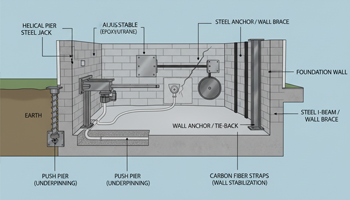
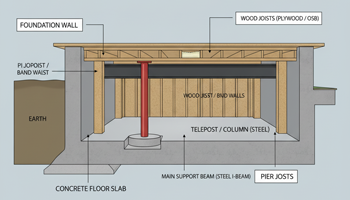
The typical basement structural system consists of several integrated components working together to support loads from above. Foundation walls transfer loads from the building down to footings and soil, while also resisting lateral earth pressure from surrounding soil. Main beams span across the basement, supported by columns or posts at regular intervals, carrying loads from floor joists and upper floors above. Load-bearing walls in the basement support beams or floor systems directly, creating critical load paths that cannot be removed without engineering intervention.
The loads these systems support are substantial. A typical residential floor generates 40 to 50 pounds per square foot of live load (occupants, furniture, movable items) plus dead load from the structural materials themselves—typically another 10 to 20 pounds per square foot. Multiply these loads by hundreds of square feet of floor area, and single beams may carry tens of thousands of pounds.
Why structural integrity matters transcends simple building code compliance—it’s fundamentally about safety and financial protection. Structural failures can cause floors to sag or collapse, create dangerous conditions for occupants, generate repair costs routinely exceeding $20,000 to $50,000, and void insurance coverage when unpermitted or improperly engineered work is discovered. Even non-catastrophic failures like excessive floor deflection cause doors and windows to stick, create cracks in walls and ceilings, and reduce home values significantly.
The consequences of improper framing extend beyond immediate safety concerns to long-term liability. If structural work performed during your ownership causes problems years later—perhaps after you’ve sold the home—you face potential legal liability to subsequent owners. Professional engineering provides documentation that work met accepted standards, offering crucial liability protection.
Identifying Load-Bearing Walls in Existing Basements
Determining which walls actually support structural loads represents perhaps the most critical skill in basement renovation planning. The difference between load-bearing and non-load-bearing walls is absolute—removing the wrong wall can cause structural failure.
Visual Clues & Inspection Techniques
Several visual indicators suggest a basement wall may be load-bearing, though none provides definitive confirmation without engineering analysis. Walls positioned directly below load-bearing walls on floors above likely continue the load path downward. Walls running perpendicular to floor joists frequently support those joists, carrying their loads to the foundation. Walls supporting beams are definitively load-bearing—the beam loads transfer through the wall to the foundation.
Additional clues include wall location at or near the center of the house, where loads from both sides of the structure converge; walls that feel substantially more robust or use larger framing members than typical partition walls; and walls with doubled top plates or other reinforcing elements suggesting they carry significant loads.
However, these visual clues can mislead. Partition walls sometimes use identical framing to load-bearing walls for simplicity or to meet specific building requirements unrelated to structural loads. Conversely, some load-bearing walls may appear indistinguishable from partitions, particularly in older homes where construction practices varied from modern standards.
Physical inspection techniques can provide additional information. From the floor above, examine how floor joists relate to the wall in question—joists ending at the wall or supported by it indicate load-bearing function. In unfinished basement ceilings, observe beam positions relative to walls—beams resting on walls transfer substantial loads. Check the basement floor beneath suspected load-bearing walls for thickened concrete or additional reinforcement, though absence of these features doesn’t prove non-load-bearing status.
Blueprint Analysis
Original building plans, if available, provide authoritative information about structural design intent. Structural drawings clearly identify load-bearing walls, specify beam sizes and spans, show column locations and spacing, and detail foundation requirements under load-bearing elements.
However, several factors complicate blueprint reliance. Plans may not reflect as-built conditions if changes occurred during construction or subsequent renovations. Many older homes lack accessible plans, and when plans do exist, they may omit structural details that were handled through standard practices of the era. Even when detailed structural plans are available, modifications over the home’s life may have altered the structural system in ways not documented.
Blueprint analysis provides valuable starting points but cannot substitute for professional structural assessment, particularly before modifications. Plans show original design intent; professional inspection verifies current conditions.
When Professional Assessment Is Required
Professional structural engineering assessment becomes absolutely mandatory in several situations. Before removing or modifying any wall you believe might be load-bearing, a structural engineer must evaluate the wall’s function, calculate loads it carries, and design appropriate alternatives if removal is desired. When you’re uncertain whether a wall is load-bearing, the modest cost of professional assessment ($500 to $1,500 for typical residential evaluations) proves trivial compared to risks of incorrect assumptions.
For any renovation creating new openings in existing walls, adding significant new loads to the structure, or modifying basement layouts substantially, professional engineering isn’t optional—it’s legally required in most jurisdictions and essential for safety. When building departments require permits (which they do for virtually all structural work), engineered drawings stamped by licensed professionals are mandatory.
The engineering assessment typically includes site inspection to observe existing conditions, analysis of load paths and structural systems, calculations determining loads and required capacities, and stamped drawings specifying any new structural elements or modifications. This documentation satisfies building code requirements, provides liability protection, and ensures work proceeds safely.
Load Calculations for Basement Structural Design
Understanding load calculations helps recognize the complexity of structural design and appreciate why professional engineering proves essential for determining appropriate beam sizes and support requirements.
Dead Load vs Live Load vs Snow Load
Structural loads fall into several categories, each requiring different assumptions and calculations. Dead loads represent the permanent, unchanging weight of the building itself—structural framing, floor systems, drywall, roofing materials, and any permanently attached components. These loads are predictable and constant, typically calculated at 10 to 20 pounds per square foot for floor systems and 15 to 30 pounds per square foot for roof systems including materials.
Live loads represent temporary, variable loads from occupancy and use—people, furniture, stored items, and movable equipment. Building codes specify minimum live load assumptions based on use: 40 pounds per square foot for bedrooms, 50 pounds per square foot for other living areas, and 30 pounds per square foot for attics with limited access. These minimums ensure adequate capacity for normal residential use.
Snow loads affect roof systems in regions with winter snowfall, varying dramatically by location and roof characteristics. Snow load calculations consider regional climate data, roof pitch and configuration, exposure factors, and potential for drift accumulation in certain roof geometries. In northern climates, design snow loads can exceed 40 to 60 pounds per square foot, substantially increasing loads that basement structural systems must ultimately support.
Point Loads vs Distributed Loads
The distribution of loads across structural elements significantly affects design requirements. Distributed loads spread uniformly across structural members—floor live loads, for example, distribute relatively evenly across the entire floor system. Beams carrying these distributed loads experience gradual load accumulation along their length.
Point loads concentrate significant forces at specific locations—columns supporting beams create point loads where they transfer accumulated loads from the entire beam span to a single support location. These concentrated forces require robust local reinforcement including larger bearing areas, thickened members under load points, and foundations specifically designed for concentrated loads.
The distinction matters because structural member sizing depends heavily on load distribution. A beam carrying 10,000 pounds distributed uniformly across 20 feet requires different sizing than a beam with the same total load concentrated at mid-span. Engineers account for these differences through moment and shear calculations that determine required beam strength and stiffness.
Regional Load Factors & Building Codes
Load requirements vary substantially by geographic region, reflecting different environmental conditions and code jurisdictions. Snow load regions range from zero in warm climates to 60+ pounds per square foot in mountain areas and northern states. Seismic design categories affect structural connection requirements and material specifications in earthquake-prone regions. Wind load requirements increase in coastal areas and exposed locations subject to severe storms.
The International Residential Code (IRC) provides baseline structural requirements adopted by most jurisdictions, though local amendments modify these standards based on regional conditions. Some areas impose requirements more stringent than IRC minimums to address local concerns about snow loading, seismic activity, or high winds.
Understanding applicable codes and regional factors requires consulting local building departments and referring to current code editions. The stakes are high—designs meeting code in one location may prove dangerously inadequate in another with different environmental loads or amended requirements.
Beam Sizing Fundamentals
Proper beam sizing represents the most critical—and most commonly mishandled—aspect of basement structural modifications. Beams that appear robust may be grossly undersized according to engineering calculations.
Beam Span Tables for Common Applications
Span tables provide quick reference for common beam applications, showing maximum safe spans for different beam sizes under typical residential loads. However, these tables come with critical limitations and assumptions that must be understood before application.
For typical residential floor loads supporting one story, common beam sizing guidelines based on extensive project experience include:
8-12 foot spans: Single LVL 1.75″ × 11.25″ generally sufficient for typical residential floor loads with intermediate support.
12-16 foot spans: Double or triple LVL beams, or steel I-beam W8 section required depending on loads and deflection limits.
16-20 foot spans: Triple LVL or steel beam W10 to W12 typically necessary for adequate capacity and acceptable deflection.
Spans over 20 feet: Steel beams become mandatory, usually W12 or larger sections depending on specific loads and span length.
These guidelines represent starting points, not final specifications. Actual requirements depend on specific loads, deflection tolerance, bearing conditions at supports, and code requirements. Professional engineering calculations must verify any beam sizing before installation.
Wood Beam Types (Solid Sawn, LVL, Glulam)
Wood beams come in several configurations, each with distinct characteristics affecting performance, cost, and availability. Solid sawn beams use single pieces of dimensional lumber—common sizes include 4×10, 4×12, 6×10, and 6×12. These traditional beams work well for shorter spans but suffer from natural wood defects, size limitations, and variable material quality. They’re readily available and familiar to all contractors.
Laminated Veneer Lumber (LVL) consists of thin wood veneers glued together under pressure, creating engineered beams with consistent properties and superior strength compared to solid sawn lumber of similar dimensions. Standard LVL beams measure 1.75 inches thick and come in depths from 9.25 inches to 18 inches. Multiple LVL beams can be fastened together creating double, triple, or larger built-up sections for heavy loads or long spans.
LVL advantages include consistent, predictable strength properties; longer available lengths than solid sawn lumber (up to 60+ feet); superior load capacity for given dimensions; and straighter, more stable performance over time. The engineered properties allow precise engineering calculations with higher confidence than solid sawn lumber.
Glulam (glued laminated timber) beams use larger lumber pieces laminated together, creating substantial beams for heavy loads and long spans. Common sizes range from 3.125 inches to 6.75 inches wide and 9 inches to 24+ inches deep. Glulam beams handle the heaviest wood beam applications but cost more and require specialized suppliers.
Steel Beam Options & When to Use Them
Steel beams provide superior strength-to-size ratios compared to wood, enabling longer spans or heavier loads with shallower beam depths that preserve basement ceiling height. Wide flange I-beams (W-beams) represent the most common steel beam type for residential applications, designated by depth and weight per foot—W8×15 means 8-inch deep beam weighing 15 pounds per linear foot.
Common residential steel beam sizes include W8 sections for moderate spans and loads, W10 sections for longer spans or heavier loads, and W12 sections for the longest spans or heaviest applications in residential construction. Steel beams excel for spans exceeding 16 to 20 feet where wood beam sizing becomes impractical, situations requiring minimal beam depth to preserve ceiling height, and applications with exceptionally heavy loads concentrated on single beams.
Steel beam advantages include exceptional strength allowing longer spans with shallower depths, completely consistent properties enabling precise engineering, and fire resistance superior to wood. Disadvantages include higher material costs, requirement for specialized trades for cutting and welding, more complex connection details at bearing points and column interfaces, and potential for corrosion in moisture-prone environments.
Built-Up Beam Configurations
Built-up beams consist of multiple members fastened together to create composite sections with greater capacity than individual components. The most common configuration uses multiple LVL beams side-by-side, fastened with nails or bolts to create double, triple, or larger assemblies.
Proper built-up beam construction requires fasteners at specified spacing creating composite action where the members work together rather than independently. Typical specifications call for rows of nails every 12 inches along the beam length, with specific patterns ensuring even load distribution between members. Inadequate fastening allows individual members to slip relative to each other, eliminating composite action and dramatically reducing capacity.
Built-up wood beams can also use dimensional lumber—2×10 or 2×12 boards fastened together create beams for lighter applications. However, LVL built-ups generally provide superior performance due to the engineered lumber’s consistent properties and higher strength.
Column & Post Requirements
Beams require support at regular intervals, provided by columns or posts that transfer accumulated loads downward to foundations. Proper column sizing, spacing, and foundation support prove essential for structural integrity.
Spacing Calculations
Column spacing depends on beam capacity, loads being supported, and practical considerations. Closer spacing allows smaller beams but increases column costs and basement obstruction. Wider spacing reduces columns but necessitates larger, more expensive beams.
Typical residential basement column spacing ranges from 8 to 12 feet where minimizing beam size is priority and multiple columns are acceptable, 12 to 16 feet for balanced approach between beam size and column quantity, to 16 to 20 feet where minimizing columns is important despite requiring larger beams. Spans exceeding 20 feet prove expensive regardless of approach, requiring either very large wood beams or steel beams plus robust columns and foundations.
Engineering calculations determine appropriate spacing by analyzing beam capacity for proposed span lengths, verifying column capacity for concentrated loads at support points, and ensuring foundations under columns can safely distribute loads into soil. The optimization involves balancing material costs, installation complexity, and functional requirements for the finished space.
Lally Column Installation
Lally columns—adjustable steel posts filled with concrete—represent the most common column type for residential basement applications. These columns consist of steel pipe, typically 3 to 4 inches diameter, with threaded adjustable tops allowing precise height adjustment, and concrete fill providing compressive strength and preventing local buckling.
Lally column installation requires proper bearing at both top and bottom. At the top, steel bearing plates distribute loads to wood beams, with minimum plate dimensions and bolt patterns specified by engineering. At the bottom, columns must bear on adequate footings—typically concrete pads 24 inches square and 12 inches thick for typical residential loads, though engineering may require larger footings for heavy loads or poor soil conditions.
Lally columns work well for basic applications and crawl spaces, though they present aesthetic challenges in finished basements. The industrial appearance doesn’t integrate well with residential finishes, and wrapping or concealing columns requires additional framing and materials.
Wood Post Specifications
Wood posts offer aesthetic advantages in visible installations, integrating more naturally with residential finishes and simplifying attachment of trim, walls, or other finishing elements. Typical wood post sizing for residential basement applications uses 4×4 posts for lighter loads and shorter heights, 6×6 posts for typical residential applications with good load capacity, and 6×8 or larger posts for the heaviest applications.
Wood posts must use appropriate lumber grades—No. 1 or Select Structural grades provide the load capacity needed for structural applications. Lower grades lack adequate strength for dependable performance under sustained loads. All wood posts bearing on concrete must use pressure-treated lumber rated for ground contact to prevent moisture-induced deterioration.
Wood posts require similar bearing plate and foundation considerations as Lally columns. Proper bearing ensures loads transfer efficiently without crushing wood or overstressing bearing surfaces. Steel bearing plates or caps at top and bottom distribute loads across adequate areas.
From extensive project observation, I prefer 6×6 wood posts over Lally columns in visible installations—they integrate better aesthetically and simplify finishing work. Lally columns excel in utility areas, crawl spaces, or locations where industrial appearance doesn’t matter.
Footing Requirements Under Columns
Columns concentrate substantial loads at small footprints, requiring footings that spread these forces over adequate soil bearing area. Undersized footings settle excessively, causing structural damage above.
Typical residential column footings measure 24 inches square and 12 inches thick for average soil conditions and typical floor loads. Heavy loads, poor soil bearing capacity, or multiple stories above may require footings 30 to 36 inches square or larger. Engineering analysis based on column loads and soil bearing capacity determines exact requirements.
Footings must be reinforced with rebar grid—typically #4 bars at 12 inches on center each direction—to prevent cracking and distribute loads effectively. The reinforcement should be positioned in the lower third of the footing thickness where tensile stresses concentrate.
Footings must bear on undisturbed or properly compacted soil. Placing footings on fill or loose soil invites settlement problems. If existing floor slabs must be removed to install new footings, excavate to required depth, compact soil thoroughly, and pour footings before replacing floor slabs.
Framing Lumber Specifications
The lumber used for framing basement walls and supporting structural elements must meet specific grade and treatment requirements to ensure adequate performance and durability.
Grade Requirements (No. 2 vs Select Structural)
Lumber grading systems classify wood based on strength properties, knot characteristics, and defects. Higher grades cost more but provide essential performance for structural applications. For basement framing, minimum acceptable grades vary by application.
No. 2 grade lumber suffices for typical wall studs, plates, and non-critical framing where loads remain modest and member spans are short. This represents the standard grade for most residential wall framing, balancing adequate strength with reasonable cost.
Select Structural or No. 1 grades become necessary for beams, headers over openings, posts supporting significant loads, and any application where higher strength proves critical for safety. The superior material properties provide greater load capacity and more predictable performance under sustained loading.
Using improper grades—particularly undersized grades for critical applications—creates structural weaknesses that may not become apparent until loads exceed capacity, potentially years after installation. The modest cost difference between grades represents false economy when structural adequacy is at stake.
Pressure-Treated Bottom Plates
Wood bottom plates fastened to concrete basement floors face moisture exposure from concrete’s natural dampness and potential water infiltration. Untreated lumber deteriorates under these conditions, compromising structural connections and potentially supporting mold growth.
Pressure-treated lumber rated for ground contact must be used for all bottom plates on concrete floors in basements. The treatment chemicals protect against moisture-induced decay, preserving structural integrity and preventing deterioration. The requirement applies even in seemingly dry basements—concrete naturally transmits moisture even absent obvious dampness.
The pressure treatment process does affect lumber dimensions slightly and requires corrosion-resistant fasteners (hot-dipped galvanized or stainless steel) since treatment chemicals accelerate corrosion of standard fasteners. These considerations require attention during installation but don’t complicate construction significantly.
Stud Spacing (16″ OC vs 24″ OC)
Wall stud spacing—expressed as «on center» (OC) meaning measured from center of one stud to center of the next—affects wall strength, material costs, and drywall attachment quality. The two standard spacings each have appropriate applications.
Sixteen-inch OC spacing represents the default for most residential framing, providing adequate strength for typical wall loads, creating solid substrate for drywall attachment, and aligning with 4-foot and 8-foot drywall panel dimensions for efficient material use. Load-bearing walls typically require 16-inch spacing to ensure adequate capacity for the loads transferred through the wall.
Twenty-four-inch OC spacing reduces lumber costs and speeds framing but limits applications to non-load-bearing partition walls with appropriate wall coverings, situations where code specifically permits wider spacing, and areas where reduced structural demands allow the lighter framing. The wider spacing creates less rigid substrate for drywall, potentially allowing more flexibility and fastener pop issues.
For basement applications, 16-inch spacing should be default unless engineering specifically approves 24-inch spacing for particular walls. The modest material savings from wider spacing aren’t worth compromised structural performance or finishing quality issues.
Load-Bearing Wall Construction Details
Constructing load-bearing walls requires attention to specific details that distinguish them from simple partition walls and ensure proper load transfer through the structural system.
Top Plate & Bottom Plate Installation
Top and bottom plates create the foundation for wall framing, anchoring the assembly to floor and ceiling surfaces. Bottom plates must be pressure-treated lumber when installed on concrete, as discussed previously. The plates must be fastened securely—powder-actuated fasteners or concrete anchors at 16 to 24 inches OC for bottom plates on concrete, and appropriate nails or screws to floor joists or blocking for top plates.
Load-bearing walls typically require doubled top plates—two 2×4 or 2×6 plates stacked on top of the studs. The doubled plates distribute loads more effectively and provide stiffness at the wall top where concentrated loads from beams or joists may occur. Plates should be offset at corners and intersections so the upper plate bridges joints in the lower plate, creating continuous load paths.
Proper plate installation ensures the wall frame maintains alignment and effectively transfers loads. Poorly fastened or inadequately sized plates create weak points where the entire structural system becomes compromised.
Header Construction Over Openings
Any opening in a load-bearing wall—for doors, windows, or pass-throughs—interrupts the vertical load path and requires a header beam spanning the opening to carry loads around to supporting studs on each side. Header sizing depends on opening width and loads being carried.
Common residential header construction uses dimensional lumber on edge—single 2×6, 2×8, 2×10, or 2×12 for lighter loads and narrower openings; doubled 2× lumber (two pieces side-by-side) for typical residential door and window openings; or LVL beams for wider openings or heavier loads. The header must bear on full-height «jack studs» or «trimmer studs» that transfer loads down to the bottom plate and foundation.
Built-up headers typically include ½-inch plywood spacer between the 2× lumber pieces to bring total thickness to 3.5 inches matching standard wall framing. This ensures drywall or other wall coverings install flush across the entire wall surface.
Undersized headers represent one of the most common and dangerous framing errors. An opening that appears modest may carry substantial loads, and inadequate headers sag over time, causing structural problems throughout the building.
King Stud, Jack Stud, & Cripple Stud Placement
Framing openings in load-bearing walls requires specific stud configurations to ensure proper load transfer. King studs are full-height studs extending from bottom plate to top plate, positioned immediately adjacent to openings. Jack studs (trimmer studs) run from bottom plate to the header, positioned between king studs and the opening, supporting the header ends.
Cripple studs are short studs filling spaces above headers (extending from header to top plate) and below sills in window openings (from bottom plate to sill). These maintain proper stud spacing for wall covering attachment and help distribute loads.
The number of jack studs under each header end depends on the loads and opening width—single jack studs for typical residential door openings with modest loads, doubled or tripled jack studs for wider openings or heavier loads. Engineering specifications dictate requirements for critical applications.
Proper stud placement and sizing ensures loads transfer cleanly through the framing system to the foundation. Omitted or undersized jack studs create concentrated bearing that can crush lumber, causing headers to sag and structural systems above to fail.
Non-Load-Bearing Partition Walls
Understanding differences between load-bearing walls and partition walls helps recognize where simplified construction proves appropriate and where structural requirements demand attention.
Differences from Load-Bearing Walls
Non-load-bearing partition walls support only their own weight and attached finishes—they carry no loads from floors, roofs, or other structural elements above. This fundamental difference allows simplified construction with reduced material requirements and less critical installation tolerances.
Partition walls don’t require doubled top plates since they aren’t distributing significant loads. Single top plates suffice for attaching wall covering and connecting the framing. Header requirements over openings simplify dramatically—openings up to 4 feet typically require only flat 2× lumber rather than beams on edge. Stud spacing can extend to 24 inches OC if appropriate for wall covering being installed.
The key distinction: partition walls could be removed entirely without affecting structural integrity of the building above. This differentiates them absolutely from load-bearing walls whose removal would compromise structural systems.
Simplified Framing Requirements
Partition wall framing uses standard lumber without special grade requirements—No. 2 grade suffices for all applications. Pressure-treated bottom plates remain necessary when plates contact concrete, but the treatment addresses durability rather than structural concerns.
Construction proceeds more quickly since the consequences of minor errors remain minimal. Slightly out-of-plumb walls, small alignment variations, or simplified connection details don’t create structural risks—they may affect aesthetic quality but pose no safety hazards.
This simplified approach saves time and money compared to load-bearing wall construction. However, ensuring a wall is truly non-load-bearing requires professional assessment—assumptions about partition wall status have led to structural failures when walls actually served load-bearing functions.
Attachment Methods to Existing Structure
Partition walls must connect securely to existing basement floors, ceiling joists, and adjacent walls to create stable installations even though they don’t support structural loads from above.
Bottom plates attach to concrete floors using the same fasteners as load-bearing walls—powder-actuated fasteners or concrete anchors at appropriate spacing. The attachment prevents wall movement and provides base for the framing system.
Top plates connect to floor joists above using nails or screws driven into joist sides or bottom edges. When walls run parallel to joists, blocking between joists provides attachment points for top plates. Alternatively, top plates can attach to subfloor above, though this creates less robust connections.
Where partition walls intersect existing walls, various blocking and backing techniques create solid connections. The specific method depends on whether the existing wall is exposed framing or finished with drywall, and whether access exists behind the existing wall.
Beam-to-Post Connection Methods
The connection between beams and their supporting posts represents a critical load transfer point requiring proper hardware and installation techniques to ensure forces transfer safely without failure.
Mechanical Fasteners
Simple mechanical fasteners—nails, screws, bolts, or lag screws—create basic connections between beams and posts. However, these fasteners alone rarely provide adequate capacity for the concentrated loads at beam-post connections in structural applications.
Bolts or lag screws through beams into posts can work for light applications with engineering approval. The fasteners must be sized appropriately—typically ½-inch or larger diameter—and installed with washers to distribute bearing loads. Multiple fasteners are usually necessary to develop adequate capacity.
Toe-nailing beams to posts—driving nails at angles through beam bottoms into post tops—creates inadequate connections for structural applications. While common in light framing, this approach doesn’t reliably transfer the concentrated loads present at beam-post intersections.
Steel Brackets and Hangers
Engineered steel connectors provide reliable, code-compliant connections at beam-post interfaces. These brackets are designed specifically for transferring loads, with published capacity ratings that simplify engineering and code compliance.
Post caps attach to post tops, providing bearing surfaces and side flanges for fastening to beams. The caps distribute beam loads across post tops while providing uplift resistance through nailed or bolted flanges. Beam hangers support beam ends at bearing walls or posts, transferring beam loads through mechanical connections rather than relying solely on bearing contact.
These engineered connectors must be installed exactly per manufacturer specifications—using specified fastener types, quantities, and locations. Substituting incorrect fasteners or omitting fasteners voids the rated capacity and creates potentially dangerous conditions.
Code-Compliant Installation Practices
Building codes require specific connection details for beam-to-post assemblies, ensuring adequate load transfer and structural continuity. Key requirements include bearing area adequate to distribute loads without crushing wood, mechanical connections preventing uplift or lateral movement, and proper fastening with specified fastener types and spacing.
Inspectors verify these connection details during framing inspections before walls close up. Improper connections represent common code violations requiring correction before work can proceed. Using engineered brackets that meet code requirements and following manufacturer installation specifications ensures compliance and structural adequacy.
Building Code Requirements (IRC & IBC)
Building codes establish minimum structural standards ensuring safety and performance. Understanding code requirements helps recognize the complexity of compliant construction and appreciate why professional expertise proves essential.
Inspection Points & Documentation
Building departments require structural inspections at specific construction phases, verifying work meets code requirements before subsequent construction proceeds. Footing and foundation inspections occur after excavation and formwork but before concrete placement. Framing inspections occur after rough framing completion but before insulation and drywall cover the structure.
Each inspection verifies specific elements—proper bearing for beams and posts, adequate fastening throughout the structure, correct lumber grades and sizes, code-compliant connections at critical load transfer points, and proper header sizing over openings. Failed inspections require corrections before work proceeds.
Maintaining documentation proves essential—engineering drawings, permit records, inspection reports, and photos of concealed work provide permanent records that protect homeowners, facilitate future work, and support home sale transactions.
Engineering Stamps: When Required
Licensed professional engineers must design and stamp drawings for structural modifications exceeding prescriptive code provisions. The specific triggers vary by jurisdiction, but generally include removing or modifying load-bearing walls, beams spanning beyond prescriptive limits, unusual load conditions, and any work in areas with seismic or high wind requirements.
The engineering stamp indicates a licensed professional has analyzed the design, verified adequate capacity for all loads, and certified the work meets applicable codes. Building departments require stamped drawings before issuing permits for structural work, and inspectors verify work matches the approved engineered designs.
Engineering costs typically range from $1,200 to $3,000 for typical residential basement structural modifications—modest compared to project costs and essential for ensuring safety and code compliance.
Common Code Violations to Avoid
Certain code violations appear repeatedly in residential structural work, representing common misunderstandings or shortcuts that compromise safety. Undersized beams for the span and loads—the single most common violation observed across hundreds of projects—can appear adequate but fail engineering analysis. Inadequate bearing area under beam ends where loads concentrate on insufficient contact area leads to crushing and failure.
Missing or improperly installed hardware at beam-post connections creates weak points where loads can’t transfer reliably. Improper lumber grades using economy lumber where structural grades are required compromises load capacity. Insufficient fastening throughout the structure, particularly at critical connections, represents attempted cost-cutting that eliminates safety margins.
Understanding these common violations helps contractors and homeowners recognize areas demanding particular attention and professional verification.
Common Structural Framing Mistakes
Learning from common errors helps avoid expensive corrections and dangerous conditions. These mistakes appear repeatedly across residential projects, often with severe consequences.
Undersized Beams for Span
The single most prevalent structural framing error involves installing beams without adequate capacity for the span length and loads being supported. A single LVL beam 1.75 inches by 11.25 inches might appear «sufficiently robust» for a 16-foot span, but engineering calculations may require double or triple LVL for safe performance.
The error stems from visual judgment replacing engineering analysis. Beams that look substantial may carry only a fraction of required capacity. The consequences unfold over time—initial installation appears fine, but gradual deflection begins, accelerating as materials creep under sustained loading until visible sagging, cracked finishes, and structural concerns become apparent.
The case that profoundly illustrated this pattern: an experienced contractor installed a single LVL beam for a 16-foot span supporting two floors. The installation appeared solid during construction with no immediate concerns. Three months later, floors above began sagging visibly—doors wouldn’t close, drywall cracks appeared, and vibration when walking across the floor indicated serious structural inadequacy. The correction required removing finished ceilings and walls, installing temporary shoring to support loads during replacement, and installing properly sized triple LVL beam. Total cost exceeded $18,000 compared to the $1,200 a structural engineer would have charged upfront for proper design.
Inadequate Column Support
Columns must bear on proper foundations and connect adequately to beams above. Common errors include placing columns directly on floor slabs without dedicated footings, undersizing footings for the concentrated loads, and omitting or improperly installing bearing plates at beam-column interfaces.
Each error creates point of potential failure. Columns on slabs without footings may punch through the slab or settle differentially as concrete cracks under the concentrated loads. Undersized footings settle excessively, causing columns to drop and beams to sag. Inadequate bearing plates create localized crushing where loads concentrate on insufficient contact area.
The cumulative effect of these errors appears months or years after installation as gradual settlement manifests through visible structural distress. Early correction proves far less expensive than addressing failures after they develop fully.
Improper Fastening Techniques
Structural connections rely on proper fastening to transfer loads safely. Common fastening errors undermine structural performance even when member sizes are adequate.
Inadequate nailing—using too few nails or incorrect nail sizes—at critical connections reduces capacity and allows movement under loading. Over-driving nails or screws into wood crushes fibers and reduces holding power. Using wrong fastener types—particularly non-rated fasteners in engineered connector brackets—voids manufacturer ratings and creates unreliable connections.
Toe-nailing where engineered brackets are required represents attempted cost-cutting that eliminates structural adequacy. The modest savings from omitting proper hardware creates false economy given the loads involved and consequences of failure.
Basement Beam Sizing Calculator & Tables
While professional engineering remains mandatory for structural modifications, understanding beam sizing principles helps recognize when professional help is essential and provides educational value for those learning structural concepts.
Practical Span Tables
The following span guidelines represent typical residential applications with standard loads (50 PSF total load including dead and live loads). These are educational examples, not design specifications—actual projects require engineering analysis accounting for specific conditions.
Single LVL 1.75″ × 11.25″:
- 8-foot span: Adequate for typical residential floors
- 10-foot span: Adequate with moderate deflection
- 12-foot span: Approaching limits, may experience noticeable deflection
- 14+ foot span: Inadequate for typical applications
Double LVL 3.5″ × 11.25″:
- 12-foot span: Adequate for typical residential floors
- 14-foot span: Adequate with acceptable deflection
- 16-foot span: Approaching limits for floor applications
- 18-foot span: May be adequate depending on specific loads
Triple LVL 5.25″ × 11.25″:
- 14-foot span: Excellent capacity with minimal deflection
- 16-foot span: Adequate for most residential applications
- 18-foot span: Adequate with attention to deflection
- 20-foot span: Approaching limits, verify with engineering
Steel W8 sections:
- Spans 12-16 feet: W8×15 typically adequate
- Spans 14-18 feet: W8×18 or W8×21 often required
- Longer spans or heavier loads: Larger sections necessary
These guidelines assume continuous lateral support from floor systems, proper bearing at supports, and typical residential loads. Any variation from these assumptions requires engineering analysis.
Load Assumptions
The span tables above assume 50 PSF total load (40 PSF live load plus 10 PSF dead load), simple span conditions (beam supported at ends only), and deflection limits of L/360 for floors under live load. Different load conditions, continuous spans, or tighter deflection requirements substantially affect beam capacity.
Engineering analysis accounts for actual load conditions including exact dead loads based on construction materials, appropriate live loads for the specific use, any concentrated loads at particular locations, and actual span configurations including continuous beams over multiple supports.
Safety Factors
Building codes incorporate safety factors ensuring structures maintain adequate capacity even under unexpected conditions. These factors account for material variability, construction tolerances, load variations beyond design assumptions, and long-term effects like creep and degradation.
However, building codes represent minimums, not optimal design. A beam that «meets code» may still generate noticeable floor deflection, bouncing, or vibration that occupants find unacceptable. Based on extensive project experience, good engineering practice designs structural systems 15% to 20% above minimum code requirements, achieving superior rigidity and performance that satisfies occupants even under conditions approaching design limits.
This conservative approach costs modestly more in materials but dramatically improves long-term satisfaction and structural performance. The investment in slightly larger beams proves worthwhile for eliminating the floor bounce and vibration that plague code-minimum installations.
Need professional structural engineering for your basement framing project? Before removing walls, sizing beams, or modifying structural systems, consult a licensed structural engineer. The modest consultation cost prevents expensive corrections and ensures your home’s structural integrity remains uncompromised.
References
Currently viewing
Basement Structural Framing

Urban Flood Mitigation
Urban Flood Mitigation and Foundation Design in Coastal Cities Coastal urban centers face mounting pressure…

Sump Pump Maintenance
Sump Pump Maintenance Guide: Annual Checklist & When to Replace [2025] Sump pump failure rates…
Window Well Drainage Systems
Window Well Drainage Systems: Prevent Basement Window Flooding Window well flooding destroys finished basements through…

Crawl Space Encapsulation Cost
Crawl Space Encapsulation Cost: Vapor Barrier Installation Guide Your roof collects hundreds of gallons of…

Gutter Drainage & Downspout Extensions
Gutter Drainage & Downspout Extensions: Prevent Foundation Water Damage Your roof collects hundreds of gallons…

Basement Dehumidifier Sizing
Basement Dehumidifier Sizing Guide: Square Footage & Moisture Level Calculator Choosing the wrong dehumidifier size…

Drylok vs Xypex vs Thoroseal
Drylok vs Xypex vs Thoroseal: Which Basement Waterproofing Paint Actually Works? Basement waterproofing paints promise…
Exterior Basement Waterproofing
Exterior Basement Waterproofing: Complete Excavation Cost & Membrane Installation Guide Exterior basement waterproofing represents the…
Best Sump Pump Systems with Battery Backup
Best Sump Pump Systems with Battery Backup When your power goes out during a severe…
French Drain vs Interior Drainage
French Drain vs Interior Drainage System: Which Protects Your Basement Better? When water threatens your…