
Concrete Foundation vs Pier & Beam: Repair Cost Differences
When foundation problems arise, one of your first questions is likely about repair costs. But here’s what most homeowners don’t realize: the type of foundation you have dramatically affects what you’ll pay. A $3,000 repair on a pier and beam foundation might cost $12,000 on a concrete slab—or vice versa, depending on the specific problem.
If you’re researching foundation repair costs, you’ve probably encountered wildly different estimates. That’s because slab foundations and pier and beam foundations fail differently, require different repair methods, and involve different labor and accessibility factors. After working on over 1,200 foundation repairs across both types in Texas, Oklahoma, and Arkansas, I can tell you this: there is no universally «cheaper» foundation type to repair. The answer depends entirely on what’s actually wrong.
This guide breaks down the real-world repair costs for both foundation types, explains why certain repairs cost more for one type versus the other, and gives you the decision framework I use with homeowners facing major repair or conversion decisions. You’re not stuck with a «bad» foundation type—each has strengths, weaknesses, and appropriate solutions for different scenarios.
Let’s cut through the confusion with specific numbers, real repair scenarios, and the cost factors that actually matter.
Foundation Type Fundamentals
Before we can compare repair costs meaningfully, you need to understand what you’re actually dealing with. These two foundation types are fundamentally different in construction, which directly impacts how they fail and how much it costs to fix them.
Slab-on-Grade (Concrete Slab) Foundations: Design & Prevalence
A concrete slab foundation is exactly what it sounds like: a single, thick layer of reinforced concrete poured directly on the ground. The slab serves as both the foundation and the floor of your home. Modern slabs are typically 4-6 inches thick, reinforced with steel rebar or wire mesh, and often include post-tensioning cables that compress the concrete to resist cracking.
Slab foundations dominate in warm climates and areas with expansive clay soils. They’re the standard choice for homes built after 1970 in the Southwest, California, and most new construction nationwide. The appeal is straightforward: lower initial construction cost, faster installation, and no crawl space to maintain.
Pier & Beam (Raised) Foundations: Construction & Components
Pier and beam foundations—also called raised foundations—elevate your home 18-24 inches above ground level. Concrete piers extend into the soil, supporting horizontal wooden beams (the «girders» or «main beams»), which in turn support smaller floor joists. Your floor sits on top of this framework, with a crawl space underneath.
This design was the standard for residential construction before 1960 and remains common in flood-prone areas, regions with high water tables, and areas where soil conditions make slabs problematic. You’ll find pier and beam foundations throughout older neighborhoods, coastal regions, and parts of the South where traditional construction methods persist.
Regional Distribution: Where Each Type Dominates
Texas (Dallas, Houston, Austin): Mixed market. Newer construction heavily favors slabs, but pier and beam remains common in established neighborhoods. The expansive clay soils that plague Texas create constant challenges for both types.
California: Slab-dominant, especially in newer developments. Older homes in seismic zones often have pier and beam, which requires seismic retrofitting.
Southeast (Louisiana, Mississippi, Alabama): Pier and beam still prevalent due to moisture, flooding, and termite considerations.
Midwest and Northeast: Basement foundations dominate, but crawl space pier and beam exists in moderate climates.
Pacific Northwest: Crawl space pier and beam common in older homes; newer construction transitioning to slabs.
Age Factor: Foundation Types by Construction Era
The age of your home strongly predicts foundation type:
- Pre-1950: Pier and beam almost universally
- 1950-1970: Transition period—regional variation determines predominant type
- 1970-2000: Slab becomes standard in most regions
- 2000-present: Slab dominant, except specialty situations (coastal, flood zones)
This timeline matters for repair costs because older pier and beam foundations approaching 60-80 years often face complete overhaul decisions, while slabs from this era are typically just hitting their stride.
Common Problems by Foundation Type
The problems you’ll encounter—and therefore the repairs you’ll need—differ fundamentally between these foundation types. Understanding this is critical because it explains why cost comparisons often seem contradictory.
Concrete Slab Issues: Settlement, Cracks, Heaving
Slab foundations primarily suffer from settlement (sinking into the soil) and heaving (being pushed upward by expanding soil). Both create visible cracks in walls, doors that won’t close, and floors that slope. The concrete itself rarely fails; instead, the soil beneath it moves.
Common slab problems include:
- Differential settlement: One section sinks while another remains stable, creating stress cracks
- Perimeter beam failure: The thickened edge of the slab settles, pulling the interior down
- Center heave: Moisture accumulates under the middle of the slab, causing clay soils to expand and push upward
- Shrinkage cracks: Normal hairline cracks from concrete curing, usually cosmetic
In expansive clay soil regions (Texas, Oklahoma, Colorado), settlement and heaving represent ongoing battles. The soil swells when wet, shrinks when dry, and constantly moves the slab. In stable soil regions, slabs can last 50+ years without significant problems.
Pier & Beam Issues: Rotting Beams, Failing Piers, Sagging Floors
Pier and beam foundations fail through deterioration of components—primarily wood rot in the beams and joist settlement from failing piers. Unlike slabs where the problem is soil-related, pier and beam failures are often material degradation issues.
Common pier and beam problems include:
- Wood rot: Moisture in the crawl space causes beams and joists to rot, losing structural integrity
- Termite damage: Subterranean termites attack wooden components, sometimes extensively before discovery
- Settling piers: Original piers sink, shift, or deteriorate, causing beams to lose support
- Sagging floors: Insufficient support spacing causes floors to bounce or dip between beams
The critical difference: pier and beam problems often progress invisibly in the crawl space. By the time you notice sagging floors or bouncing, significant damage may have occurred. Slabs telegraph problems faster through visible cracks.
Accessibility Differences: Crawl Space Access vs. Breaking Concrete
This single factor explains many repair cost differences. Pier and beam foundations offer direct access to structural components through the crawl space. A contractor can crawl underneath, inspect everything visually, and work on beams and piers without disturbing your home’s interior or exterior.
Slab foundations require breaking through concrete to access underlying problems. Piering a slab means drilling through the concrete edge, excavating beneath it, and installing support piers—all while managing the disruption to landscaping and potentially your home’s interior. Access limitations increase both labor hours and equipment requirements.
This accessibility advantage gives pier and beam a significant edge for certain repairs—but only when the crawl space itself is accessible. Homes with only 12-18 inches of clearance, moisture problems, or pest infestations can erase this advantage quickly.
Water Management: Drainage Implications for Each Type
Drainage problems affect both foundation types but manifest differently:
Slabs: Poor drainage causes soil expansion and contraction cycles, leading to settlement and heaving. Water typically doesn’t contact the foundation directly—instead, it affects the supporting soil. Drainage corrections often solve underlying causes without foundation repair.
Pier and beam: Poor drainage creates moisture in the crawl space, promoting wood rot and rust on metal components. Water management requires both exterior drainage improvements and crawl space moisture control (vapor barriers, dehumidification).
The ongoing cost difference is significant: slab drainage is typically a one-time exterior grading project ($1,500-$4,000), while pier and beam moisture control requires initial investment ($2,000-$5,000) plus ongoing monitoring and maintenance.
Repair Methods: Slab Foundations
Slab repair methods address the fundamental problem: supporting a monolithic concrete structure that has moved. Each method has specific applications, costs, and durability characteristics.
Slabjacking & Polyurethane Foam Lifting
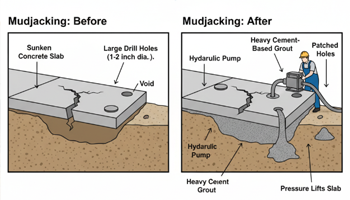
Slabjacking—also called mudjacking or foam jacking—involves pumping material beneath the slab to fill voids and lift settled sections. Modern polyurethane foam injection has largely replaced older cement-based mudjacking for residential applications.
The process: Technicians drill 1-inch holes through the concrete, inject expanding polyurethane foam beneath the slab, and monitor with lasers as the foam lifts the concrete back to level. The foam cures in minutes, weighs almost nothing (reducing future settlement risk), and fills voids that caused the original settlement.
Typical costs: $2,000-$3,500 for a 200 square foot area. Expect to pay $8-$18 per square foot depending on the amount of lift required and regional pricing. Minor leveling of a single room runs $1,500-$2,500, while whole-house foam injection can reach $8,000-$15,000.
Best for: Isolated settlement areas, void filling, situations where soil conditions remain stable after repair.
Not suitable for: Active heaving areas, severely cracked slabs, situations where ongoing soil movement will continue.
Piering: Push Piers & Helical Piers for Slabs
When settlement stems from soil failure rather than voids, piering provides permanent support by transferring the structure’s weight to stable soil or bedrock below. This represents the most durable slab foundation repair method.
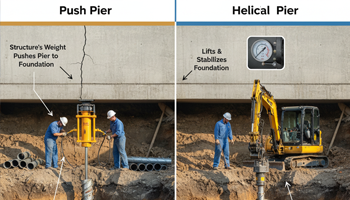
Push piers (resistance piers): Hydraulically driven steel tubes pushed through unstable soil layers until reaching load-bearing strata. The pier sections connect, and a bracket attaches to the foundation, transferring weight directly to the pier. Each pier supports 10,000-60,000 pounds depending on configuration.
Helical piers (screw piers): Steel shafts with helical plates twisted into the ground like screws. Best for lighter loads and situations where bedrock is too deep for push piers. Helical piers offer more precise installation depth control.
Typical costs per pier: $1,500-$3,000 installed, depending on depth required, soil conditions, and regional pricing. A typical repair installing 6-8 piers runs $9,000-$18,000. Major perimeter piering requiring 12-20 piers costs $18,000-$35,000.
Best for: Severe settlement, ongoing soil movement areas (expansive clay), permanent solutions where foam lifting would fail.
Installation reality: Expect disruption. Excavation around the foundation perimeter, heavy equipment in your yard, potential landscaping damage, and 2-5 days of work. Factor in $1,000-$3,000 for landscaping restoration.
Crack Injection: Epoxy & Polyurethane
Foundation cracks in slabs don’t always indicate structural problems, but they do require sealing to prevent water intrusion and further deterioration. Crack injection methods depend on crack width and cause.
Epoxy injection: For structural cracks (those affecting load-bearing capacity). Epoxy essentially re-glues the concrete together, restoring structural integrity. Used for cracks wider than 1/8 inch that result from settlement stress.
Polyurethane injection: For waterproofing non-structural cracks. The polyurethane foam expands to fill the crack and adjacent voids, stopping water infiltration but not restoring structural strength.
Typical costs: $1,500-$4,000 for multiple crack repairs. Expect $300-$600 per crack for epoxy injection, $200-$400 per crack for polyurethane. Extensive crack networks across the entire slab can reach $6,000-$10,000.
Important distinction: Crack injection addresses symptoms, not causes. If settlement continues, new cracks will form. Successful crack repair often requires concurrent piering or soil stabilization.
Mudjacking for Minor Settlement
Traditional mudjacking (cement-based slurry injection) still has applications for budget-conscious homeowners dealing with minor settlement. The process mirrors foam injection but uses a cement mixture instead of polyurethane.
Advantages over foam: Lower cost ($3-$7 per square foot vs. $8-$18 for foam), longer track record, works well for larger void filling.
Disadvantages: Heavier material (adds load to soil), requires larger injection holes (2-inch vs. 1-inch), longer cure time (24-48 hours vs. minutes), less precise lift control.
Typical costs: $1,000-$2,500 for minor repairs, roughly 30-50% less than foam injection for comparable work.
Best for: Budget repairs on stable soil, large void filling, situations where future settlement is unlikely.
Repair Methods: Pier & Beam Foundations
Pier and beam repairs focus on replacing or reinforcing individual components rather than lifting a monolithic structure. This component-based approach offers both advantages (incremental repairs possible) and disadvantages (multiple points of potential failure).
Beam Replacement: Sistering & Full Replacement
When beams rot, crack, or sag, you have two primary options depending on damage extent.
Sistering: Attaching a new beam alongside the damaged original, distributing the load across both. Works when damage is localized and the original beam retains some structural capacity. The new beam is bolted or bracketed to the old, effectively doubling the support in that location.
Full replacement: Removing the damaged beam entirely and installing a new one. Required when rot is extensive, the beam has lost structural integrity, or sistering would create moisture trapping conditions.
Typical costs: Sistering a single beam runs $800-$1,500 depending on length and access difficulty. Full beam replacement costs $1,200-$2,500 per beam. Replacing multiple main beams (4-6 beams) typically costs $6,000-$12,000 including labor, materials, and temporary support systems during replacement.
Material choices: Modern replacements often use treated lumber or steel I-beams instead of traditional dimensional lumber. Steel costs more upfront ($2,000-$3,500 per beam installed) but eliminates future rot concerns.
Pier Installation/Replacement: Concrete & Steel
Original pier and beam foundations often used masonry piers (stacked bricks or blocks) that settle, crumble, or shift over time. Modern replacement piers offer superior performance.
Concrete piers: Poured-in-place concrete columns extending below the frost line, providing stable support. The standard for modern pier installation. Each pier costs $150-$300 installed, depending on depth requirements and soil conditions.
Steel piers: Driven or helical steel piers similar to those used for slab repairs, offering the most reliable support in problematic soils. More expensive at $500-$1,200 per pier but necessary in expansive clay or high water table conditions.
Typical pier replacement project: Installing 8-12 new piers to replace failing originals runs $2,000-$4,500 for concrete piers, $4,000-$9,000 for steel piers.
Labor reality: Crawl space work is physically demanding. Tight spaces, poor lighting, moisture, and insects all increase labor costs. Homes with minimal crawl space clearance (under 18 inches) can see 50% labor premiums.
Shimming & Leveling: Temporary vs. Permanent
Shimming—inserting wedges between beams and piers—offers the quickest, cheapest leveling option for pier and beam foundations. But understanding its limitations is critical.
Temporary shimming: Using wooden shims to level floors and buy time before more extensive repairs. Costs $300-$800 for a focused area, potentially $1,500-$2,800 for whole-house shimming. This is a Band-Aid solution that may last 1-3 years before underlying problems require permanent repair.
Permanent shim systems: Steel shim plates with proper load distribution, combined with pier work, creating a durable leveling solution. Costs approach half the price of full beam replacement but offers better longevity than temporary wooden shims.
When shimming makes sense: You need time to budget for major repairs, problems are minor and non-progressive, or you’re planning to sell within 2-3 years and need functional floors during the listing period.
When shimming is wasteful: Active rot is present, piers are actively failing, or the home needs permanent repair anyway. In these cases, shimming just postpones inevitable higher costs.
Crawl Space Jacks: Adjustable Support Systems
Crawl space jacks—adjustable steel columns—provide supplemental support between existing piers, addressing sagging floors without full beam replacement. Modern jack systems offer clean, efficient solutions for specific problems.
How they work: Steel columns extend from concrete footer pads on the crawl space floor to the underside of floor beams. Screw-adjust mechanisms allow precise height adjustment and future releveling if needed.
Typical costs: $200-$400 per jack installed. A typical installation addressing floor bounce in a 15×20 room requires 3-4 jacks, costing $800-$1,600 total.
Best applications: Addressing under-supported floor spans, fixing bouncy floors, providing additional support in high-traffic areas without major structural issues.
Not a substitute for: Beam replacement when rot is present, pier repair when foundations are settling, moisture control when crawl space conditions cause ongoing deterioration.
Cost Comparison: Slab vs. Pier & Beam Repairs
Here’s what homeowners actually want to know: specific cost comparisons for real-world scenarios. These numbers reflect 2025 pricing in mid-range markets (Texas, Oklahoma, Arkansas primary basis). Expect 20-30% higher costs in high-cost-of-living areas (California, Northeast) and 10-20% lower in rural or low-cost regions.
Minor Repairs: $1,000-$3,000 Range
Slab foundation:
- Crack injection (2-3 cracks): $1,500-$2,500
- Small area foam lift (under 100 sq ft): $1,200-$2,000
- Minor mudjacking: $1,000-$1,800
Pier & beam foundation:
- Shimming and leveling (single area): $1,500-$2,800
- Minor beam sister repair: $800-$1,500
- Installing 2-3 crawl space jacks: $600-$1,200
Winner: Pier and beam typically 15-20% cheaper for minor issues. Crawl space access reduces labor costs significantly. However, pier and beam minor repairs are more often temporary solutions compared to slab repairs.
Moderate Repairs: $4,000-$10,000 Range
Slab foundation:
- Foam injection (200-300 sq ft): $3,500-$6,000
- Installing 4-8 foundation piers: $6,000-$14,000
- Mudjacking with some crack repair: $4,000-$8,000
Pier & beam foundation:
- Replacing 2-4 main beams: $4,000-$8,000
- Installing 6-10 new piers: $2,500-$5,000
- Multiple beam repairs plus jack installation: $5,000-$9,000
Winner: Roughly equivalent. Specific costs depend on problem type. Pier and beam has slight edge when problems are isolated to beams. Slab has slight edge when settlement is the primary issue.
Major Repairs: $10,000-$25,000+ Range
Slab foundation:
- Full perimeter piering (12-20 piers): $18,000-$35,000
- Extensive foam lifting plus piering: $15,000-$28,000
- Complete foundation stabilization: $20,000-$40,000
Pier & beam foundation:
- Complete crawl space overhaul (all beams/joists/piers): $20,000-$45,000
- Major beam replacement plus comprehensive pier work: $15,000-$30,000
- Conversion to concrete slab: $15,000-$50,000 (varies by square footage)
Winner: Slab foundation surprisingly edges ahead. When you need comprehensive repair, slab’s monolithic nature means you’re addressing the entire structure at once. Pier and beam complete overhauls require replacing dozens of individual components, driving labor costs higher.
Labor & Accessibility Cost Factors
Understanding why similar-seeming repairs cost differently for each foundation type requires examining the hidden labor and access factors.
Crawl Space Access: Advantage for Pier & Beam
Direct component access in pier and beam foundations provides multiple cost advantages:
No excavation required: Work happens in existing crawl space without disturbing landscaping, driveways, or interior spaces. Saves $1,000-$3,000 in excavation and restoration costs compared to slab work.
Visual inspection possible: Contractors can see problems directly, reducing diagnostic costs and preventing surprise discoveries mid-project. Comprehensive crawl space inspection costs $200-$400 versus $500-$800 for slab foundation inspection requiring invasive investigation.
Hand-portable materials: Wooden beams, concrete blocks, and small tools can be carried into crawl spaces. No heavy equipment rental required for many repairs. Savings: $500-$1,500 in equipment costs.
The catch: These advantages disappear when crawl space access is poor. Homes with 12-18 inch clearance, moisture problems requiring protective gear, or extensive pest infestations can actually cost MORE to repair than slabs due to difficult working conditions.
Concrete Breaking: Added Cost for Slab Repairs
Slab foundation repairs often require breaking through concrete—an expense pier and beam never faces.
Core drilling: Creating access holes for foam injection, piering, or plumbing repairs. Cost: $50-$150 per hole, with typical projects requiring 6-20 holes.
Saw cutting: Cutting concrete sections for pier bracket installation or severe repair. Cost: $200-$500 per cut location.
Concrete restoration: Patching holes and cuts after repair completion. Cost: $300-$1,000 depending on extent.
Total add-on: Concrete work adds 10-20% to slab repair costs compared to equivalent work on pier and beam where no concrete breaking is required.
Interior vs. Exterior Access: Impact on Pricing
Access location affects both foundation types but differently:
Slab foundations: Most repairs work from the exterior perimeter. Interior access (tunneling under the slab) is rare and expensive—$3,000-$8,000 for plumbing repairs requiring tunneling versus $300-$800 for equivalent pier and beam crawl space plumbing access.
Pier and beam foundations: Require crawl space access points. Homes without adequate access (common in older homes) may need access openings cut through floors or foundation walls, adding $500-$1,500 to project costs.
Equipment Requirements: Different for Each Type
Different repair methods require different equipment, directly affecting pricing:
Slab repairs need:
- Hydraulic pump systems for piering: $200-$500 daily rental
- Foam injection rigs: Usually contractor-owned but factored into per-square-foot pricing
- Concrete cutting equipment: $150-$300 daily rental
- Heavy excavation equipment for major work: $500-$1,200 daily rental
Pier and beam repairs need:
- Temporary jacking systems: $100-$300 rental
- Hand tools primarily: Minimal equipment costs
- Material delivery only: Lower logistics costs
Net effect: Equipment-intensive slab repairs include 15-25% of total cost as equipment charges. Pier and beam equipment costs typically under 10% of total project cost.
Long-Term Durability & Maintenance Costs
Initial repair costs tell only part of the story. Total cost of ownership over 20 years differs substantially between foundation types.
Concrete Slab: 50+ Year Lifespan, Low Maintenance
Properly designed and installed slabs require minimal maintenance:
Expected maintenance (20 years):
- Periodic drainage inspection: $200-$400 every 3-5 years = $800-$1,600 total
- Minor crack sealing (cosmetic): $300-$800 over 20 years
- Plumbing leak repairs (if they occur): $2,000-$5,000 (not foundation-specific)
Total 20-year maintenance: $500-$1,000 in foundation-related costs, plus potential repair if settlement occurs.
The reality: Most slabs go decades without requiring attention. In stable soil areas, genuine foundation problems may never develop. In expansive clay regions, settlement becomes a «when» not «if» question, but repairs—once completed properly—often last 20-30 years.
Pier & Beam: 40-60 Years with Regular Maintenance
Pier and beam foundations require active maintenance:
Annual/biennial inspection recommended: $200-$400 for comprehensive crawl space inspection including moisture levels, wood condition, pier status, and pest activity.
Moisture control ongoing costs:
- Vapor barrier replacement: $1,500-$3,000 every 10-15 years
- Dehumidifier operation: $200-$400 annually in electricity and maintenance
- Periodic drainage improvements: $500-$1,500 every 5-10 years
Pest control:
- Termite inspection and treatment: $300-$800 annually
- General pest control: $200-$400 annually
Expected component replacement (20 years):
- 1-2 beams requiring attention: $2,000-$4,000
- Several pier adjustments/replacements: $1,000-$2,500
- Minor repairs and shimming: $1,000-$2,000
Total 20-year maintenance: $8,000-$15,000 in ongoing costs, NOT including major repair events.
Ongoing Costs: Moisture Control, Wood Rot Prevention
The maintenance premium for pier and beam stems primarily from moisture management requirements:
Why moisture control matters: Wood rot doesn’t happen in dry conditions. Maintaining crawl space relative humidity below 60% prevents virtually all rot-related problems. This requires:
Proper ventilation: Foundation vents must remain unblocked and functional. Cost: free if properly maintained, $500-$1,200 if vents need replacement or additional vents are required.
Vapor barriers: 6-mil polyethylene sheeting covering crawl space dirt floors prevents ground moisture evaporation. Initial installation: $1,500-$3,000 for typical homes. Replacement every 10-15 years.
Dehumidification: In humid climates or poorly ventilated crawl spaces, mechanical dehumidification may be necessary. System cost: $1,200-$2,500 installed. Operating cost: $150-$300 annually.
The comparison: Slab foundations eliminate these costs entirely. No crawl space means no moisture management requirements. This represents the single largest ongoing cost difference between foundation types.
Total Cost of Ownership: 20-Year Analysis
Here’s the real comparison homeowners need:
Pier & Beam (typical 20-year scenario):
- Ongoing maintenance: $5,000-$8,000
- Expected repairs: $6,000-$12,000
- Total: $11,000-$20,000
Slab Foundation (typical 20-year scenario):
- Ongoing maintenance: $500-$1,000
- Expected repairs (if needed): $10,000-$18,000
- Total: $10,500-$19,000
The insight: Total costs are remarkably similar, but the timing and nature of expenses differ dramatically. Pier and beam requires steady, predictable maintenance spending plus occasional repairs. Slab requires almost nothing until a problem develops, then demands a significant lump sum.
Financial planning implications: Pier and beam suits homeowners who can budget $300-$600 annually for maintenance. Slab suits homeowners who prefer low ongoing costs but can handle $10,000+ surprise expenses if settlement occurs.
Climate & Soil Impact on Repair Costs
Geographic location and soil conditions create dramatic repair cost variations. Understanding your region’s specific challenges helps set realistic expectations.
Expansive Clay Soils: Slab Foundation Challenges
Expansive clay soils—those containing minerals that swell when wet and shrink when dry—represent the single biggest driver of slab foundation problems in the United States.
Where clay dominates: Texas (particularly Dallas-Fort Worth and Houston), Oklahoma, Colorado’s Front Range, parts of California, and scattered areas throughout the Great Plains.
The mechanism: Clay soil volume changes of 10-20% between wet and dry seasons create cyclical movement beneath slabs. Even well-designed slabs eventually develop stress points, leading to settlement or heaving.
Cost impact: In expansive clay regions, slab foundation repair is endemic. Settlement issues affect 60-70% of homes over their lifetime. Typical Dallas-Fort Worth metro area homeowners can expect to spend $12,000-$20,000 on foundation stabilization at some point during ownership.
Pier and beam advantage: Raised foundations with proper pier depth extend below the clay active zone (3-6 feet deep). Soil movement affects them less significantly. However, piers must be properly designed—shallow piers in clay soil still experience movement.
High Moisture Areas: Pier & Beam Rot Risk
Coastal areas, river valleys, and regions with high water tables create constant moisture challenges for pier and beam foundations.
Where moisture dominates: Gulf Coast (Louisiana, Mississippi, Alabama, Texas coast), Pacific Northwest, low-lying areas throughout the Southeast, and river valleys nationwide.
The mechanism: Persistent crawl space humidity above 60% creates ideal conditions for wood rot, mold, and fungal decay. Without aggressive moisture control, wooden components deteriorate steadily.
Cost impact: High-moisture region pier and beam foundations require mandatory vapor barriers ($1,500-$3,000), often need dehumidification systems ($1,200-$2,500), and experience 2-3x higher beam replacement rates compared to dry climates.
Slab advantage: No wood components means no rot risk. High moisture primarily affects only the supporting soil. In coastal areas, slabs often represent the superior long-term choice.
Freeze-Thaw Cycles: Effects on Both Types
Northern climates with significant freeze-thaw cycling create specific foundation stresses.
Where freeze-thaw matters: Northern tier states with frost depths exceeding 3 feet—Minnesota, Wisconsin, Michigan, New York, New England.
The mechanism: Water penetrating cracks or soil voids freezes, expands, and creates pressure. Repeated cycling gradually worsens small problems into major ones.
Cost impact on slabs: Requires deeper foundation footers and proper drainage to prevent frost heaving. Repair costs similar to warm climates but with added complexity from frozen ground during winter months (can add 20-30% to project costs if winter repair is necessary).
Cost impact on pier and beam: Piers must extend below the frost line to prevent heaving. Shallow piers in freeze-thaw zones inevitably fail, requiring complete replacement at $4,000-$10,000 for typical repairs.
Regional Cost Variations: Texas vs. California vs. Midwest
Labor costs, material availability, and competitive market factors create significant regional pricing variations:
Texas (Dallas-Fort Worth market, representative):
- Foundation pier installation: $1,500-$2,500 per pier
- Beam replacement: $1,200-$2,000 per beam
- Crawl space jacks: $200-$350 each
- Foam lifting: $10-$15 per square foot
California (Los Angeles/Bay Area, high-cost market):
- Foundation pier installation: $2,500-$4,000 per pier
- Beam replacement: $2,000-$3,500 per beam
- Crawl space jacks: $350-$500 each
- Foam lifting: $15-$22 per square foot
Midwest (Kansas City/St. Louis, moderate market):
- Foundation pier installation: $1,200-$2,000 per pier
- Beam replacement: $1,000-$1,800 per beam
- Crawl space jacks: $180-$300 each
- Foam lifting: $8-$12 per square foot
Regional multipliers: California typically runs 50-80% above Texas pricing. Northeast corridor similar to California. Southeast 10-20% below Texas. Rural areas 20-30% below suburban pricing regardless of region.
Conversion Considerations
Sometimes the question isn’t «repair which type» but «should I convert from one type to another?» This decision involves comparing long-term repair costs against conversion investment.
Can You Convert Pier & Beam to Slab? (Cost: $15K-$50K)
Yes, converting from pier and beam to concrete slab is structurally feasible and increasingly common when facing major pier and beam repairs.
The process:
- Remove existing flooring down to joists
- Install plumbing, electrical, and HVAC components that will be under the slab
- Fill crawl space with compacted fill material
- Install moisture barrier, insulation, rebar grid
- Pour 4-6 inch reinforced concrete slab
- Reinstall flooring systems
Typical costs by home size:
- Under 1,500 sq ft: $15,000-$30,000
- 1,500-2,500 sq ft: $25,000-$40,000
- Over 2,500 sq ft: $35,000-$50,000
Variables affecting cost: Existing plumbing configuration (cast iron under the home is expensive to reroute), HVAC ductwork location (crawl space ducts must move to attic), foundation wall modifications required, and regional labor costs.
Benefits & Drawbacks of Conversion
Conversion benefits:
- Eliminates ongoing maintenance: No more crawl space moisture control, inspections, or wood rot concerns
- Energy efficiency improvement: Properly insulated slab floors outperform uninsulated pier and beam
- Increased resale appeal: Many buyers prefer slabs, particularly in regions where they’re standard
- Solves extensive rot problems: When repair costs approach $20,000-$30,000, conversion becomes financially competitive
- Long-term durability: Modern slabs typically outlast pier and beam in most climates
Conversion drawbacks:
- High upfront cost: $15,000-$50,000 is substantial, even if it «solves problems forever»
- Plumbing access loss: Future under-floor plumbing repairs require expensive tunneling
- Construction disruption: Weeks-long project requiring moving out or living in construction zone
- Can’t be undone: Permanent decision
- May not solve soil issues: If you have expansive clay soils causing pier and beam problems, slab will eventually face settlement issues too
When Conversion Makes Financial Sense
Use this decision framework based on my experience with over 200 conversion consultations:
Convert if:
- Current pier and beam repair estimate exceeds $20,000 AND you’re planning to stay 10+ years
- Home has extensive rot or termite damage affecting 50%+ of beams
- You’re doing major remodel anyway (flooring replacement, bathroom/kitchen gut, etc.)
- Expansive clay soil causes constant adjustment needs with pier and beam
- You have health concerns (mold, moisture) related to crawl space and prefer elimination over management
- Home value is significantly affected by foundation type (slab expected in your neighborhood)
Don’t convert if:
- Current foundation is in good condition with 70%+ components sound
- Repair estimate is under $15,000
- You’re planning to sell within 5 years (won’t recover conversion cost)
- Home is in high water table area (creates drainage complications)
- Historical home preservation is important
- You value future plumbing access
- Your budget is tight and staged pier and beam repairs are feasible
The math: If pier and beam repairs plus 10 years of ongoing maintenance total $25,000-$35,000, conversion at $30,000-$40,000 starts making sense—IF you’re staying long enough to benefit from zero-maintenance years ahead.
Permit & Engineering Requirements
Conversion isn’t a simple DIY project. Expect these regulatory requirements:
Structural engineering: Required in most jurisdictions. Engineer must design the slab system, specify rebar placement, and approve soil compaction methods. Cost: $1,500-$3,500.
Building permits: Foundation work always requires permits. Expect 4-8 week permit processing. Permit costs: $500-$2,000 depending on jurisdiction.
Inspections: Multiple inspections during construction—typically after fill compaction, after plumbing rough-in, after rebar placement, and final inspection after pour. Failed inspections can delay project weeks.
Code upgrades: Conversion may trigger requirements to bring other building systems to current code (electrical panel upgrade, seismic bracing, etc.), adding $2,000-$8,000 to total project cost.
Underground utilities: Before excavation and filling, utility location services required. Most areas offer free utility locating, but private utility identification (old septic, water lines) may cost $300-$800.
Making the Decision: Repair vs. Replace
Sometimes the question isn’t slab versus pier and beam, but whether to repair at all versus replacing the entire foundation—or even selling and moving.
Condition Assessment: When Repair Isn’t Enough
Foundation problems exist on a spectrum from minor to catastrophic. Knowing where your situation falls determines appropriate action:
Definitely repair (problems are fixable):
- Settlement affecting one section (less than 30% of foundation perimeter)
- Isolated beam rot affecting 2-3 beams
- Cracking confined to one area without ongoing movement
- Floor sag or bounce in specific rooms
- Pier settlement affecting 25% or fewer piers
Consider replacement (extensive problems):
- Settlement affecting entire perimeter (360-degree problem)
- Pier and beam rot affecting 60%+ of structural members
- Ongoing active heaving or settlement despite previous repairs
- Repairs failed within 5 years
- Foundation age 80+ years with multiple component failures
Sell as-is or rebuild entirely (catastrophic):
- Structural engineer recommends demolition
- Repair estimates exceed 40% of home value
- Previous major repairs failed, soil issues are intractable
- Foundation failure combines with other major home systems failures (roof, plumbing, electrical)
The insider secret: Foundation companies benefit from major repairs, not from telling you to sell. If a reputable contractor suggests replacement or hints you might consider selling, take that seriously—the problem may be worse than typical repairs can address.
Cost-Benefit Analysis: Repair vs. New Foundation
Running the numbers properly requires considering all factors:
Total repair cost includes:
- Foundation repair itself
- Interior repairs (drywall cracks, door/window adjustments)
- Exterior repairs (brick repointing, stucco repair, landscaping restoration)
- Plumbing system stress testing and potential repairs
- Alternative housing if work requires moving out
Replacement foundation cost includes:
- Complete foundation removal: $5,000-$12,000
- New foundation installation: $15,000-$50,000 depending on type and size
- All of the above interior/exterior repairs
- Extended construction timeline (4-8 weeks vs. 3-7 days for repair)
- Engineering and permit costs
The comparison: If repair estimates exceed $30,000 and replacement would be $50,000, repair makes sense. But if repair is $35,000 with questionable long-term outcomes and replacement is $50,000 with 50-year lifespan, replacement may be the better investment—IF you’re planning to stay 15+ years.
Critical consideration: Financing. Foundation repairs often can’t be financed (you’ll need cash or HELOC). Foundation replacement during new construction or major remodel can be wrapped into construction financing.
Home Value Considerations: ROI on Foundation Work
Foundation repairs rarely provide 1:1 return on investment in immediate resale value. Understanding ROI helps set expectations:
Repair ROI scenarios:
- Disclosure-required repair (you must fix to sell): 70-90% ROI—buyers discount heavily for foundation problems, repair brings value to market rate
- Preventive repair (fixing minor issues before listing): 40-60% ROI—buyers may not credit you fully for proactive work
- Long-term repair (you’re staying 10+ years): ROI is comfort, functionality, preventing larger problems—not resale value
The reality: You’re unlikely to recover full foundation repair costs at resale. The value is in:
- Making the home saleable (can’t sell with obvious foundation failure)
- Preventing bigger problems (minor settlement becomes major structural issue)
- Quality of life (functioning doors, level floors, no leaks)
- Avoiding inspection issues that kill deals
Strategic timing: If planning to sell within 1-2 years and problems are minor, consider selling with foundation issues disclosed and reducing price. Buyers can address issues to their preference, and you avoid paying retail for repairs you won’t enjoy.
Insurance & Warranty Implications
Understanding insurance and warranty coverage (or lack thereof) affects repair decisions:
What insurance typically DOESN’T cover:
- Settlement from soil conditions (considered «maintenance»)
- Wood rot and deterioration (gradual damage excluded)
- Tree root damage (considered preventable)
- Most foundation movement (unless tied to specific covered event)
What insurance SOMETIMES covers:
- Sudden plumbing leak causing slab undermining (if you can prove sudden nature)
- Foundation damage from covered natural disaster (earthquake with earthquake insurance, flood with flood insurance)
- Damage from specific recent event with clear causation
Strategic documentation: If you suspect plumbing leak caused foundation problems, document timeline carefully before filing claim. Engineer reports connecting specific damage to specific events help claims succeed.
Foundation repair warranties:
- Reputable companies offer 10-year to lifetime transferable warranties
- Read carefully: warranty covers repair method failure, NOT new foundation problems in different locations
- Lifetime warranties require annual inspections and maintenance compliance
- Foundation warranties add resale value by reassuring buyers
Warranty value: Homes with transferable foundation warranties and documentation of proper repairs sell faster and command 2-5% premiums over equivalent homes with undocumented or warranty-less repairs.
FAQs
Which is cheaper to repair, slab or pier and beam foundation?
It depends completely on the specific problem. For minor settlement or leveling, pier and beam is typically 15-20% cheaper due to easier crawl space access. For major structural overhauls, slab repairs often cost less because you’re addressing a single monolithic structure versus dozens of individual components. The best answer: pier and beam has lower repair costs for common minor-to-moderate problems, but higher ongoing maintenance costs.
How much does it cost to replace beams in a pier and beam foundation?
Expect $1,200-$2,500 per beam for complete replacement, or $800-$1,500 per beam for sistering (reinforcing alongside the existing beam). A typical project replacing 4-6 main beams runs $6,000-$12,000 total. Steel beam replacements cost more ($2,000-$3,500 each) but eliminate future rot concerns.
Is it worth converting pier and beam to slab foundation?
Conversion makes financial sense when current pier and beam repair costs exceed $20,000 and you’re planning to stay 10+ years. The conversion costs $15,000-$50,000 depending on home size but eliminates all ongoing maintenance costs and wood rot risks. Don’t convert if your current foundation is in decent condition or you’re planning to sell within 5 years—you won’t recover the cost.
Do concrete slab foundations last longer than pier and beam?
Slabs typically last 50+ years with minimal maintenance in stable soil conditions. Pier and beam foundations last 40-60 years but require regular maintenance—moisture control, inspections, and component replacement. The total 20-year cost is similar ($10,500-$20,000 for both types), but slabs require almost no attention until problems develop, while pier and beam demands steady maintenance spending.
How much does slab foundation settlement repair cost?
Minor settlement repairs using polyurethane foam injection run $2,000-$3,500 for a 200 square foot area. Moderate settlement requiring 6-8 foundation piers costs $9,000-$18,000. Major perimeter settlement requiring 12-20 piers runs $18,000-$35,000. The cost depends primarily on settlement extent and soil conditions requiring pier depth.
What causes more problems, slab or pier and beam foundations?
Different problems, not more or fewer. Slabs suffer primarily from settlement and heaving due to soil movement—especially in expansive clay regions. Pier and beam foundations fail through wood rot, termite damage, and pier settlement. Slabs telegraph problems through visible cracks. Pier and beam problems often progress invisibly in the crawl space. Neither type is inherently more problematic—each has failure modes specific to its design.
Need help deciding between repair options for your specific situation? Consider getting multiple repair estimates from foundation specialists in your area who can assess your home’s actual condition, soil type, and climate factors. Foundation decisions are site-specific—the right answer depends on your unique combination of problems, budget, and long-term plans.
Currently viewing
Concrete Foundation vs Pier & Beam
Foundation Inspection Checklist
Foundation Inspection Checklist: What to Look for Before Buying a Home Buying a home is…

Foundation Settlement Warning Signs
Foundation Settlement Warning Signs: When to Call a Structural Engineer You’ve noticed a crack in…

Bowing Basement Wall Repair
Bowing Basement Wall Repair: Carbon Fiber vs Steel I-Beams If you’ve noticed your basement walls…
Slabjacking vs Mudjacking
Slabjacking vs Mudjacking vs Polyurethane Foam Leveling Your concrete driveway has sunk three inches. The…

Foundation Repair Cost
Foundation Repair Cost By Problem Type & Home Size Foundation damage is one of the…
Push Piers vs Helical Piers
Push Piers vs Helical Piers: Foundation Underpinning When your home’s foundation starts settling, the choice…

Foundation Crack Repair
Foundation Crack Repair: Epoxy vs Polyurethane Injection Complete Guide Foundation problems strike fear into homeowners…
Foundation Repair
Foundation Repair Guide: Systems, Costs & Decision Framework Foundation problems strike fear into homeowners for…