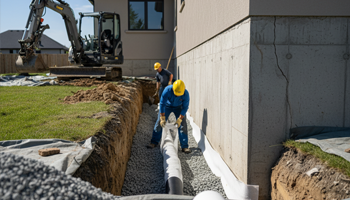
Foundation Waterproofing Membrane: Exterior Application & Materials
If you’re facing chronic basement water problems or planning a major renovation, exterior foundation waterproofing might be the solution you need—but it’s expensive. The typical project runs $12,000 to $28,000 for a medium-sized home, with excavation accounting for 40-45% of that cost. This isn’t a quick fix or a DIY weekend project.
Exterior waterproofing involves excavating around your foundation’s perimeter, applying a waterproof membrane directly to the exterior walls, installing a drainage system, and backfilling. It’s the most comprehensive approach to keeping water out of your basement, addressing the problem at its source rather than managing water that’s already infiltrated.
This guide breaks down membrane types, materials, application processes, and costs so you can make an informed decision about whether exterior waterproofing is right for your situation. We’ll also cover when less expensive interior solutions might be sufficient, because sometimes the $15,000 exterior system isn’t necessary when a $5,000 interior approach will work.
The key question isn’t whether exterior waterproofing works—it does—but whether it’s the right investment for your specific foundation problem.
Foundation Waterproofing Fundamentals
Interior vs. Exterior Waterproofing: Key Differences
Interior waterproofing manages water that has already penetrated your foundation walls. Systems like sump pumps, French drains beneath the basement floor, and vapor barriers channel water away after it’s entered. These solutions typically cost $3,000 to $8,000 and can be installed without excavation.
Exterior waterproofing prevents water from reaching your foundation walls in the first place. By creating a barrier on the outside and directing water away through perimeter drains, you eliminate hydrostatic pressure and moisture infiltration. This requires excavating around your foundation, which is why costs jump to $12,000 to $40,000 depending on foundation size and depth.
Think of interior systems as managing symptoms while exterior systems address the root cause. Both can be effective, but they serve different purposes and suit different situations.
Why Exterior Waterproofing is Superior (But More Expensive)
Exterior waterproofing keeps water away from your foundation walls completely. This prevents moisture damage to concrete, eliminates hydrostatic pressure that can cause cracks and bowing, and creates a permanently dry basement environment.
The system works with gravity rather than against it. Water is intercepted before reaching your foundation and directed away through perimeter drains. This reduces stress on your foundation walls and eliminates the dampness that can lead to mold, efflorescence, and structural deterioration.
However, superior performance comes at superior cost. You’re paying primarily for excavation and labor, not materials. A typical $18,000 project breaks down like this: excavation $6,000-$8,000, labor $5,000-$7,000, materials $3,000-$5,000, and backfill restoration $1,500-$2,500. The waterproofing materials themselves represent only 20-25% of total cost.
Waterproofing vs. Dampproofing: Critical Distinction
Many contractors apply dampproofing and call it waterproofing. This is a critical distinction that affects both performance and your wallet.
Dampproofing is a spray-applied asphalt coating that resists moisture vapor but cannot withstand hydrostatic pressure. It costs $1-$2 per square foot and is required by building code for new construction. Dampproofing will slow moisture transmission but fails when water stands against the foundation.
Waterproofing creates an impermeable barrier that withstands hydrostatic pressure. Materials include rubberized asphalt sheets, liquid-applied membranes, and bentonite systems costing $2-$10 per square foot. These materials can handle standing water and sustained pressure.
If you have groundwater issues, a high water table, or chronic basement flooding, dampproofing will fail. You need true waterproofing. Don’t let a contractor sell you the cheaper solution when you need the more robust one.
When Exterior Waterproofing is Necessary
Exterior waterproofing becomes necessary rather than optional in specific situations. New construction or major renovations where the foundation is already exposed make it a straightforward decision. The marginal cost to add waterproofing when excavation is already happening drops to $3-$5 per square foot.
Chronic basement water problems that persist despite interior solutions indicate you need to address water at the source. If you’ve installed sump pumps and interior drains but still face infiltration, especially standing water against foundation walls, exterior waterproofing is likely your only permanent solution.
Foundation repair projects requiring excavation create an ideal opportunity. If you’re excavating for foundation piering or structural repairs anyway, adding waterproofing increases project cost by only 25-35% rather than 100%. Solve both problems simultaneously.
High-value homes justify the investment as protection for your property. If you’re planning a $50,000+ basement remodel, spending $15,000-$20,000 on exterior waterproofing makes sense as insurance. High water table areas also demand exterior solutions since interior systems can’t overcome constant hydrostatic pressure.
Exterior Waterproofing Membrane Types
Sheet Membranes (Rubberized Asphalt, HDPE, PVC)
Sheet membranes come in rolls that adhere directly to foundation walls. Rubberized asphalt sheets bond aggressively to concrete and offer excellent puncture resistance. HDPE (high-density polyethylene) and PVC sheets provide chemical resistance and extremely long lifespans.
These materials excel in durability and puncture resistance. A properly installed sheet membrane can last 30-50 years with minimal degradation. Installation requires careful attention to overlaps, corners, and penetrations. Seams must overlap 3-4 inches minimum, and corners require double-ply coverage.
Application methods vary by product. Self-adhering membranes peel and stick, requiring clean, dry surfaces for proper bonding. Torch-applied membranes use heat to create aggressive adhesion but require experienced installers to avoid damage. Most professional installations use self-adhering products for safety and reliability.
Cost ranges from $3-$8 per square foot installed, depending on membrane quality and thickness. Premium products like Grace Bituthene fall at the higher end but offer superior warranties and performance in demanding conditions. Budget products save $2-3 per square foot but may sacrifice longevity.
Liquid-Applied Membranes (Spray/Roll-On)
Liquid membranes create seamless coverage by spraying or rolling polymer-modified materials directly onto foundation walls. Polymer-modified asphalts, polyurethanes, and acrylic formulations each offer different performance characteristics.
The primary advantage is seamless coverage. No seams means no potential failure points. This makes liquid membranes ideal for irregular surfaces, block foundations with mortar joints, and complex geometries with numerous penetrations. Detail work around corners and utility penetrations becomes simpler.
Temperature-flexible application allows work in varied conditions, though each product has specific temperature ranges. Installation is faster than sheet membranes on complex foundations, though proper thickness requires attention. Most specifications call for two coats to achieve minimum mil thickness.
The challenge lies in thickness variation. Final waterproofing effectiveness depends heavily on installer skill and technique. Thin spots create weak points. Verification of proper coverage is harder compared to sheet membranes. Curing time of 24-72 hours before backfill can delay project completion.
Cost ranges from $2-$6 per square foot installed. Lower-end products work for basic applications, while premium polyurethane systems command higher prices for superior flexibility and longevity.
Bentonite Clay Systems
Bentonite is sodium-based clay that swells when exposed to water, creating a self-healing waterproof barrier. Available in panel form or as a spray-applied coating, bentonite systems offer unique properties.
Self-healing is the standout feature. Minor installation imperfections seal themselves once moisture is present because the clay expands to fill gaps. This makes bentonite somewhat forgiving of installation errors that would compromise other membrane types.
The material is environmentally friendly, containing no solvents or volatile organic compounds. No primer is required, simplifying surface preparation compared to adhesive membranes. Bentonite bonds mechanically rather than chemically.
However, bentonite is the most expensive option at $4-$10 per square foot installed. It cannot be used in applications requiring permanent dewatering since the material needs moisture to function. Installation requires specific expertise to ensure proper coverage and protection. Panel systems add weight that must be considered for some foundation types.
Bentonite excels in high water table conditions where self-healing properties provide long-term reliability even if minor settling or movement creates small gaps in other membrane types.
Drainage Boards & Composite Systems
Drainage boards combine waterproofing with an integrated drainage layer. Dimpled HDPE sheets create air gaps against the foundation wall, allowing water to flow down to the perimeter drain rather than standing against the waterproofing membrane.
These systems provide membrane protection plus drainage in one installation. The dimpled surface protects the waterproofing from backfill damage while reducing hydrostatic pressure against foundation walls. Installation moves faster since you’re placing one material instead of separate waterproofing and protection layers.
Premium cost of $6-$12 per square foot installed reflects the dual functionality. Products like Delta MS and Tuff-N-Dri dominate professional installations. Proper termination at the top of the wall is critical to prevent water from running behind the board. Filter fabric over exposed surfaces prevents soil from clogging drainage channels.
Drainage boards make most sense in premium installations where comprehensive protection justifies cost. They’re particularly valuable in high water table areas where reducing hydrostatic pressure provides measurable foundation protection beyond waterproofing alone.
Complete Exterior Waterproofing System Components
Foundation Membrane (Primary Barrier)
The membrane is your primary defense against water infiltration. Material selection depends on soil conditions, water table level, and budget. Rubberized asphalt sheets work for most residential applications. Liquid-applied membranes suit block foundations with irregular surfaces. Bentonite systems excel in high water table conditions. Drainage composite boards serve premium installations.
Quality matters more than most homeowners realize. When you’re already paying $6,000-$8,000 for excavation, upgrading from a $3 per square foot membrane to a $5 per square foot premium product adds only $1,000-$1,500 to total project cost. That small increment buys significantly better performance and longer warranties.
Drainage System (French Drain/Weeping Tile)
Waterproofing alone is incomplete. You must direct water away from the foundation. A perimeter drain at the footing level collects water and channels it away. Four-inch perforated pipe, often called weeping tile, runs around the foundation’s perimeter.
The drain must have proper slope, minimum 1/4 inch per foot, to ensure water flows rather than pools. Connection to daylight, a storm sewer, or a sump pump provides water discharge. Without drainage, hydrostatic pressure builds against even the best waterproofing membrane, eventually causing failure.
Filter Fabric (Geotextile Protection)
Filter fabric wraps around drainage gravel to prevent soil migration into the drainage system. Without fabric, fine soil particles gradually clog perforated pipes and drainage channels, reducing system effectiveness over time.
Quality geotextile fabric costs little, typically $0.50-$1.00 per square foot, but prevents expensive drainage system failures years later. This is not where you cut costs.
Gravel Backfill (Drainage Enhancement)
Clean gravel backfill, 12-18 inches wide from footing to grade, provides drainage pathways. Water entering this zone drains down to the perimeter pipe rather than standing against the foundation.
Three-quarter-inch clean gravel or drainage stone works best. Avoid crushed limestone that can cement over time or pea gravel too small to provide adequate drainage voids.
Perimeter Drain Connection to Daylight/Sump
The perimeter drain must terminate somewhere. Daylight termination, where the drain pipe exits to a lower elevation away from the house, provides gravity drainage with no mechanical systems. This is ideal when topography permits.
Interior termination to a sump pump works when daylight isn’t available. The perimeter drain connects through the footing to an interior sump basin, where a pump removes collected water. This adds mechanical complexity and maintenance but works on flat lots.
Storm sewer connection is acceptable where permitted by local code. Some jurisdictions prohibit footing drain connections to storm sewers to reduce drainage system overload during heavy rain.
Application Process Step-by-Step
Excavation: Exposing Foundation Walls
Excavation must reach the footing level, typically 6-10 feet below grade depending on foundation depth. Width needed for working space typically adds 3-4 feet beyond the foundation wall. A skilled operator with a mini-excavator can complete residential excavation in 1-3 days.
Equipment selection depends on access and foundation size. Mini-excavators fit through 36-inch gates for backyards with limited access. Full-size excavators move more soil quickly when access permits. Hand digging becomes necessary in extremely tight spaces, dramatically increasing labor cost.
Utility location is critical before excavation begins. Call 811 at least 3 days before digging to mark underground utilities. Gas lines, electrical, water, sewer, and communications cables must be precisely located to avoid damage and potential danger.
Surface Preparation
Clean walls are essential for membrane adhesion. Pressure washing removes dirt, efflorescence, and loose material. Wire brushing handles stubborn areas. The foundation must be smooth enough for membrane contact. Major defects require patching with repair mortar before waterproofing.
Drying time matters more than most contractors acknowledge. Concrete must be dry for adhesive membranes to bond properly. Allow 24-48 hours after pressure washing before membrane application, longer in humid conditions. Membrane applied to damp concrete delaminates within years.
Surface repair using structural mortars addresses cracks and rough areas. Products with high bond strength and rapid cure time prevent project delays. The smoother the surface, the better the membrane contact and long-term performance.
Primer Application (If Required)
Some membrane systems require primer for proper adhesion, particularly on porous or rough concrete. Primer creates a consistent surface for membrane bonding. Application is straightforward but must be performed according to manufacturer specifications.
Allow proper primer drying time before membrane application. Applying membrane over wet primer causes bonding failures. Follow product data sheets precisely.
Membrane Installation
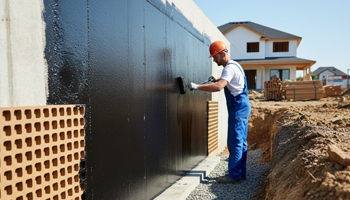
Sheet membrane installation requires careful technique. Start at the footing level and work upward. Overlap seams 3-4 inches minimum, more at corners. Roll the membrane firmly to ensure complete contact and eliminate air pockets. Pay special attention to corners, requiring double-ply coverage, and penetrations for utilities.
Liquid membrane application typically requires two coats to achieve specified thickness. Allow proper drying time between coats. Verify coverage, particularly in corners and around penetrations. Film thickness gauges ensure adequate material application.
Cold weather affects both sheet and liquid membranes. Most products require temperatures above 40°F for proper application. Some specialized products work at lower temperatures but command premium prices.
Protection Board Installation
Protection board shields the waterproofing membrane from puncture during backfill. Rigid foam insulation, dimpled drainage boards, or dedicated protection panels work. Install vertically from footing to grade with minimal gaps.
This step costs $1-$2 per square foot but prevents membrane damage that would require re-excavation to repair. Required? No. Highly recommended? Absolutely. The insurance is cheap relative to the risk.
Drainage System Installation
Place perforated drain pipe at the footing level with holes facing down. Surround with 12-18 inches of clean gravel, wrapped in filter fabric. Maintain 1/4 inch per foot minimum slope toward the outlet point.
Connect to daylight or sump as appropriate. Verify proper slope with a level. Test drainage flow with a garden hose at the high point before backfilling to ensure water reaches the outlet.
Backfill & Restoration
Backfill carefully to avoid damaging the membrane or protection board. Initial backfill with gravel or sand provides cushioning. Heavy equipment must stay away from the excavation edge to prevent cave-ins or membrane damage.
Compact backfill in lifts to prevent settling. Restore landscaping, driveways, and other disturbed areas. Budget $1,500-$2,500 for restoration work on typical projects.
Material Selection Guide
Climate Considerations (Freeze-Thaw, UV Exposure)
Freeze-thaw cycles demand flexible membranes that won’t crack with temperature changes. Rubberized asphalt and polyurethane systems handle freeze-thaw well. Rigid membranes can fail prematurely in northern climates.
UV exposure affects above-grade portions of waterproofing. Rubberized asphalt degrades with UV exposure. If membrane extends above grade, specify UV-resistant materials or provide protection with drainage boards or foundation coating.
Soil Conditions (Clay, Sandy, Rocky)
Clay soils expand and contract with moisture changes, creating movement against foundation walls. Bentonite systems and flexible liquid membranes accommodate movement better than rigid sheets. Clay also creates drainage challenges requiring robust perimeter drain systems.
Sandy soils drain well, reducing hydrostatic pressure. Less expensive membrane options may suffice since pressure against the foundation remains lower. Drainage systems are still necessary but face less demanding conditions.
Rocky soils complicate excavation, increasing cost 15-30%. Sharp rocks during backfill threaten membrane integrity. Protection board becomes essential, and premium membrane products with superior puncture resistance make sense.
Water Table Level Impact
High water table creates constant hydrostatic pressure against foundation walls. Premium waterproofing becomes mandatory, not optional. Bentonite systems and heavy-duty sheet membranes work best. Drainage systems must connect to mechanical removal since gravity drainage may not work below the water table.
Low water table allows more flexibility in material selection. Basic systems may suffice since sustained pressure won’t develop. Budget products save money without sacrificing performance in these conditions.
Foundation Type (Block, Poured, Stone)
Block foundations with mortar joints suit liquid-applied membranes that fill joints and create uniform coverage. Sheet membranes can bridge over joints but require more careful application.
Poured concrete foundations provide smooth surfaces ideal for sheet membranes. Adhesion is excellent on dense, uniform concrete. Liquid membranes work but offer less advantage on smooth surfaces.
Stone foundations present challenges. Irregular surfaces require liquid membranes or extensive surface preparation for sheet products. Foundation condition may require structural repairs before waterproofing makes sense.
Budget vs. Performance Trade-offs
When excavation dominates project cost, material quality becomes a small increment. Upgrading from budget to professional-grade membranes adds 10-20% to total cost but significantly improves performance and longevity.
Budget tier ($2-$3 per square foot): Basic liquid asphalts, thin sheet membranes. Acceptable for low-risk applications with good drainage and low water tables. Warranties of 5-10 years.
Professional tier ($3-$6 per square foot): Quality rubberized asphalt sheets, premium liquid systems. Suitable for most residential applications. Warranties of 10-15 years. This is the recommended minimum.
Premium tier ($6-$12 per square foot): Bentonite systems, drainage composite boards, heavy-duty sheet membranes. For high water tables, problem soils, or when maximum longevity justifies cost. Warranties of 15-25 years.
The marginal cost difference between tiers shrinks when considering total project cost. Spending an extra $2,000 on premium materials for a $20,000 project makes sense for 20+ years additional life expectancy.
Cost Analysis 2025
Material Costs by Type
Liquid-applied membranes: $2-$6 per square foot installed. Budget spray-on asphalts fall at the low end, premium polyurethanes at the high end.
Sheet membranes: $3-$8 per square foot installed. Basic rubberized asphalt products start around $3, premium products like Grace Bituthene reach $7-$8.
Bentonite systems: $4-$10 per square foot installed. Panel systems typically cost more than spray-applied.
Drainage boards: $6-$12 per square foot installed. Premium pricing reflects dual waterproofing and drainage functionality.
Labor & Excavation Costs (Largest Component)
Labor and excavation dominate project costs, accounting for 70-80% of total expenditure. Typical breakdown for an $18,000 project on a 1,500 square foot foundation:
Excavation equipment and operator: $6,000-$8,000. This includes equipment rental, operator time, and disposal of excavated soil. Access difficulty, depth, and soil conditions dramatically affect this cost.
Labor for surface prep, membrane application, drainage installation: $5,000-$7,000. Professional installation requires 3-5 days with a 2-3 person crew.
Backfill and restoration: $1,500-$2,500. Compacting backfill properly, grading, and restoring landscaping or hardscaping.
This cost structure explains why DIY exterior waterproofing rarely makes financial sense. You’ll still pay $3,000-$5,000 for materials and equipment rental, leaving minimal savings for massive effort and risk.
Total Project Cost Ranges
Small foundation (800-1,200 square feet, 4-6 feet depth): $8,000-$15,000 for budget to professional systems. Premium systems reach $15,000-$25,000. Limited excavation depth and smaller area keep costs manageable.
Medium foundation (1,200-2,000 square feet, 6-8 feet depth): $12,000-$25,000 for budget to professional systems. Premium approaches $25,000-$40,000. Most residential projects fall in this range.
Large foundation (2,000-3,000+ square feet, 8+ feet depth): $20,000-$40,000 for budget to professional systems. Premium installations exceed $40,000, reaching $60,000+ for extensive foundations with challenging conditions.
These ranges assume average access, normal soil conditions, and foundations in reasonable condition requiring minimal repair before waterproofing.
Cost Factors: Access, Depth, Soil Conditions
Difficult access multiplies costs 20-40%. Tight lots requiring hand excavation, utilities preventing excavator access, or extensive landscaping demolition all increase labor time and equipment needs. Projects requiring crane lifting of excavators over fences or buildings jump to premium pricing.
Deep excavation beyond 8 feet adds 30-50% to base costs. Shoring requirements for safety, increased excavation time, and additional material for drainage and backfill compound costs.
Poor soil conditions increase costs 15-30%. Rock requires slower excavation, sometimes hydraulic hammers or blasting. Heavy clay creates difficult working conditions and drainage challenges. Wet soils may require temporary dewatering.
Foundation repairs needed before waterproofing vary widely. Minor crack sealing adds $500-$1,500. Extensive repairs requiring structural mortars or carbon fiber reinforcement add $3,000-$10,000+. Severe structural issues requiring piering or wall replacement dominate costs, making waterproofing a secondary expense.
Leading Membrane Products & Manufacturers
Tremco Barriers (TREMproof, ExoAir)
Tremco offers comprehensive foundation waterproofing systems. TREMproof 250GC is a polyurethane liquid membrane providing seamless protection with excellent flexibility. The product handles substrate movement without cracking, important in freeze-thaw climates.
Professional contractors appreciate Tremco’s technical support and clear application guidelines. Material cost runs $4-$6 per square foot installed. Warranties extend 10-15 years depending on application.
Henry Blueskin WP200 (Rubberized Asphalt Sheet)
Henry Blueskin WP200 is a self-adhering rubberized asphalt membrane with a blue polyethylene film. This product dominates mid-range residential applications, offering reliable performance at reasonable cost.
Installation is straightforward. Peel and stick application works in temperatures above 40°F. The membrane conforms to surface irregularities reasonably well. Cost is $3-$5 per square foot installed. Contractors stock Blueskin widely, making it readily available for projects.
Grace Bituthene (Premium Sheet Membrane)
Grace Bituthene represents premium sheet membrane performance. Thicker rubberized asphalt backing and superior adhesive technology create aggressive bonding to concrete. The product excels in demanding applications with high water tables or challenging conditions.
Cost of $6-$8 per square foot installed reflects premium positioning. Warranties extend 15-20 years. Professional contractors specify Bituthene for projects where performance justifies cost over budget alternatives.
Mar-flex Warm-N-Dri (Liquid-Applied)
Mar-flex Warm-N-Dri is a polymer-modified asphalt emulsion applied by spray or roller. The system includes foundation coating plus foam insulation board for waterproofing and insulation in one installation.
The product works well on block foundations where seamless coverage benefits outweigh sheet membrane advantages. Cost runs $3-$5 per square foot installed. Regional contractors often favor Mar-flex in areas where the company provides strong support.
Tuff-N-Dri (Drainage Board System)
Tuff-N-Dri offers composite drainage board systems combining waterproofing with integrated drainage. The dimpled HDPE board creates drainage channels while protecting the membrane beneath.
This represents premium approach pricing at $8-$12 per square foot installed. The system excels in high water table applications where reducing hydrostatic pressure provides measurable value. Installation moves faster than separate waterproofing and drainage board systems.
Voltex (Bentonite Sheet System)
Voltex bentonite sheet consists of sodium bentonite clay sandwiched between geotextiles. The system provides self-healing waterproofing that seals minor imperfections and maintains protection even if foundation movement creates small gaps.
Premium cost of $6-$10 per square foot installed limits applications to situations where self-healing properties justify expense. High water table conditions and applications where long-term settlement might occur favor bentonite systems.
Jabec Products (Morteros de Reparación Integration)
Jabec structural mortars and repair products integrate with waterproofing systems during surface preparation. Foundation cracks require repair before membrane application. Jabec mortars provide high bond strength and rapid cure times that prevent project delays.
Surface patching with Jabec repair mortars creates smooth, uniform surfaces essential for sheet membrane adhesion. Rough concrete patches poorly, creating air pockets and weak spots in the waterproofing layer. Quality surface preparation using professional repair mortars makes the difference between long-term success and premature failure.
Exterior Waterproofing vs. Other Solutions
Interior Waterproofing Systems (Cost Comparison)
Interior systems manage water after it has penetrated foundation walls. Basement drainage channels installed beneath the floor slab collect water and direct it to a sump pump. Interior French drains, sump pumps, and vapor barriers typically cost $3,000-$8,000 installed.
Installation takes 2-4 days without excavation. The basement remains usable throughout most of the process. Systems provide immediate relief from water infiltration and can be installed year-round regardless of weather.
However, interior systems don’t address hydrostatic pressure against foundation walls. Water still contacts the foundation, causing gradual concrete deterioration and efflorescence. Interior solutions work best for minor seepage issues in otherwise sound foundations.
When Interior Solutions are Sufficient
Minor seepage problems where occasional dampness appears but no standing water accumulates respond well to interior waterproofing. Seasonal water infiltration during spring thaw or heavy rain periods can be managed with properly sized sump systems.
Budget constraints often dictate interior solutions. When $3,000-$5,000 is available but $15,000-$20,000 is not, interior waterproofing provides meaningful improvement over no protection. Many homeowners successfully manage water with interior systems for decades.
Impossible or prohibitively expensive exterior access makes interior waterproofing the only practical option. Properties with permanent structures built against foundation walls, complex landscaping, or utility conflicts that would cost $30,000+ to excavate around favor interior approaches.
Foundation condition matters. If structural integrity is sound and water infiltration is the only issue, interior management may provide adequate protection. No need to excavate if the foundation doesn’t require exterior access for repairs anyway.
Combination Approaches (Exterior + Interior)
High-risk properties sometimes justify both systems. Exterior waterproofing provides primary defense while interior drainage offers backup protection if any water bypasses the exterior system.
This approach makes most sense when performing foundation excavation for structural repairs. Adding interior drainage during the same project period costs little extra since access and equipment are already mobilized. Total investment of $20,000-$30,000 provides comprehensive protection.
Phased implementation allows spreading costs. Install interior drainage first to manage immediate water problems for $4,000-$6,000. Plan exterior waterproofing for future when budget allows, knowing interior system provides interim protection.
Cost-Benefit Analysis: $15K Exterior vs. $5K Interior
Interior waterproofing at $5,000 provides immediate water management without excavation. Works for minor to moderate infiltration. Requires electricity for sump pump operation and ongoing maintenance. Doesn’t protect foundation walls from hydrostatic pressure. Suitable solution for many homeowners.
Exterior waterproofing at $15,000 eliminates water contact with foundation walls. Prevents hydrostatic pressure and moisture damage to concrete. Works passively without electricity requirements. Protects foundation structure long-term. Necessary for severe water problems or high water tables.
The breakeven analysis favors interior solutions for minor issues. If interior waterproofing solves the problem, the $10,000 saved exceeds any foundation protection benefit. However, if interior systems prove inadequate, you’ll pay $15,000 for exterior waterproofing anyway, making total cost $20,000 versus $15,000 if you’d gone exterior initially.
Risk tolerance matters. Conservative homeowners on high-value properties favor exterior waterproofing as comprehensive protection. Budget-conscious owners comfortable with ongoing sump pump maintenance favor interior solutions.
Common Installation Mistakes & How to Avoid
Inadequate Surface Preparation
Foundation surfaces must be clean, smooth, and dry for proper membrane adhesion. Contractors rushing through preparation to save time create failures years later. Pressure washing removes dirt, efflorescence, and loose material. Wire brushing addresses stubborn deposits.
Drying time is critical but often ignored. Applying membrane to damp concrete prevents proper bonding. Allow 24-48 hours after washing before membrane application. Verify surfaces are completely dry by touch before proceeding.
Surface repairs using quality mortars smooth rough areas and patch defects. Attempting to waterproof over rough, deteriorated concrete leaves voids and weak spots. The few hundred dollars spent on proper surface prep prevents thousands in future repairs.
Membrane Gaps & Poor Seam Overlap
Sheet membrane seams require 3-4 inch minimum overlap. Single-inch overlaps fail prematurely as seasonal movement and settling separate poorly bonded seams. Corners demand double-ply coverage since stress concentrates at direction changes.
Liquid membrane thickness varies with applicator skill. Thin spots create failure points. Two coats ensure adequate coverage, particularly around corners and penetrations. Film thickness gauges verify proper material application during installation.
Penetrations for utilities, hose bibs, and electrical conduits require careful detailing. Membrane must bond completely around these interruptions. Pre-formed boots and flexible sealants ensure watertight transitions.
Drainage System Issues (Slope, Capacity)
Perimeter drains without proper slope pool water instead of directing it away. Minimum 1/4 inch per foot slope is required for flow. Greater slope improves performance. Use a level during installation to verify slope.
Undersized drainage pipe restricts flow during heavy rain. Four-inch pipe represents minimum sizing for residential foundations. Six-inch pipe suits large foundations or areas with heavy rainfall.
Filter fabric prevents soil migration that clogs drainage systems over time. Skipping this inexpensive material saves $200-$300 initially but causes drainage failure within 5-10 years. Proper fabric installation maintains long-term drainage system function.
Discharge point must handle drainage system capacity. Daylight termination requires adequate slope. Sump pumps must be sized appropriately and include battery backup for power outages during storms when you most need drainage.
Premature Backfill (Before Inspection)
Backfilling before verifying proper membrane installation makes corrections impossible without re-excavation. Sheet membranes should be inspected for gaps, missed spots, and proper overlap before covering.
Liquid membranes require adequate cure time before backfilling. Products specify 24-72 hours depending on temperature and humidity. Backfilling over uncured membrane causes damage and compromises waterproofing integrity.
Protection board installation before backfill prevents membrane puncture from rocks and debris. This inspection opportunity verifies drainage system installation and proper slope before covering with soil.
Using Dampproofing When Waterproofing Needed
Contractors sometimes apply spray-on dampproofing and call it waterproofing. The cost difference is significant—$1-$2 per square foot for dampproofing versus $3-$8 for true waterproofing—creating financial incentive to misrepresent the work.
Dampproofing cannot withstand hydrostatic pressure. It slows moisture vapor transmission but fails when water stands against foundations. Properties with high water tables, poor drainage, or chronic water problems require actual waterproofing membranes.
Verify materials being installed match specifications. Check product data sheets to confirm waterproofing rating rather than accepting contractor claims. The difference determines whether your foundation stays dry or continues having water problems.
Warranty & Long-Term Performance
Manufacturer Warranties: 10-25 Years Typical
Material warranties cover manufacturing defects in the membrane itself. Budget products offer 5-10 year warranties. Professional-grade materials provide 10-15 years. Premium products extend to 15-25 years.
These warranties typically cover material replacement cost only, not labor for re-excavation and installation. Read warranty terms carefully to understand coverage limitations. Some products require professional installation by certified contractors to activate extended warranties.
Installation Warranties: 5-10 Years
Installation warranties, separate from material warranties, cover workmanship and application errors. Typical coverage runs 5-10 years. Quality contractors confident in their work offer 10-15 year installation warranties.
Installation warranties address seam failures, missed spots, and application defects that cause water infiltration. This coverage is crucial since most waterproofing failures result from installation errors rather than material defects.
What Voids Warranties
Both manufacturer and installation warranties contain exclusions. Physical damage from subsequent excavation or foundation repairs voids coverage. Modifications to the foundation without contractor notification can void warranties.
Failure to maintain drainage systems may void warranties since clogged drains create hydrostatic pressure beyond design specifications. Foundation movement from settling or structural problems typically isn’t covered.
Transferability varies. Some warranties transfer to new owners, adding value during home sales. Others are non-transferable, providing no benefit to future buyers. Verify transfer provisions when selecting systems.
Maintenance Requirements (Minimal)
Properly installed exterior waterproofing requires virtually no maintenance since the system is buried and inaccessible. Periodic drainage system inspection ensures perimeter drains remain clear. Clean gutters and maintain proper grading to direct surface water away from the foundation.
Sump pump systems, if installed as part of drainage termination, require annual testing and battery backup verification. Interior inspection for any water infiltration provides early warning of potential problems.
Expected Lifespan: 20-50+ Years
Quality waterproofing systems installed properly last 20-50+ years. Premium materials in favorable conditions can exceed 50 years with no degradation. Budget materials in demanding applications may require replacement sooner.
Drainage systems using proper filter fabric and correctly sized pipe last as long as membranes. Without fabric, soil migration gradually clogs perforated pipe, reducing effectiveness after 15-20 years.
The long lifespan explains why exterior waterproofing, while expensive initially, provides excellent value over the foundation’s life. Amortizing $18,000 over 30 years equals $600 annually for complete protection.
Connecting to Other Foundation Systems
Integration with Foundation Repair (Crawford Roofing)
Foundation repairs often require excavation, creating ideal opportunities for waterproofing. Piering for settlement correction, wall straightening for bowing walls, and major crack repairs all involve exposing foundation walls.
Adding waterproofing during foundation repair increases project cost by only 25-35% rather than 100%. If excavating costs $8,000 for repairs, adding waterproofing materials and labor adds $5,000-$7,000 versus $15,000-$20,000 as a separate project later.
Coordination with Interior Waterproofing (Jabec)
Some projects benefit from both exterior and interior approaches. Exterior waterproofing prevents water contact with foundation walls while interior drainage manages any moisture that penetrates. This dual-layer protection suits high-risk properties.
Jabec repair mortars play a role in both systems. Exterior waterproofing requires quality surface preparation using structural mortars for crack repair and surface patching. Interior systems may need floor crack repair or wall penetration sealing where Jabec products provide proper bonding and durability.
Siding & Grading Considerations
Foundation waterproofing must integrate with above-grade water management. Proper grading directing water away from the foundation reduces load on drainage systems. Gutters and downspouts should discharge at least 6 feet from the foundation or connect to underground drain lines.
Siding and exterior finishes must allow the waterproofing to extend slightly above grade. The termination point requires weather-resistant detailing to prevent water from running behind the membrane. Improper termination creates entry points that bypass the waterproofing system.
Timing: Before or After Foundation Repairs?
Foundation repair before waterproofing is typical. Structural issues should be addressed first, then waterproofing applied to the stabilized foundation. This sequence prevents waterproofing work from being damaged during structural repairs.
Simultaneous work is ideal when feasible. Excavate once, complete all foundation repairs, apply waterproofing, and backfill. This approach minimizes costs and project duration. Coordination between foundation repair contractors and waterproofing specialists requires planning.
Waterproofing before repair is rare and usually indicates poor planning. The exception is when minor interior repairs don’t require excavation but active water infiltration is causing ongoing foundation deterioration. Stopping water infiltration first prevents further damage while interior repairs are planned.
FAQs
Can I install exterior foundation waterproofing myself?
DIY exterior waterproofing is not practical for most homeowners. Excavation requires specialized equipment costing $300-$500 per day rental plus operator expertise. Projects take 5-10 days of physical labor. Equipment rental, materials, and learning curve mistakes total $8,000-$12,000 compared to $12,000-$18,000 professional cost. The small potential savings of $4,000-$6,000 rarely justifies the massive effort and risk of improper installation. Unless you own an excavator and have construction experience, hire professionals.
How long does exterior waterproofing installation take?
Typical residential projects require 5-10 working days. Excavation takes 1-3 days depending on foundation size and access. Surface preparation and drying time require 1-2 days. Membrane application takes 1-2 days. Drainage system installation, protection board placement, and backfill require 2-3 days. Weather delays can extend timelines, particularly for liquid membranes requiring dry conditions.
Is exterior waterproofing worth the cost?
Worth depends on your situation. For new construction or when excavating for foundation repairs anyway, exterior waterproofing is definitely worth the marginal cost. For chronic water problems persisting despite interior solutions, the investment eliminates ongoing problems. For dry basements with no current issues, interior waterproofing if problems develop later costs less initially. High-value homes and expensive basement finishes justify preventive exterior waterproofing as insurance.
What’s the difference between waterproofing and dampproofing?
Dampproofing is a spray-applied asphalt coating resisting moisture vapor but failing under hydrostatic pressure. It costs $1-$2 per square foot and meets building code for new construction. Waterproofing uses membranes that withstand standing water and sustained pressure, costing $2-$10 per square foot depending on material. Properties with high water tables or chronic flooding need waterproofing, not dampproofing. Many contractors misrepresent dampproofing as waterproofing, so verify actual materials being installed.
How much does exterior foundation waterproofing cost?
Medium-sized homes with 1,200-2,000 square foot foundations cost $12,000-$28,000 for complete exterior waterproofing including excavation, membrane, drainage system, and backfill. Small foundations cost $8,000-$15,000. Large foundations cost $20,000-$40,000. Excavation represents 40-45% of cost, labor 30-35%, materials 20-25%. Access difficulty, excavation depth, and soil conditions significantly impact final price. Get three quotes from licensed contractors for accurate project pricing.
Do I need a drainage system with waterproofing?
Yes. Waterproofing membrane without drainage creates hydrostatic pressure that eventually overwhelms any membrane. Perimeter drains at the footing level collect water and direct it away from the foundation, reducing pressure against walls. The combination of waterproofing plus drainage provides comprehensive protection. Waterproofing alone is an incomplete solution that will underperform or fail prematurely. Budget must include both components for long-term success.
Need more specifics about your foundation conditions, budget, or timing for repairs? Share your foundation type, water infiltration severity, and property access constraints for tailored guidance on whether exterior waterproofing makes sense for your situation.
Currently viewing
Foundation Waterproofing Membrane
Foundation Inspection Checklist
Foundation Inspection Checklist: What to Look for Before Buying a Home Buying a home is…
Concrete Foundation vs Pier & Beam
Concrete Foundation vs Pier & Beam: Repair Cost Differences When foundation problems arise, one of…

Foundation Settlement Warning Signs
Foundation Settlement Warning Signs: When to Call a Structural Engineer You’ve noticed a crack in…

Bowing Basement Wall Repair
Bowing Basement Wall Repair: Carbon Fiber vs Steel I-Beams If you’ve noticed your basement walls…
Slabjacking vs Mudjacking
Slabjacking vs Mudjacking vs Polyurethane Foam Leveling Your concrete driveway has sunk three inches. The…

Foundation Repair Cost
Foundation Repair Cost By Problem Type & Home Size Foundation damage is one of the…
Push Piers vs Helical Piers
Push Piers vs Helical Piers: Foundation Underpinning When your home’s foundation starts settling, the choice…

Foundation Crack Repair
Foundation Crack Repair: Epoxy vs Polyurethane Injection Complete Guide Foundation problems strike fear into homeowners…