
Concrete Slab Repair: Crack Injection vs Surface Patching Methods
Concrete slabs develop cracks for numerous reasons—settlement, thermal expansion, shrinkage, structural overloading, or moisture movement. When cracks appear, homeowners and property managers face a critical decision: which repair method will effectively address the problem while providing lasting value? The choice between crack injection and surface patching methods fundamentally affects both repair effectiveness and long-term performance.
The repair method selection isn’t merely technical preference—it’s a decision that determines whether you’re achieving actual structural repair or simply masking cosmetic symptoms. Surface patching methods excel at addressing appearance issues and sealing minor cracks, but they provide minimal structural strengthening. Crack injection techniques restore structural integrity and stop water infiltration through full-depth cracks, though at higher material and labor costs.
After specifying concrete repairs for hundreds of residential and commercial projects, I’ve learned the decision between injection and patching depends entirely on your objective: aesthetic improvement or structural restoration? The distinction proves critical because using cosmetic methods to address structural problems merely postpones inevitable failure while allowing underlying issues to worsen.
Common mistakes compound problems: using surface patching for settlement cracks that continue moving, repairing cracks without addressing root causes like poor drainage or unstable soil, and selecting inappropriate materials like rigid epoxy for control joints that must accommodate movement. These errors waste repair budgets and guarantee recurrence.
This comprehensive guide examines both crack injection and surface patching methods, explaining when each approach provides optimal value, comparing costs and performance characteristics, and identifying common pitfalls that undermine repair effectiveness.
Understanding Concrete Slab Damage
Concrete slabs face multiple deterioration mechanisms, each generating distinct crack patterns and requiring specific repair approaches. Understanding damage causes helps select appropriate repair methods and address underlying issues that cause recurring problems.
Common Causes of Cracks and Deterioration
Concrete cracking stems from various sources, often working in combination. Shrinkage cracks develop as concrete cures and loses moisture, creating volume reduction that manifests as random cracks across the surface. These typically measure 1/16 to 1/8 inch wide and remain relatively stable after initial curing completes.
Settlement cracks result from differential soil movement beneath the slab, creating stress concentrations where the slab spans unsupported areas. These cracks often run straight lines across slabs and may show vertical displacement where one side sits higher than the other. Settlement cracks can widen over time as soil continues consolidating or eroding.
Thermal expansion and contraction generates stress as temperature cycles cause concrete to expand when warm and contract when cool. Without adequate control joints to accommodate these movements, stress relief cracks develop at weak points in the slab. Overloading beyond design capacity creates structural cracks when applied loads exceed the concrete’s load-bearing capability. These cracks may appear suddenly after heavy equipment placement or gradually as repeated loading fatigues the concrete.
Freeze-thaw damage occurs in cold climates when water trapped in concrete pores freezes and expands, creating internal pressure that degrades the concrete structure. This manifests as surface scaling, spalling, or deep cracks that worsen with repeated freeze-thaw cycles.
Poor construction practices including inadequate reinforcement, insufficient concrete thickness, improper curing, or weak subgrade preparation create inherent weaknesses that generate premature cracking.
When Repair vs Replacement Makes Sense
Determining whether to repair or replace damaged concrete slabs involves assessing crack extent and pattern, structural integrity remaining in the slab, underlying cause of damage, and economic comparison between repair and replacement costs.
Repair proves appropriate when cracks remain isolated affecting less than 30% of slab area, the slab retains structural integrity with minimal deflection or settlement, underlying causes can be addressed or mitigated, and repair costs remain significantly less than replacement expenses.
Replacement becomes advisable when cracks are extensive covering most of the slab area, the slab shows significant settlement or deflection indicating subgrade failure, underlying issues like expansive soils cannot be economically mitigated, or accumulated repair costs approach 50% to 70% of replacement costs.
For typical residential applications, isolated cracks totaling 10 to 20 linear feet in a 500 square foot slab justify repair rather than replacement. However, a slab with dozens of interconnected cracks, significant spalling, and evidence of continued settlement likely requires replacement regardless of repair costs.
Types of Concrete Slab Cracks
Understanding crack classification helps determine appropriate repair methods and predict long-term performance. Different crack types require different approaches for effective repair.
Hairline Cracks (< 1/8″)
Hairline cracks measuring less than 1/8 inch width represent the most common and least concerning category. These fine cracks typically result from concrete shrinkage during curing, minor thermal movement, or surface stresses that don’t compromise structural integrity.
For most applications, hairline cracks pose primarily cosmetic concerns rather than structural threats. They rarely allow significant water infiltration and don’t typically indicate ongoing movement or structural failure. However, in basement floors where water infiltration matters, even hairline cracks can create moisture issues requiring attention.
Repair options for hairline cracks favor surface treatments—thin epoxy or polyurethane sealers, concrete crack repair caulks, or patching compounds applied to the surface. These treatments seal the cracks preventing water infiltration while addressing cosmetic appearance. Injection methods prove difficult for hairline cracks since the narrow width prevents proper penetration of injection materials.
Structural Cracks (> 1/4″)
Cracks exceeding 1/4 inch width typically indicate structural issues requiring serious attention. These wider cracks may result from excessive loading, significant settlement, or structural design inadequacies that compromise the slab’s load-bearing function.
Structural cracks often display vertical displacement where one side of the crack sits higher than the other—a clear indication of differential settlement or structural failure. They may also show widening over time, indicating active movement that surface treatments cannot address effectively.
These cracks demand structural repair methods that restore load transfer across the crack and prevent continued degradation. Crack injection with structural epoxy provides the most effective repair, essentially re-bonding the concrete across the crack plane and restoring load-bearing capacity.
Settlement Cracks
Settlement cracks develop when soil beneath the slab compresses, erodes, or otherwise moves, creating voids that allow portions of the slab to sink or deflect. These cracks typically run in relatively straight lines and often show stepped patterns where the crack follows weak planes in the concrete.
The distinguishing characteristic of settlement cracks: vertical displacement between crack faces. One side visibly sits lower than the other, sometimes by 1/4 inch to 1 inch or more in severe cases. This displacement indicates the crack resulted from slab movement rather than shrinkage or thermal effects.
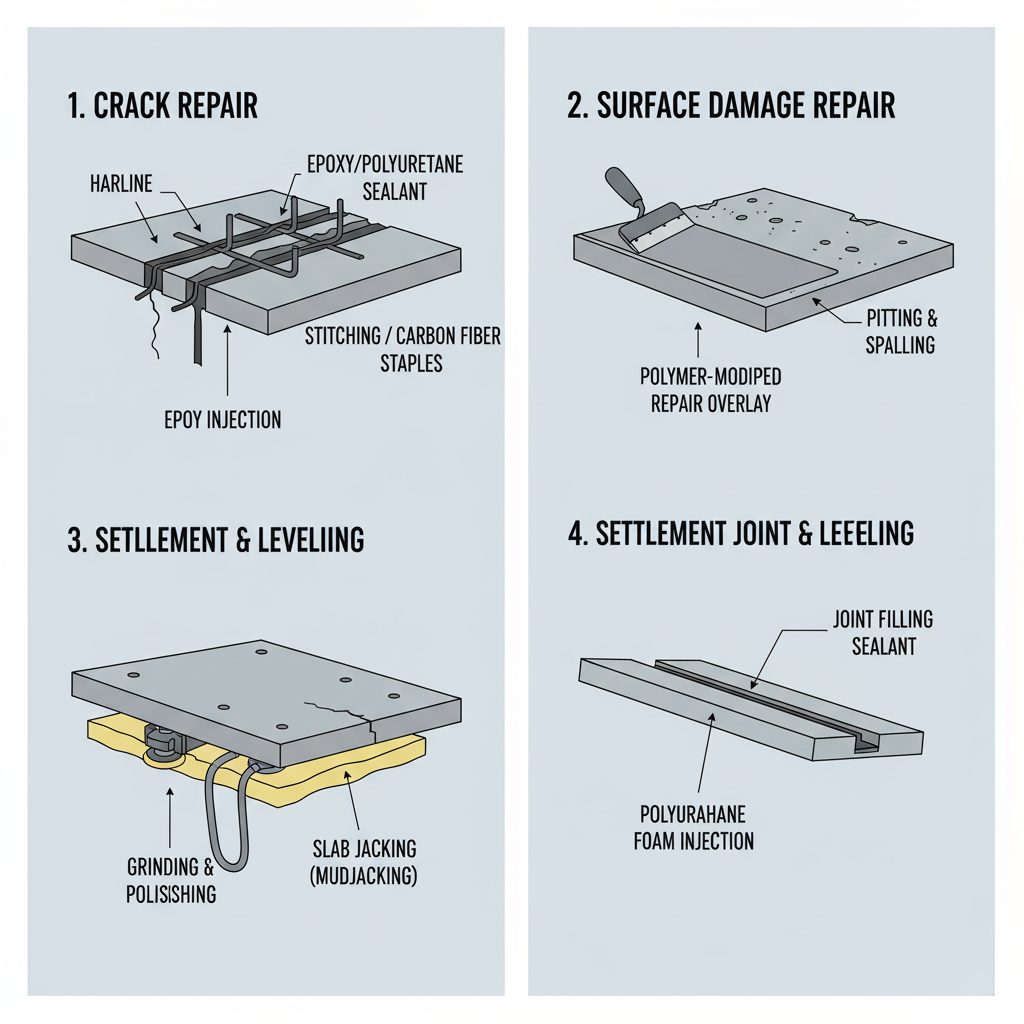
Settlement cracks present serious challenges because simply filling the crack without addressing underlying soil issues guarantees recurrence. The repair strategy must address both the soil void and the crack itself—often requiring mudjacking or polyurethane foam injection beneath the slab to fill voids and stabilize soil, followed by crack repair once the slab position has been corrected.
Expansion Joint Failures
Expansion joints (control joints) are intentionally created weak points that allow concrete slabs to expand and contract without generating random cracks elsewhere. When these joints fail—through deterioration of joint filler material, improper initial installation, or movement exceeding design capacity—cracks develop adjacent to or through the joint.
Failed expansion joints create maintenance issues as the crack allows water infiltration, debris accumulation, and continued damage from freeze-thaw cycles in cold climates. The joint edges may spall and chip, creating wider openings that worsen over time.
Repairing failed expansion joints requires flexible materials that accommodate ongoing movement. Rigid epoxy repairs fail quickly as continued joint movement cracks the hardened epoxy. Polyurethane sealants or specialized joint fillers that maintain flexibility provide appropriate solutions.
Crack Injection Method Explained
Crack injection represents the most effective method for achieving structural repair and complete crack sealing through the full slab thickness. The technique forces liquid repair materials deep into cracks under pressure, filling the crack from bottom to top.
Epoxy Injection for Structural Repair
Epoxy injection provides structural repair that restores concrete to near-original strength. The process uses low-viscosity epoxy resins that penetrate deep into cracks, then harden to create strong bonds between crack faces that effectively reunite the separated concrete.
The epoxy materials consist of two components—resin and hardener—that mix immediately before injection. Once mixed, the epoxy remains workable for limited time (typically 20 to 40 minutes depending on formulation) before beginning to harden. Complete cure requires 24 to 72 hours, during which the epoxy achieves full strength.
Structural epoxy injection works best for static cracks that have stopped moving—typically shrinkage cracks, stable settlement cracks after soil stabilization, or structural cracks in sound concrete where loads won’t increase. The rigid cured epoxy effectively locks the crack closed, preventing reopening but also preventing any future movement accommodation.
For basement floors and foundation applications where structural integrity restoration matters, epoxy injection represents the gold standard repair method. The technique provides nearly 100% restoration of structural integrity across the crack plane when properly executed.
Polyurethane Injection for Waterproofing
Polyurethane injection prioritizes waterproofing and flexibility over pure structural strength. The materials react with moisture, expanding to fill cracks and creating foam-like structures that seal against water infiltration while maintaining some elasticity.
Modern hydrophilic polyurethane formulations prove particularly valuable for repairing actively leaking cracks. These products can be injected into wet cracks—something impossible with epoxy which requires dry conditions—and actually utilize moisture in the crack to drive the expansion reaction. This characteristic makes polyurethane ideal for basement walls and floors with active water infiltration.
The expanded polyurethane remains somewhat flexible after curing, allowing it to accommodate minor crack movement without failing. This flexibility makes polyurethane appropriate for cracks that may experience ongoing minor movement—though it provides less structural strengthening than rigid epoxy.
For active cracks that continue moving—perhaps due to seasonal soil movement or thermal cycling—polyurethane injection proves more durable than rigid epoxy. The material’s flexibility allows it to stretch and compress with crack movement rather than debonding or cracking like rigid repairs.
Equipment & Materials Required
Professional crack injection requires specialized equipment including injection ports (surface-mounted fittings that provide access points for injecting materials into the crack), injection pump (mechanical or pneumatic pump that forces materials into cracks under controlled pressure), mixing equipment for combining two-part epoxy or polyurethane components, and crack preparation tools including grinders, wire brushes, and surface sealants.
Material requirements vary by crack type and repair goals. Epoxy injection typically uses low-viscosity structural epoxies rated for crack widths from 0.003 to 0.25 inches or wider, with specific products selected based on crack characteristics and temperature conditions. Polyurethane injection employs either hydrophilic formulations that react with water for wet conditions, or hydrophobic polyurethanes for dry applications.
Surface sealants temporarily seal crack faces preventing injected materials from leaking out during the injection process. These sealants must bond to concrete but remain removable after repair completion.
Installation Process Step-by-Step
Professional epoxy or polyurethane injection follows systematic procedures ensuring complete crack filling and effective repair. The process begins with surface preparation—cleaning the crack and surrounding area of dirt, oil, loose concrete, and contaminants that would prevent adhesion. Crack preparation may include grinding or routing to create clean edges if the crack shows spalling or deterioration.
Injection ports are installed along the crack at spacing determined by crack width and depth—typically 8 to 16 inches apart for basement floor cracks. The ports attach to the surface using quick-setting adhesive or mechanical fasteners. Surface sealing closes the crack between ports using epoxy paste or polyurethane caulk, creating a channel that forces injected material to flow through the crack depth rather than leaking out at the surface.
Injection proceeds systematically, typically starting at the lowest point if the crack is vertical, or at one end for horizontal cracks. Material is pumped into each port until it appears at the next port downstream, indicating the crack section has filled completely. The process continues port-by-port until the entire crack receives material.
Curing time varies by product—epoxy typically requires 24 to 72 hours for full strength development, while polyurethane may cure faster or slower depending on formulation and moisture conditions. Ports and surface sealant are removed after curing, and surfaces are ground smooth if necessary for aesthetic requirements.
Surface Patching Methods
Surface patching addresses cracks through materials applied to the slab surface rather than injected into depth. These methods prove effective for cosmetic repairs, sealing hairline cracks, and situations where full structural repair isn’t necessary.
Polymer-Modified Patching Compounds
Polymer-modified patching compounds combine portland cement with polymers that enhance adhesion, flexibility, and durability compared to plain cement-based patches. The polymer content—typically latex, acrylic, or epoxy—improves bonding to existing concrete and reduces shrinkage that causes patch failures.
These compounds work well for filling wider cracks and small surface defects, creating durable repairs that withstand traffic and environmental exposure. Application involves preparing the crack by cleaning and sometimes widening through routing, mixing the compound per manufacturer instructions, and troweling material into the crack slightly overfilled.
Curing requires keeping the patch moist for several days to ensure proper strength development. Most polymer-modified patches achieve sufficient strength for light traffic within 24 hours and full cure within 7 days.
The limitation: these surface patches provide minimal structural repair. They seal cracks and restore appearance but don’t restore load transfer across deep cracks or strengthen weakened slabs significantly.
Hydraulic Cement Applications
Hydraulic cement sets rapidly even under wet conditions, making it valuable for repairing actively leaking cracks in basement floors and walls. The material begins setting within minutes of mixing and develops substantial strength within hours.
The rapid set proves both advantage and limitation. For emergency repairs of active leaks, hydraulic cement can stop water infiltration quickly, allowing permanent repairs to proceed later under dry conditions. However, the rapid set leaves little working time, and the material’s rigidity makes it prone to cracking if applied too thickly or in applications requiring flexibility.
Hydraulic cement works best for small repairs, filling specific leak points, or temporary measures before permanent repairs. For comprehensive crack repair, polymer-modified compounds or injection methods generally provide superior long-term performance.
Resurfacing vs Spot Repair
Surface repair strategies range from addressing individual cracks to complete slab resurfacing depending on damage extent and aesthetic goals. Spot repairs involve treating individual cracks with appropriate patching materials, grinding or routing cracks if necessary, filling with selected compounds, and feathering edges to blend with surrounding concrete. This approach minimizes cost and disruption for isolated damage.
Complete resurfacing covers the entire slab with thin overlay material—typically 1/8 to 1/4 inch thick—creating new surface that conceals cracks and deterioration while providing fresh, uniform appearance. Resurfacing requires thorough surface preparation, application of bonding agents, and proper curing of overlay materials.
The decision between spot repair and resurfacing depends on crack extent, aesthetic requirements, and budget considerations. Multiple scattered cracks covering significant slab area often justify resurfacing rather than dozens of individual spot repairs.
Self-Leveling Overlays
Self-leveling overlay compounds provide convenient resurfacing solutions for interior concrete floors. These specialized materials flow easily when poured, seeking level surfaces without extensive troweling or finishing work. The compounds typically cure to smooth, hard surfaces suitable for most interior applications.
Application involves thorough surface preparation to ensure bonding, priming the existing concrete if required, mixing overlay compound to proper consistency, and pouring material while using gauge rakes to control thickness. The material self-levels within minutes, requiring only edge finishing and minor touchup.
Self-leveling overlays prove particularly effective for basement floors where multiple cracks exist and level, smooth surfaces are desired. A technique that works exceptionally well based on extensive project experience: V-routing major cracks plus epoxy injection for structural repair, followed by self-leveling overlay for superior visual finish. This provides both structural restoration and excellent aesthetics—ideal for finished basements where appearance matters.
Crack Injection: Pros & Cons
Understanding crack injection advantages and limitations helps determine when this premium repair method justifies its higher costs compared to surface treatments.
Structural Integrity Restoration
Epoxy crack injection provides the most significant advantage: near-complete restoration of structural integrity across the crack plane. The hardened epoxy effectively rebonds separated concrete, creating a repair often stronger than the surrounding concrete. Load transfer across the crack returns to pre-cracking levels, preventing further deterioration from differential movement.
This structural restoration proves essential for cracks in load-bearing slabs, foundation elements, or locations where structural performance matters for safety or function. For basement floors supporting finished living spaces, walls, or equipment loads, the structural restoration justifies premium costs.
Cost Considerations
Professional crack injection typically costs $400 to $800 per crack for typical residential applications spanning 10 to 15 linear feet, based on current 2025 market rates. The cost includes materials, specialized equipment, skilled labor, and warranty coverage from reputable contractors.
DIY injection proves challenging due to equipment requirements and technique demands. While injection kits are available for homeowner use, achieving professional results requires practice, proper equipment operation, and understanding of material properties. Most homeowners attempting DIY injection achieve inferior results compared to professional work.
The higher cost compared to surface patching—which runs $2 to $5 per linear foot for DIY work—must be weighed against the structural benefits and longevity injection provides. For critical structural repairs, the premium proves worthwhile. For purely cosmetic hairline cracks, surface treatments may suffice.
Best Applications
Crack injection excels in specific situations: structural cracks exceeding 1/4 inch requiring strength restoration, basement floors and walls where complete waterproofing through slab thickness is essential, cracks in load-bearing elements where structural performance matters, and situations where long-term durability justifies higher initial investment.
For basements, my consistent recommendation: always use professional injection for structural cracks—those showing vertical displacement, penetrating full slab thickness, or carrying significant loads. The investment ensures structural integrity and prevents progressive failure that surface treatments cannot address.
Surface Patching: Pros & Cons
Surface patching methods offer distinct advantages for specific applications while accepting limitations compared to injection techniques.
Cosmetic vs Structural Effectiveness
Surface patching effectively addresses cosmetic concerns—sealing hairline cracks, smoothing rough areas, and creating uniform appearances. However, these methods provide minimal structural strengthening. The patch material adheres to crack surfaces but doesn’t penetrate crack depth or restore load transfer across deep cracks.
For non-structural applications where appearance matters more than strength—garage floors, patios, basement floors in storage areas—surface patching delivers adequate performance at lower cost. For structural elements or situations requiring waterproofing through full slab thickness, surface patches prove insufficient.
Cost Benefits
Surface patching offers substantial cost advantages: DIY materials cost $2 to $5 per linear foot, professional surface patching runs $5 to $15 per linear foot, and complete resurfacing costs $3 to $8 per square foot—all significantly less than injection methods.
The lower costs make surface patching attractive for addressing multiple minor cracks, purely cosmetic repairs, or situations where budget constraints prevent premium repair methods. The cost savings prove particularly meaningful when treating extensive cracking across large slab areas.
Longevity Expectations
Properly executed surface patches can last 5 to 15 years depending on traffic, environmental exposure, and whether underlying crack causes have been addressed. However, patches typically fail sooner than injection repairs, particularly for active cracks that continue moving.
The most common mistake I observe: using cosmetic surface patching methods for structural problems—superficially patching a 1/2-inch settlement crack only temporarily masks the problem. Without addressing underlying settlement and achieving structural repair, the patch will fail within months to a few years as movement continues.
DIY vs Professional Repair Decision Matrix
Understanding when DIY approaches prove adequate and when professional services become essential helps allocate budgets appropriately and avoid ineffective repairs.
When DIY Is Appropriate
DIY concrete repair makes sense for hairline cracks (under 1/8 inch) that are purely cosmetic, surface damage in non-structural elements like garage floors or patios, stable cracks showing no ongoing movement or water infiltration, and situations where budget constraints prevent professional services.
Home Depot and similar retailers stock effective DIY products for these applications—concrete crack repair caulks, polymer-modified patching compounds, and epoxy repair kits. Following manufacturer instructions carefully, capable homeowners achieve satisfactory results for appropriate applications.
The key limitation: DIY methods work well for cosmetic repairs of minor, stable cracks but cannot effectively address structural issues or achieve the penetration and bonding that professional injection provides.
When Professional Service Is Required
Professional concrete repair becomes mandatory for structural cracks exceeding 1/4 inch, any crack showing vertical displacement or ongoing movement, basement floor or wall cracks where complete waterproofing is essential, and cracks in load-bearing elements where structural integrity matters.
Additionally, extensive cracking affecting large slab areas, situations where improper repair could create liability issues, and cases where warranty coverage provides important protection all justify professional services despite higher costs.
Professional contractors bring specialized equipment, technical expertise, proven materials and techniques, and warranty backing that DIY approaches cannot match. For critical repairs where failure consequences prove expensive or dangerous, professional service represents the only appropriate choice.
Cost Comparison
The economic analysis between DIY and professional repair varies dramatically by application. For small hairline crack repairs in a garage floor, DIY costs of $20 to $50 in materials versus professional costs of $200 to $400 make DIY clearly economical. For structural crack injection in a basement floor, DIY equipment costs of $200+ plus materials and uncertain results versus professional costs of $400 to $800 with guaranteed outcomes favor professional service.
The calculation must also consider opportunity costs of homeowner time, risk of inadequate repair requiring professional correction, and value of warranty coverage professionals provide. For many homeowners, the peace of mind from professional work justifies the premium even when DIY might prove technically feasible.
Material Selection Guide
Selecting appropriate repair materials for specific crack types and conditions determines repair effectiveness and longevity.
Epoxy Products Comparison
Structural crack repair epoxies vary in viscosity, cure time, temperature range, and strength characteristics. Low-viscosity epoxies (consistency like water) penetrate narrow cracks effectively but require careful surface sealing to prevent leakage. Medium-viscosity products balance penetration and handling characteristics for typical crack widths. Fast-cure formulations set within hours, allowing quick return to service but leaving little working time. Standard-cure products offer extended working time with strength development over 24 to 72 hours.
Temperature-rated epoxies accommodate hot or cold conditions—important for exterior applications or when working in extreme weather. Specialty formulations address specific needs like flexibility for active cracks or enhanced water resistance for submerged applications.
Polyurethane Sealants
Polyurethane crack repair products fall into two main categories: hydrophilic formulations that react with water, expanding to fill cracks and seal against active leaks, ideal for wet basement conditions; and hydrophobic formulations that repel water, suitable for dry cracks where waterproofing and flexibility are desired.
Single-component polyurethanes simplify application by eliminating mixing requirements, while two-component systems offer more controlled curing and potentially superior performance. Flexible polyurethanes maintain elasticity after curing, accommodating crack movement better than rigid epoxies.
The advances in polyurethane technology over the past five years have been significant—modern hydrophilic polyurethane products can be injected into actively wet cracks with excellent results, something impossible with traditional epoxies that require dry conditions.
Patching Compound Options
Surface patching compounds range from basic cement-based materials to advanced polymer-modified formulations. Standard concrete mix or mortar provides economical repairs for non-critical applications but suffers from poor adhesion and shrinkage cracking. Polymer-modified patching compounds offer superior adhesion, reduced shrinkage, and enhanced durability at moderate cost premiums.
Epoxy patching compounds provide maximum strength and adhesion but cost significantly more and require mixing two components. Quick-setting hydraulic cements stop active leaks rapidly but work best for small repairs due to limited working time.
Brand Recommendations
While avoiding excessive product endorsement, certain manufacturers consistently deliver quality repair materials. For epoxy injection, Simpson Strong-Tie Crack-Pac system and Sikadur crack injection products receive strong professional recommendations. For polyurethane injection, Prime Resins EC-300 and similar hydrophilic formulations perform reliably. For surface patching, Quikrete concrete repair products provide good value for DIY applications, while Euclid Chemical and BASF MasterEmaco lines serve professional contractors well.
Surface Preparation Requirements
Proper surface preparation determines repair success regardless of method or materials selected. Inadequate preparation causes the majority of premature repair failures.
Cleaning and Degreasing
All concrete surfaces must be thoroughly cleaned before repair materials are applied. Dirt, dust, oils, curing compounds, and other contaminants prevent proper adhesion, causing repairs to debond prematurely.
Cleaning methods include wire brushing for loose debris, pressure washing for general cleaning, degreasing solvents for oil-contaminated areas, and mechanical abrasion for stubborn surface contaminants. The goal: exposing clean, sound concrete with no contamination layer between repair material and substrate.
For injection repairs, crack faces must be blown clean with compressed air after surface cleaning, removing all loose particles from within the crack that could prevent bonding.
Crack Routing and Chasing
Routing involves cutting along cracks with grinders or specialized crack-chasing tools, creating uniform V-grooves or channels that improve repair effectiveness. The process removes weak, spalled concrete along crack edges, creates mechanical interlock for patching materials, and exposes sound concrete for bonding.
Typical routing creates grooves 1/4 to 1/2 inch wide and deep, though dimensions vary based on crack size and repair method. The V-shape (wider at top than bottom) helps lock patching materials in place mechanically.
Not all cracks require routing—hairline cracks treated with surface sealers or injection methods often skip this step. However, wider cracks showing deterioration along edges benefit from routing that removes damaged material before repair.
Moisture Testing
Moisture content in concrete affects repair material selection and application success. Excess moisture prevents proper bonding of many materials, while completely dry concrete may need dampening before cement-based repairs.
Moisture testing methods include plastic sheet testing (tape plastic over concrete, check for condensation after 24 hours), moisture meters for quantitative readings, and visual observation for obvious dampness. Many epoxies require moisture content below 4% to 6% for successful bonding, while polyurethanes and some patching compounds tolerate higher moisture levels.
Step-by-Step Repair Procedures
Systematic repair procedures ensure complete, effective crack treatment regardless of method selected.
Epoxy Injection Process
Professional epoxy crack injection follows specific sequences ensuring complete crack filling and maximum strength development. Begin with thorough crack cleaning using wire brushes and compressed air, removing all loose material and contaminants. Install injection ports along the crack at appropriate spacing—typically 6 to 12 inches for basement floor cracks depending on crack width and depth.
Apply surface sealant along the crack between ports, creating closed channel that forces injected epoxy to flow through crack depth. Allow sealant to achieve initial set per manufacturer recommendations before beginning injection.
Mix epoxy components according to package directions, ensuring thorough combination but avoiding excessive air entrainment from overly vigorous mixing. Load mixed epoxy into injection equipment and begin pumping into the lowest port or one end of horizontal cracks.
Continue injection at each port until epoxy appears at the adjacent port, indicating complete filling of that crack section. Proceed systematically through all ports until the entire crack receives material. Allow full cure time—typically 24 to 72 hours—before removing ports and surface sealant. Grind smooth any remaining surface irregularities if aesthetic requirements demand.
Surface Patching Application
Surface patching proceeds through preparation, application, and finishing phases. Prepare the crack by routing if necessary, thoroughly cleaning all surfaces, and dampening for cement-based patches (or ensuring dryness for epoxy patches) as appropriate for the selected material.
Mix patching compound to proper consistency—typically thick paste for trowel application. Apply material into the crack, overfilling slightly and working material into crack depth with troweling action. Feather edges to blend with surrounding concrete.
For wider cracks or patches, apply in layers rather than single thick applications to minimize shrinkage cracking. Each layer should be 1/4 to 1/2 inch maximum thickness, with additional layers applied after previous layers achieve initial set.
Finish the patch surface to match surrounding concrete—smooth trowel finish for interior floors, broomed texture for exterior applications, or specific finishes matching existing surfaces. Implement proper curing by keeping patches moist for several days, ensuring strength development and minimizing shrinkage.
Curing Times & Traffic Considerations
Curing time requirements vary substantially by material type and application conditions. Epoxy injection repairs typically require 24 hours minimum before light foot traffic and 48 to 72 hours before heavy loads or vehicular traffic. Full strength develops over 7 days.
Polyurethane injection cures faster in some formulations, potentially allowing traffic within 6 to 12 hours, though full cure may require 24 hours. Cement-based patching compounds require 24 to 48 hours for light traffic and 7 days for full strength development and heavy loads.
Environmental conditions affect curing—cold temperatures slow all chemical reactions, extending cure times, while hot conditions may accelerate setting but can compromise final properties if moisture evaporates too quickly from cement-based repairs.
Preventing Future Slab Damage
Effective crack repair addresses existing damage, but preventing recurrence requires identifying and mitigating underlying causes.
Proper Drainage Around Slabs
Water-related damage—settlement from soil erosion, freeze-thaw deterioration, and moisture-induced movement—accounts for substantial concrete slab distress. Proper drainage systems prevent water accumulation that causes these problems.
Surface grading should slope away from slabs, carrying runoff away from concrete edges. Minimum slope of 6 inches drop in first 10 feet prevents water ponding adjacent to slabs. Gutters and downspouts must discharge water well away from concrete—at least 5 to 10 feet from slab edges where practical.
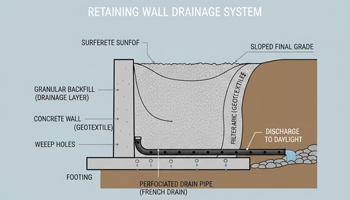
Foundation drains around basement slabs collect groundwater before it reaches the slab, reducing hydrostatic pressure and moisture infiltration. These perforated pipes in gravel beds should discharge to daylight or sump systems.
Addressing drainage issues represents the single most important step in preventing future concrete damage. Repairing cracks without improving drainage guarantees recurrence as water continues causing the problems that created initial damage.
Control Joint Maintenance
Control joints create intentional weak planes where concrete cracks predictably rather than randomly. Maintaining these joints prevents deterioration that allows random cracking and water infiltration.
Joint maintenance involves removing deteriorated filler material, cleaning joint faces thoroughly, and installing new flexible sealant appropriate for joint movement. The sealant must accommodate expansion and contraction without losing adhesion or tearing.
Joint sealants require periodic replacement—typically every 5 to 10 years depending on exposure and product quality. Maintaining joints costs far less than repairing random cracks that develop when joints fail.
Soil Stabilization
Settlement cracks result from soil movement beneath slabs. Stabilizing soil prevents continued settlement and crack development.
Stabilization methods include compaction grouting that fills voids and densifies loose soil, polyurethane foam injection that fills voids while lifting settled slabs, and drainage improvements that prevent soil erosion and consolidation from water infiltration.
The most critical point from extensive project observation: not addressing the root cause—repairing cracks without soil stabilization, drainage improvement, or load reduction—guarantees failure recurrence. The repair investment is wasted when underlying problems continue generating new damage.
Cost Analysis: Repair Methods Compared
Understanding true costs enables informed decisions balancing immediate expenses against long-term value and performance.
Material Costs
Material costs vary substantially between repair methods. DIY surface patching materials typically cost $2 to $5 per linear foot for quality polymer-modified compounds or concrete repair caulks. Professional-grade patching materials run $3 to $8 per linear foot when purchased in contractor quantities.
Epoxy crack injection materials cost $50 to $150 per crack for typical 10 to 15-foot residential applications when buying retail injection kits. Professional contractors purchasing bulk materials may achieve material costs of $30 to $80 per crack but require amortizing equipment costs across multiple jobs.
Polyurethane injection materials run similar or slightly higher costs than epoxy—$60 to $180 per crack for retail kits or $40 to $100 for professional materials. Complete resurfacing overlay materials typically cost $0.50 to $2.00 per square foot depending on product selection and thickness.
Labor Rates
Labor represents the dominant cost component for professional repairs. Professional surface patching typically runs $3 to $10 per linear foot for labor, bringing total installed costs to $5 to $15 per linear foot including materials.
Crack injection labor costs $300 to $700 per crack for typical residential applications, bringing total costs including materials to $400 to $800 per crack. Complete slab resurfacing labor runs $2 to $6 per square foot, yielding total installed costs of $3 to $8 per square foot.
These labor costs reflect skilled professional rates, appropriate for quality work with warranty backing. Lower-priced providers may offer reduced rates but often deliver inferior results or lack proper insurance and warranty protection.
Long-Term Value Assessment
Evaluating repair methods over time rather than initial cost alone reveals true economic value. A surface patch costing $100 that lasts 3 to 5 years before requiring replacement costs $20 to $33 per year. An injection repair costing $600 that lasts 15 to 25 years costs $24 to $40 per year—comparable annual costs despite dramatically different initial investments.
However, the comparison becomes less straightforward when considering that the injection repair provides structural strengthening and complete waterproofing that surface patches cannot match. For critical applications, the performance difference justifies injection costs regardless of annual cost calculations.
The economic decision should account for consequences of repair failure—a failed cosmetic patch in a garage floor creates minor inconvenience, while failed repair of structural basement cracks can generate thousands in water damage, mold remediation, and structural corrections.
Need help deciding between crack injection and surface patching for your concrete slab repair? Share details about your crack characteristics, location, and repair goals for customized guidance on the most effective and economical approach for your specific situation.
References
Currently viewing
Concrete Slab Repair
Structural Engineer vs Foundation Contractor
Structural Engineer vs Foundation Contractor: When You Need Each Understanding the distinction between structural engineers…
Basement Moisture Testing
Basement Moisture Testing: Before Starting Renovation Projects Moisture testing represents the single most overlooked yet…
Retaining Wall Drainage
Retaining Wall Drainage: Weep Holes, Backfill & Filter Fabric Drainage represents the single most critical…

Basement Insulation
Basement Insulation: Rigid Foam vs Spray Foam for Concrete Walls Basement insulation strategy fundamentally affects…

Egress Window Requirements
Egress Window Requirements: Code Compliance & Installation Cost Egress windows represent one of the most…
Basement Structural Framing
Basement Structural Framing: Load-Bearing Walls & Beam Sizing Understanding basement structural framing represents one of…

Basement Finishing Cost
Basement Finishing Cost: Framed Drywall vs Modular Panels Finishing a basement transforms unused square footage…
Retaining Wall Design
Retaining Wall Design: Concrete vs Block vs Segmental Systems Selecting the right retaining wall system…
Basement & Foundation Structural
Structural Solutions for Basements & Foundations: Complete Engineering Guide Foundation and basement structural engineering represents…