
Basement Insulation: Rigid Foam vs Spray Foam for Concrete Walls
Basement insulation strategy fundamentally affects both energy efficiency and long-term structural health of your home. The choice between rigid foam board and spray foam insulation for concrete basement walls determines not only heating and cooling costs but also moisture management, comfort levels, and potential for mold growth—making this decision far more consequential than simple material cost comparisons might suggest.
The science of basement insulation has evolved dramatically over the past 10 to 15 years. The old standard approach—fiberglass batts installed between studs against concrete walls—is no longer acceptable under most building codes and represents terrible practice from a moisture management perspective. Modern building science recognizes that basement walls face unique challenges including cold concrete surfaces that create condensation risks, moisture migration through foundation materials, and the need for continuous thermal barriers that prevent heat loss while managing water vapor.
Understanding these challenges helps explain why rigid foam board and spray foam have become the two dominant insulation strategies for basement walls, each offering distinct advantages for specific situations and budgets. Rigid foam provides economical thermal performance with good moisture control when properly installed, typically costing $2.50 to $4.00 per square foot installed. Spray foam delivers superior air sealing and moisture resistance but commands premium pricing at $3.50 to $5.00+ per square foot for professional installation.
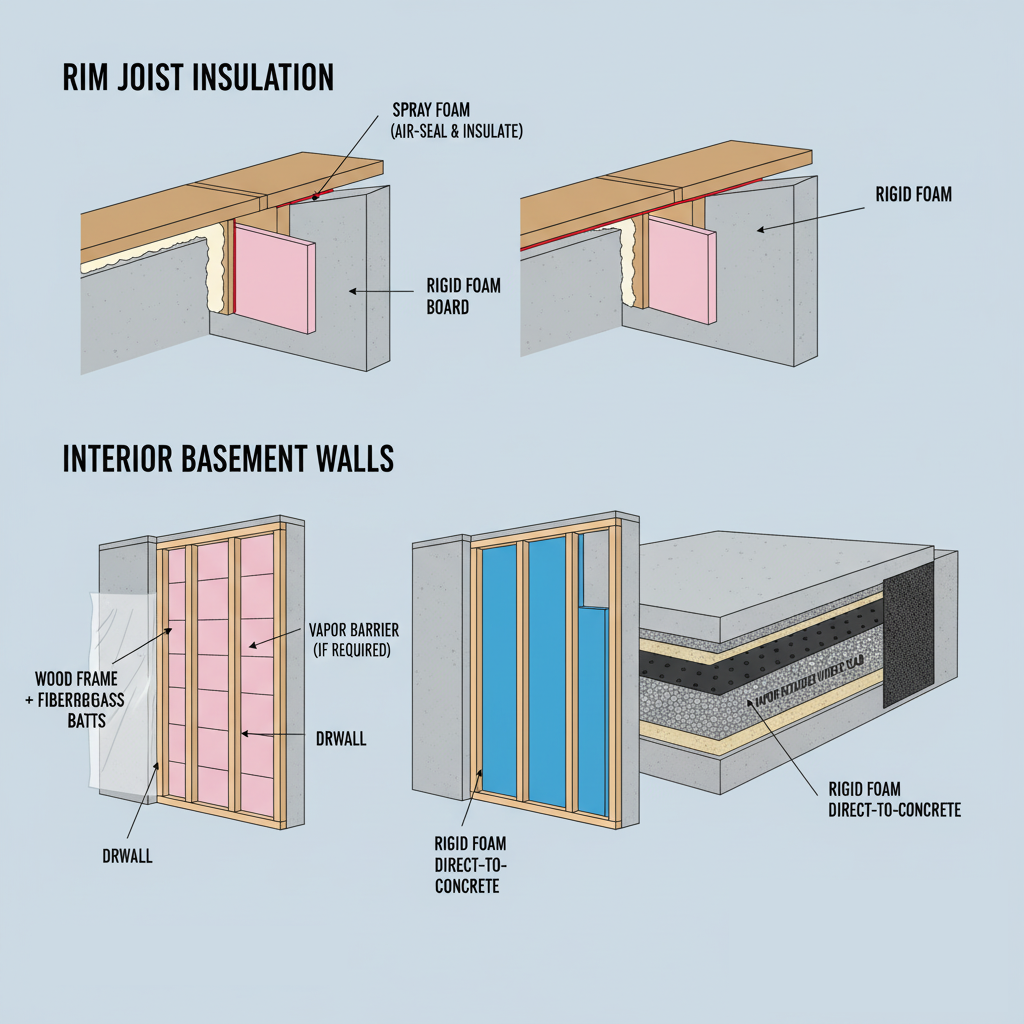
After specifying basement insulation for countless residential projects, my standard recommendation for most applications involves 2 inches of XPS rigid foam (R-10) adhered directly to concrete, followed by 2×4 framing with optional fiberglass cavity insulation for additional R-value. This approach provides continuous thermal break, adequate vapor barrier properties, space for electrical and plumbing in the stud cavity, and reasonable costs. However, for basements with historical moisture issues or in particularly humid climates, closed-cell spray foam at 2 to 3 inches thickness proves superior despite higher costs, delivering perfect air sealing, exceptional vapor barrier performance, and R-6.5 per inch thermal resistance.
This comprehensive guide compares rigid foam and spray foam insulation systems, examines installation methods and costs, explains critical moisture management principles, and identifies the best applications for each approach based on building science and real-world performance data.
Why Basement Insulation Strategy Matters
Basement insulation affects far more than energy bills—it influences structural durability, indoor air quality, comfort, and home value through interconnected performance characteristics.
Energy Efficiency Impact
Uninsulated basement walls create massive heat loss in winter and unwanted heat gain in summer, forcing HVAC systems to work harder and consume more energy. Concrete conducts heat readily, with typical R-values of only 0.08 per inch—meaning an 8-inch concrete wall provides only R-0.64 of thermal resistance, virtually nothing compared to code requirements.
A well-insulated basement can reduce overall home heating and cooling loads by 20% to 35%, enabling smaller, more efficient HVAC equipment in whole-home renovations. This load reduction can offset significant portions of insulation costs through equipment downsizing opportunities and ongoing energy savings.
The energy payback period for basement insulation typically spans 7 to 12 years depending on climate zone and local energy costs. However, this calculation addresses only financial returns—the comfort benefits of uniform temperatures, elimination of cold floors, and reduced drafts prove valuable from day one regardless of energy cost calculations.
Moisture Management Concerns
Moisture represents the critical challenge in basement insulation, with improper strategies creating mold growth, material deterioration, and indoor air quality problems that dwarf any energy efficiency benefits. Concrete naturally absorbs moisture from surrounding soil and transmits it inward through capillary action and vapor diffusion.
When warm, humid interior air contacts cold concrete surfaces, condensation forms, creating ideal conditions for mold growth on any organic materials present. Traditional fiberglass insulation installed against concrete provides no barrier to this moisture, absorbs condensation like a sponge, and supports mold growth when wet.
Effective basement insulation strategies must address moisture by creating vapor-resistant layers on the cold side of the insulation assembly, maintaining concrete temperatures above dew point to prevent condensation, and avoiding moisture traps where water accumulates without drying paths.
The most critical errors I observe repeatedly: using open-cell spray foam on basement walls where it absorbs moisture like a sponge, installing vapor barriers on the warm (interior) side that trap moisture and guarantee mold problems, and failing to air-seal rim joists that account for 25% to 30% of basement thermal loss.
Understanding Basement Wall Insulation Challenges
Basement walls present unique insulation challenges that distinguish them from above-grade applications and require specialized approaches.
Concrete Thermal Properties
Concrete’s thermal mass and conductivity create distinct performance characteristics. The material absorbs and stores heat, moderating temperature swings over daily cycles. However, when in constant contact with cold earth, concrete continuously loses heat to the ground, requiring substantial insulation to maintain comfortable interior temperatures.
The thermal conductivity of concrete—its tendency to transfer heat—means thin insulation layers prove insufficient. Code minimum R-values for basement walls typically range from R-10 in warm climates to R-15 or R-20 in cold regions, requiring 2 to 4 inches of foam insulation depending on product type and climate zone.
Moisture Migration Through Foundation
Moisture moves through and around foundation walls through multiple mechanisms. Capillary action draws water upward through concrete pores from surrounding soil, with older foundations lacking modern waterproofing particularly vulnerable. Vapor diffusion allows water molecules to migrate through concrete from high-concentration areas (exterior soil) toward low-concentration areas (basement interior).
Hydrostatic pressure from groundwater forces moisture through cracks, gaps, and porous concrete when water tables rise or drainage systems fail. Managing these moisture sources requires exterior waterproofing ideally, though interior insulation strategies must accommodate some moisture migration without creating problems.
Condensation Risks
Condensation forms when warm, moisture-laden air contacts surfaces below the dew point temperature. In summer, hot humid outdoor air entering basements contacts cold concrete surfaces, creating condensation. In winter, warm interior air that penetrates insulation and reaches cold concrete also condenses.
Proper insulation placement and vapor control prevents these condensation scenarios by keeping concrete surfaces warm enough to remain above dew point temperatures, creating vapor-resistant barriers on the cold side of assemblies, and eliminating air leakage paths that allow warm, humid air to reach cold surfaces.
Code Requirements for Basement Insulation
Building codes establish minimum insulation levels based on climate zones. The International Energy Conservation Code (IECC) and equivalent state codes specify requirements ranging from R-10 in warm climates (zones 1-2) to R-15 or R-20 in cold climates (zones 6-7).
Beyond R-value minimums, codes address fire safety by requiring that foam insulation be covered with fire-rated materials—typically ½-inch drywall—that provide 15-minute thermal barriers protecting foam from ignition. Codes also specify vapor retarder requirements in certain climates, though basement applications differ from above-grade walls.
Rigid Foam Insulation: Types & Specifications
Rigid foam boards come in several formulations, each with distinct characteristics affecting performance, cost, and appropriate applications.
EPS (Expanded Polystyrene)
Expanded polystyrene—the white beaded foam familiar from packaging and coffee cups—provides economical insulation at R-3.6 to R-4.2 per inch depending on density. The material is manufactured by expanding polystyrene beads with steam, creating lightweight boards with small beads visible on cut edges.
EPS advantages include lowest cost among rigid foam options ($0.30 to $0.50 per square foot per inch of thickness), good long-term R-value stability, and permeable to water vapor allowing some drying. Disadvantages involve lower R-value per inch requiring thicker installations, water absorption if not protected from moisture exposure, and less structural rigidity than denser foam types.
For basement applications, EPS works adequately when protected from moisture and used in thicker installations (3 to 4 inches) to achieve code-required R-values. The lower cost can offset the thickness requirement for budget-conscious projects.
XPS (Extruded Polystyrene)
Extruded polystyrene—typically pink, blue, or green depending on manufacturer—provides R-5 per inch with denser structure and better moisture resistance than EPS. The manufacturing process extrudes molten polystyrene through dies, creating uniform closed-cell structure with smooth surfaces.
XPS represents the most popular basement insulation choice based on extensive project experience, balancing performance, moisture resistance, and cost. The material costs approximately $0.40 to $0.70 per square foot per inch of thickness—moderately more than EPS but substantially less than spray foam.
XPS advantages include good R-value per inch allowing thinner installations, excellent moisture resistance with minimal water absorption, easy cutting and handling, and vapor semi-impermeability that slows moisture migration without completely preventing drying. The material maintains R-value over time better than some alternatives and provides dimensional stability for reliable long-term performance.
For typical basement wall applications, 2 inches of XPS (R-10) adhered directly to concrete provides adequate thermal resistance for moderate climates while creating effective vapor-slowing layer. The material costs $1.80 to $2.50 per square foot for materials alone, or $2.50 to $4.00 per square foot professionally installed.
Polyisocyanurate (Polyiso)
Polyisocyanurate boards—often foil-faced—deliver the highest R-value per inch among rigid foam options at R-6 to R-6.5 per inch when new. The material consists of closed-cell foam with facings that create vapor barriers and provide structural reinforcement.
Polyiso advantages include maximum R-value per inch minimizing installation thickness, foil facings that reflect radiant heat, and good fire resistance compared to polystyrene products. However, significant disadvantages limit basement applications: R-value decreases substantially at cold temperatures (potentially dropping to R-4 to R-4.5 per inch at temperatures below 40°F), moisture sensitivity that can degrade performance, and higher cost at $0.60 to $0.90 per square foot per inch.
For basement walls that remain cold for extended periods, polyiso’s temperature-dependent R-value performance makes it less ideal than XPS despite the nominal higher R-value rating. The material works better in above-grade applications where temperatures remain moderate.
R-Value Comparison by Thickness
Understanding R-value per inch helps determine required thickness for code compliance:
1-inch thickness:
- EPS: R-3.6 to R-4.2
- XPS: R-5
- Polyiso: R-6 to R-6.5 (at room temperature, lower when cold)
2-inch thickness:
- EPS: R-7.2 to R-8.4
- XPS: R-10
- Polyiso: R-12 to R-13 (nominal)
3-inch thickness:
- EPS: R-10.8 to R-12.6
- XPS: R-15
- Polyiso: R-18 to R-19.5 (nominal)
For basement applications in moderate climates requiring R-10, XPS at 2 inches provides adequate performance with reasonable thickness. Cold climate requirements of R-15 to R-20 necessitate 3 to 4 inches of XPS or spray foam alternatives.
Spray Foam Insulation: Closed Cell vs Open Cell
Spray polyurethane foam insulation applies as liquid that expands and hardens, creating seamless insulation and air barrier. Two types serve different applications with dramatically different basement suitability.
Closed Cell Spray Foam Characteristics
Closed-cell spray foam consists of tiny closed cells that trap gas, creating dense, rigid foam with superior insulating and moisture-resistant properties. The material delivers R-6 to R-6.5 per inch—higher than any rigid foam board option—while providing structural reinforcement to walls.
Closed-cell foam advantages for basement applications prove substantial: exceptional R-value per inch allowing code compliance with 2 to 3-inch thickness, perfect air sealing that eliminates infiltration and convective heat loss, vapor impermeability that blocks moisture migration through foundation walls, and structural adhesion that can reinforce aging foundation walls.
The material cures to rigid, dimensionally stable foam that won’t sag, settle, or degrade over time. The vapor impermeability—sometimes cited as disadvantage in certain applications—proves beneficial for basement walls where preventing interior moisture from reaching cold concrete surfaces is critical.
Professional closed-cell spray foam installation costs $3.50 to $5.00 per square foot for 2-inch thickness, substantially more than rigid foam alternatives but delivering performance advantages that justify costs for challenging applications or quality-focused projects.
Open Cell Spray Foam Applications
Open-cell spray foam uses similar chemistry but expands more, creating lower-density foam with interconnected cells. The material provides R-3.5 to R-4 per inch—similar to fiberglass—while offering superior air sealing compared to batts.
However, open-cell foam proves completely inappropriate for basement wall applications—a critical error I observe repeatedly. The open-cell structure absorbs moisture like a sponge, providing no vapor control and supporting mold growth when exposed to the moisture present in basement environments.
Open-cell foam works well for cathedral ceilings, attic rooflines, and above-grade walls where moisture exposure remains minimal and vapor permeability allows drying. For basement applications, closed-cell foam is the only suitable spray foam option—using open-cell foam on basement walls represents one of the most common and damaging insulation mistakes.
R-Value Per Inch
The R-value efficiency of spray foam affects required installation thickness and total costs:
Closed-cell spray foam: R-6 to R-6.5 per inch allows 2 inches for R-12 to R-13, or 3 inches for R-18 to R-19.5. This efficiency means relatively thin applications satisfy code requirements even in cold climates.
Open-cell spray foam: R-3.5 to R-4 per inch (included for completeness but should not be used in basements). The lower R-value would require 4 to 5 inches for R-15, making costs prohibitive while still providing inadequate moisture control.
Vapor Barrier Properties
Closed-cell spray foam at 2+ inches thickness qualifies as Class II vapor retarder (permeability of 0.1 to 1.0 perm), effectively blocking moisture migration while allowing minimal drying. This vapor resistance prevents warm interior air from reaching cold concrete where condensation would form.
The vapor control eliminates need for separate vapor barrier layers that complicate construction and create failure points at seams and penetrations. The seamless application creates continuous barrier without gaps.
Installation Methods: Rigid Foam
Proper rigid foam installation determines performance and longevity, with several viable approaches offering different advantages.
Direct-to-Concrete Adhesive Application
Adhering rigid foam directly to concrete using appropriate adhesives creates continuous insulation layer with good thermal contact. The method uses foam-compatible adhesives—either polyurethane foam in cans for smaller projects or construction adhesive applied with caulking guns for larger installations.
Application involves cleaning concrete surfaces removing dust, oils, and loose material, applying adhesive in ribbons or dots across foam back surfaces (typical pattern: vertical ribbons 12 to 16 inches apart), pressing foam panels firmly against concrete holding for 30 to 60 seconds, and immediately sealing joints between panels with foam or tape.
This direct-adhesion approach provides several advantages: continuous contact maintains concrete above dew point temperatures minimizing condensation risk, thermal bridging through mechanical fasteners is eliminated, and installation proceeds quickly without drilling into concrete.
Mechanical Fastening Options
Mechanical fasteners—concrete screws with large washers or specialized foam fasteners—secure rigid foam when adhesive alone proves inadequate or where future removal might be desired. The fasteners penetrate through foam into concrete, with washers distributing holding forces across foam surface.
Typical fastener patterns space fasteners 16 to 24 inches apart across panel surfaces and at all panel edges. The fasteners create minor thermal bridges where heat conducts through the metal, slightly reducing overall R-value, but the impact remains minimal with proper fastener selection and spacing.
Framing Over Foam
After foam installation, wood or metal stud framing creates cavities for electrical, plumbing, and additional insulation if desired. The framing attaches to concrete through the foam using appropriate length fasteners, or builds free-standing walls that don’t penetrate the foam layer.
My standard detail: 2 inches of XPS adhered to concrete, then 2×4 framing with bottom plates fastened through foam to concrete using 3-inch concrete screws. The stud cavities can remain empty (total R-10) or receive R-13 fiberglass batts for combined R-value of R-23—well exceeding code requirements and providing excellent thermal performance.
This framing cavity provides practical benefits including routing electrical wiring without penetrating the foam vapor barrier, installing plumbing if needed, and attaching drywall over standard framing rather than specialized foam fasteners.
Sealing Joints & Penetrations
Sealing all joints, seams, and penetrations in the foam layer proves critical for both thermal performance and moisture control. Gaps allow air infiltration that defeats insulation effectiveness and creates pathways for warm, humid air to reach cold concrete surfaces.
Sealing methods include canned spray foam expanding into gaps and irregular spaces, specialized foam-compatible tape covering seams, and polyurethane caulk for smaller gaps and penetrations. All panel joints, penetrations for utilities, and transitions to other building elements require thorough sealing.
Particular attention to rim joist areas—where floor framing meets foundation tops—proves essential since these locations account for 25% to 30% of basement heat loss yet often receive minimal insulation attention.
Installation Methods: Spray Foam
Spray foam installation requires professional application with specialized equipment, though understanding the process helps ensure quality results.
Professional Application Process
Professional spray foam contractors use truck-mounted equipment that heats, pressurizes, and mixes two chemical components, then sprays the mixture through application guns. The chemicals react and expand within seconds, creating foam that adheres to all surfaces and fills gaps and voids.
The application proceeds in multiple passes—called «lifts»—with each pass adding 1 to 2 inches of thickness. Multiple lifts prevent overheating from chemical reactions while ensuring complete coverage and proper density.
Surface preparation involves masking windows, doors, and areas that shouldn’t receive foam, covering the floor with protective paper or plastic, and ensuring adequate ventilation. The spraying process generates fumes requiring occupant evacuation for several hours.
Thickness Requirements for Code
Code-compliant R-values determine required spray foam thickness. For R-15 requirements, closed-cell foam needs approximately 2.5 inches (2.5 × R-6 = R-15). For R-20 requirements, 3 to 3.5 inches provides adequate performance.
Contractors typically spray slightly thicker than minimum to ensure all areas meet requirements even where thickness varies slightly. The seamless application inherently provides uniform coverage without the gaps possible with board insulation.
Surface Preparation
Concrete surfaces must be clean, dry, and at appropriate temperatures for spray foam adhesion. Excessively damp concrete—measured above 3% to 4% moisture content—prevents proper foam adhesion and traps moisture.
Moisture testing using moisture meters confirms concrete is sufficiently dry for foam application. In particularly damp conditions, drying may require time, dehumidification, or addressing exterior moisture sources before foam application.
Temperature requirements typically specify minimum 40°F to 50°F ambient and surface temperatures for proper chemical reactions and foam expansion. Cold conditions slow reactions and reduce foam density, compromising performance.
Safety Considerations During Application
Spray foam installation involves chemical exposure requiring proper safety protocols. Occupants must vacate premises during application and for several hours afterward until fumes dissipate. Applicators wear full protective equipment including respirators, protective suits, and eye protection.
Adequate ventilation during and after application ensures fume removal. The chemicals off-gas intensely during application but cure to inert foam within hours to days depending on formulation and thickness.
These safety requirements make spray foam exclusively professional work—DIY application with consumer-grade kits proves impractical for full basement installations and carries substantial safety risks.
Cost Comparison Analysis
Understanding comprehensive costs for both systems enables informed decisions balancing performance and budget constraints.
Rigid Foam Material & Labor Costs
Material costs for rigid foam vary by type and thickness:
XPS 2-inch (R-10):
- Materials: $1.80 to $2.50 per square foot
- Installed: $2.50 to $4.00 per square foot
EPS 3-inch (R-10.8 to R-12.6):
- Materials: $0.90 to $1.50 per square foot
- Installed: $2.00 to $3.50 per square foot
Polyiso 2-inch (R-12 nominal):
- Materials: $2.00 to $3.00 per square foot
- Installed: $3.00 to $4.50 per square foot
Labor for rigid foam installation typically costs $1.00 to $1.50 per square foot for adhesive application and sealing, though complex layouts or difficult access increases labor costs. The work remains within DIY capabilities for motivated homeowners with basic construction skills.
Spray Foam Professional Installation Costs
Closed-cell spray foam installation costs substantially more than rigid foam:
Closed-cell spray foam 2-inch (R-12 to R-13):
- Professional installation only: $3.50 to $5.00 per square foot
- No realistic DIY option due to equipment requirements and safety concerns
Closed-cell spray foam 3-inch (R-18 to R-19.5):
- Professional installation: $5.00 to $7.50 per square foot
These costs include materials, professional application, and basic surface preparation. Additional costs include fire-rated covering (½-inch drywall at $1.50 to $2.50 per square foot) required by code for all foam insulation, and framing if needed to create cavities for utilities ($1.50 to $3.00 per square foot).
DIY vs Professional Installation
DIY rigid foam installation offers substantial cost savings—potentially 40% to 50% reduction compared to professional installation. For a 1,000 square foot basement, DIY rigid foam might cost $1,800 to $2,500 in materials compared to $2,500 to $4,000 professionally installed.
However, spray foam remains exclusively professional work. The equipment costs tens of thousands of dollars, requires training to operate, and creates safety hazards without proper protocols. Consumer spray foam kits work for small gaps and penetrations but prove completely impractical for full basement wall applications.
Cost Per R-Value Comparison
Evaluating cost per R-value provides useful performance comparison:
XPS 2-inch (R-10): $0.25 to $0.40 per R per square foot installed Closed-cell spray foam 2-inch (R-12): $0.29 to $0.42 per R per square foot Closed-cell spray foam 3-inch (R-18): $0.28 to $0.42 per R per square foot
This analysis reveals that spray foam and rigid foam provide similar cost-per-R-value when comparing installed costs. The spray foam premium purchases superior air sealing, moisture resistance, and seamless application rather than thermal efficiency alone.
Performance Comparison
Beyond initial costs, long-term performance characteristics differentiate these systems and affect true lifecycle value.
Thermal Efficiency
Both systems provide excellent thermal resistance when properly installed. Rigid foam at appropriate thickness meets or exceeds code requirements with consistent R-values. Spray foam matches rigid foam R-values with thinner applications due to higher R-per-inch rating.
However, spray foam’s seamless application eliminates thermal bridging at seams and gaps that can reduce rigid foam effective R-value by 5% to 10% when installation quality is poor. Professional rigid foam installation with careful sealing achieves comparable performance.
Moisture Control & Vapor Permeability
Closed-cell spray foam provides superior vapor control—essentially impermeable at typical thicknesses, completely blocking moisture migration from concrete toward interior spaces. This characteristic proves beneficial in basement applications where preventing interior moisture from reaching cold concrete surfaces is critical.
XPS rigid foam offers semi-permeability—it substantially slows vapor transmission without completely blocking it, allowing some drying while still providing adequate vapor control. For basements with good exterior drainage and minimal moisture concerns, XPS performs excellently. For problematic basements with historical moisture issues, spray foam’s impermeability provides additional security.
The key principle: vapor control should occur on the cold side of assemblies (against or near the concrete) rather than the warm side (interior surface). Both systems properly implement this principle when foam is placed directly against foundation walls.
Air Sealing Effectiveness
Spray foam delivers unmatched air sealing—the seamless application inherently eliminates all gaps, cracks, and penetration leakage. This perfect air seal substantially reduces energy consumption beyond simple R-value effects by preventing convective heat loss from air infiltration.
Rigid foam provides good air sealing when installation includes careful attention to sealing all joints, seams, and penetrations. However, achieving spray foam’s perfection requires meticulous work that some installers skip or execute incompletely. The difference between mediocre and excellent rigid foam installation largely comes down to air sealing quality.
Long-Term Durability
Both systems provide excellent long-term durability when properly protected from physical damage and moisture exposure. Rigid foam maintains R-value indefinitely with minimal degradation. Spray foam similarly maintains performance for decades without settling, sagging, or deterioration.
The primary durability difference: spray foam’s structural adhesion can reinforce aging foundation walls, providing some resistance to cracking or movement. Rigid foam provides no structural benefit though it also doesn’t create problems when minor foundation movement occurs.
Building Code Compliance
Understanding code requirements ensures compliant installations that pass inspections and provide intended performance.
IRC Requirements for Basement Insulation
International Residential Code establishes minimum R-values by climate zone:
- Climate Zones 1-2 (warm): R-10 minimum
- Climate Zone 3 (moderate): R-10 minimum
- Climate Zones 4-5 (mixed): R-10 to R-15
- Climate Zones 6-7 (cold): R-15 to R-20
- Climate Zone 8 (very cold): R-20
Local amendments may modify these minimums. Always verify requirements with local building departments before finalizing insulation specifications.
Fire-Rated Covering Requirements
Building codes require foam insulation to be covered with approved thermal barriers—typically ½-inch gypsum drywall—that provide 15-minute fire resistance. This covering prevents foam ignition during fires and slows fire spread.
The covering requirement adds $1.50 to $2.50 per square foot to insulation projects but proves mandatory for code compliance. Exposed foam in finished spaces violates code regardless of insulation performance.
Vapor Retarder Specifications
Code provisions for vapor retarders vary by climate zone. In general, basement applications should not use Class I vapor retarders (polyethylene sheet plastic) on the interior (warm) side of assemblies. This «double vapor barrier» configuration traps moisture between layers, guaranteeing mold problems.
The foam insulation itself—whether rigid or spray—provides necessary vapor control when placed against concrete. Additional vapor barriers are unnecessary and often counterproductive.
Best Applications for Each System
Understanding when each system provides optimal value helps match solutions to specific situations and priorities.
When Rigid Foam Is Optimal
Rigid foam represents the best choice for dry basements with no historical moisture problems, budget-conscious projects where cost minimization is priority, DIY projects where homeowners want to self-install, and situations requiring utility cavities for electrical and plumbing.
The system provides excellent performance at lowest cost when properly installed with attention to air sealing and vapor control. For the majority of residential basement insulation projects, 2 inches of XPS rigid foam provides the optimal balance of performance, cost, and installation practicality.
When Spray Foam Justifies the Cost
Closed-cell spray foam proves worth premium costs for basements with historical moisture problems where maximum vapor control is essential, situations where perfect air sealing justifies higher investment, projects where thin installation profile matters (limited space), and quality-focused renovations where budget accommodates best-available solutions.
For basements in humid climates, with poor exterior drainage, or with past mold issues, spray foam’s superior moisture control and air sealing can prevent problems that cheaper insulation approaches might not fully address.
Hybrid Approaches
Some projects benefit from combining both systems strategically. One effective hybrid: spray foam at rim joists where air sealing is most critical and rigid foam installation most difficult, plus rigid foam on foundation walls where costs matter and installation proves straightforward.
Another approach: spray foam on portions of basement with known moisture issues, rigid foam on drier sections. These targeted strategies optimize performance while managing costs.
Connection to HVAC Efficiency
Basement insulation affects heating and cooling system performance, creating opportunities for equipment downsizing and efficiency improvements.
Load Calculations Impact
Proper basement insulation reduces heating and cooling loads by 20% to 35% for whole-home calculations. This reduction means HVAC equipment can be downsized when replacing systems, with smaller equipment costing less initially and operating more efficiently at part-load conditions.
For new HVAC installations or major renovations, completing basement insulation before sizing equipment ensures properly matched systems that don’t waste energy cycling on and off from oversizing.
Ductwork Considerations
Basements often contain HVAC ductwork that loses substantial energy when located in unconditioned spaces. Insulating basement walls brings the entire basement into the conditioned envelope, eliminating duct losses and improving system efficiency.
The combination of insulated foundation walls and conditioned basement space can improve HVAC system efficiency by 15% to 25% compared to uninsulated basements with ducts losing energy to unconditioned environments.
Energy Savings Projections
Annual energy savings from basement insulation vary by climate, energy costs, and existing home efficiency. Typical residential applications save $200 to $500 annually in heating and cooling costs—modest returns that generate 7 to 12-year payback periods.
However, this financial analysis ignores comfort improvements that prove immediately valuable: uniform temperatures throughout the home, elimination of cold floors above basements, reduced drafts, and improved HVAC system performance. These comfort benefits often justify insulation investments regardless of pure financial returns.
Common Mistakes & How to Avoid Them
Learning from common errors helps ensure successful basement insulation projects that perform as intended without creating new problems.
Trapping Moisture Behind Insulation
The most common and damaging mistake: creating moisture traps where water accumulates without escape paths. This occurs when installing impermeable materials on both sides of assemblies (double vapor barrier), using inappropriate vapor barriers on the warm side of insulation, or insulating over active water infiltration without addressing moisture sources.
Prevention requires understanding vapor drive direction in basement applications, placing vapor control on the cold side (foam against concrete), and addressing active moisture problems before insulating.
Inadequate Air Sealing
Poor air sealing defeats much of insulation’s intended benefit. Gaps at panel joints, unsealed penetrations for utilities, and neglected rim joist areas allow infiltration that wastes energy and creates condensation risks.
Prevention demands thorough sealing of all joints using foam or tape, special attention to rim joists with either rigid foam carefully fitted and sealed or spray foam application, and systematic inspection to identify and seal gaps before covering with finishes.
Code Violations
Common code violations include insufficient R-value for climate zone, exposed foam without required fire-rated covering, improper vapor retarder installation, and missing inspection approvals.
Prevention requires verifying local code requirements before selecting materials, planning for required fire-rated covering in budget and schedule, following code-compliant vapor control strategies, and obtaining necessary permits and inspections.
FAQs
Q: Can I use fiberglass batts for basement wall insulation?
A: Fiberglass batts are no longer recommended or code-compliant in most jurisdictions for basement wall insulation. The material provides no moisture barrier, can trap condensation against cold concrete, and supports mold growth when wet. Modern building science and code requirements favor rigid foam or spray foam for basement applications.
Q: What’s the best insulation for a basement with moisture problems?
A: Closed-cell spray foam at 2 to 3 inches thickness provides superior moisture control for problematic basements. The material’s vapor impermeability and seamless application block moisture migration while perfect air sealing prevents condensation. However, exterior drainage improvements should accompany interior insulation to address root moisture causes.
Q: How thick does rigid foam need to be for basement walls?
A: Required thickness depends on climate zone and foam type. For moderate climates requiring R-10, use 2 inches of XPS or 3 inches of EPS. Cold climates requiring R-15 to R-20 need 3 to 4 inches of XPS. Always verify local code requirements for specific R-value minimums.
Q: Can I install rigid foam insulation myself?
A: Yes, rigid foam installation is DIY-friendly for homeowners with basic construction skills. The work requires cutting foam panels to size, adhering or fastening to concrete, and carefully sealing all joints and penetrations. Proper air sealing proves critical for performance, so thorough workmanship is essential.
Q: Should I use open-cell or closed-cell spray foam in my basement?
A: Always use closed-cell spray foam for basement applications. Open-cell foam absorbs moisture like a sponge, provides inadequate vapor control, and supports mold growth in basement environments. This represents one of the most critical decisions in basement insulation—using open-cell foam on basement walls is a serious error.
Q: Do I need to remove old fiberglass insulation before installing rigid foam?
A: Yes, remove old fiberglass insulation and any existing framing if installing rigid foam directly against concrete. Old insulation may harbor mold, trap moisture, and prevent proper foam installation. Starting with clean concrete ensures best adhesion and performance.
Need help selecting the right basement insulation system for your project? Share details about your basement conditions, moisture history, climate zone, and budget parameters for customized recommendations on rigid foam or spray foam solutions that deliver optimal performance for your specific situation.
References
Currently viewing
Basement Insulation

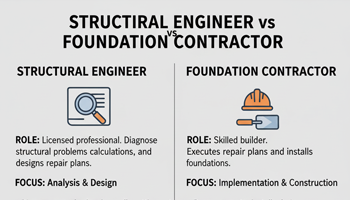
Structural Engineer vs Foundation Contractor
Structural Engineer vs Foundation Contractor: When You Need Each Understanding the distinction between structural engineers…
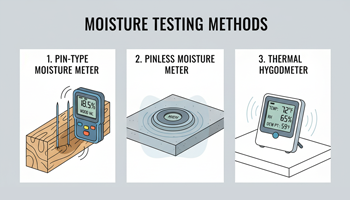
Basement Moisture Testing
Basement Moisture Testing: Before Starting Renovation Projects Moisture testing represents the single most overlooked yet…
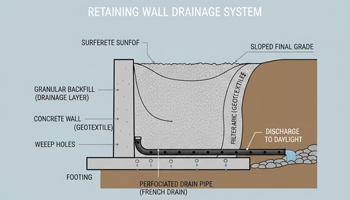
Retaining Wall Drainage
Retaining Wall Drainage: Weep Holes, Backfill & Filter Fabric Drainage represents the single most critical…

Egress Window Requirements
Egress Window Requirements: Code Compliance & Installation Cost Egress windows represent one of the most…
Concrete Slab Repair
Concrete Slab Repair: Crack Injection vs Surface Patching Methods Concrete slabs develop cracks for numerous…
Basement Structural Framing
Basement Structural Framing: Load-Bearing Walls & Beam Sizing Understanding basement structural framing represents one of…

Basement Finishing Cost
Basement Finishing Cost: Framed Drywall vs Modular Panels Finishing a basement transforms unused square footage…
Retaining Wall Design
Retaining Wall Design: Concrete vs Block vs Segmental Systems Selecting the right retaining wall system…
Basement & Foundation Structural
Structural Solutions for Basements & Foundations: Complete Engineering Guide Foundation and basement structural engineering represents…