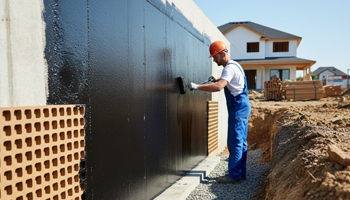
Basement Dehumidifier Sizing Guide: Square Footage & Moisture Level Calculator
Choosing the wrong dehumidifier size wastes money and leaves your basement damp—too small means constant operation without reaching target humidity, while oversized units cost more upfront with minimal benefit. The confusion intensifies when you discover that «30-pint» dehumidifiers from different years actually have different capacities due to updated testing standards, and that your cold basement dramatically reduces any dehumidifier’s performance compared to manufacturer ratings.
Most sizing guides oversimplify the calculation, treating all 1,000 square foot basements identically regardless of moisture level, temperature, or layout. This approach leads to undersizing—the most common mistake in dehumidifier selection. A basement measuring 1,000 square feet with visible condensation and 65°F temperature requires significantly more capacity than the same square footage with minor dampness at 75°F.
Here’s the critical insider knowledge: always size up one capacity level beyond basic calculations. Manufacturer specifications assume ideal conditions—80°F temperature and 60% relative humidity with moderate dampness. Real basements operate at 65°F or colder with 75%+ humidity and persistent moisture. That theoretical «30-pint» capacity becomes 20 pints in actual basement conditions, leaving your unit struggling to maintain comfortable humidity levels.
This comprehensive guide provides accurate sizing calculations accounting for real-world variables, explains the 2020 DOE standard change that created rating confusion, addresses the cold basement performance challenge most guides ignore, and reveals when dehumidifiers work as standalone solutions versus when they must supplement proper waterproofing systems.
Complete Basement Dehumidifier Sizing Guide 2025
Why basement dehumidifiers are essential:
Basements naturally accumulate moisture from multiple sources—groundwater vapor transmission through concrete, humid air settling from upper floors, condensation from temperature differentials, and moisture from laundry equipment or occupant activities. Unlike upper living spaces with better air circulation and natural ventilation, basements trap moisture in stagnant air that rarely exchanges with outside air.
This persistent moisture creates multiple problems:
Health impacts: Mold spores flourish above 60% relative humidity, causing respiratory issues, allergies, and asthma exacerbation. Dust mites—major allergen sources—thrive in humid environments above 50% RH.
Property damage: Wood framing, drywall, and stored belongings deteriorate in high humidity. Cardboard boxes collapse, fabrics develop mildew, and wooden furniture warps or develops mold.
Odor issues: The characteristic musty basement smell comes from mold, mildew, and bacterial growth that flourishes in damp conditions. This odor permeates stored items and migrates to upper floors.
Structural concerns: Chronic high humidity accelerates concrete efflorescence, rusts metal components, and deteriorates foundation materials over time.
Dehumidifiers address these problems by mechanically removing moisture from air, maintaining relative humidity between 40-50%—the optimal range preventing mold growth while avoiding excessive dryness.
How dehumidifiers prevent mold and mildew:
Mold requires three conditions: organic material (food source), appropriate temperature (40-100°F), and moisture (above 60% RH). Basements provide the first two abundantly—wooden framing, drywall paper, cardboard, fabric, and other organic materials combined with stable temperatures in mold’s preferred range.
Controlling the third factor—moisture—prevents mold growth regardless of other conditions. By maintaining relative humidity below 60% (ideally 45-50%), dehumidifiers remove the moisture mold needs to germinate and grow. Existing mold becomes dormant without adequate moisture, preventing spread and additional spore production.
Energy efficiency considerations:
Modern Energy Star certified dehumidifiers use significantly less electricity than older models—typically 15-30% less energy for equivalent moisture removal. However, basement dehumidifiers still represent substantial energy consumers, potentially adding $25-$50+ monthly to electricity bills depending on capacity and runtime.
Energy efficiency improvements to consider:
Energy Star certification: Ensures units meet efficiency standards. A 70-pint Energy Star dehumidifier uses approximately 590 watts versus 700+ watts for non-certified equivalents.
Built-in humidistat controls: Automatically cycle the unit off when target humidity is reached, preventing unnecessary operation.
Timer functions: Limit operation to specific hours, useful if you have time-of-use electricity rates.
Proper sizing: Correctly sized dehumidifiers reach target humidity and cycle off, using less total energy than undersized units running constantly without achieving humidity goals.
The energy cost perspective: running a 70-pint dehumidifier 8 hours daily costs approximately $30-$40 monthly. Compare this to $3,000-$5,000 mold remediation costs or $15,000+ water damage from uncontrolled moisture—the investment in proper humidity control proves cost-effective insurance against far more expensive problems.
Understanding Dehumidifier Capacity Ratings
Pints Per Day (PPD) Explained
Dehumidifier capacity is measured in pints of water removed per 24-hour period. A «50-pint dehumidifier» theoretically removes 50 pints of moisture from the air daily under specific test conditions.
Understanding capacity ratings prevents undersizing:
Rated capacity vs actual capacity: The PPD rating represents maximum performance under test conditions. Your basement’s actual moisture removal will typically be 60-80% of rated capacity due to temperature and humidity variations from test standards.
Coverage area correlation: Manufacturers often suggest coverage areas (square footage) for capacity ratings, but these assume moderate moisture conditions. Heavy dampness or very damp conditions require higher capacity regardless of square footage.
Continuous vs intermittent operation: Properly sized dehumidifiers cycle on and off, running intermittently once target humidity is achieved. Undersized units run continuously without reaching humidity goals—a clear sign of inadequate capacity.
Old vs New DOE Testing Standards (2020 Update)
The 2020 Department of Energy testing standard change created massive confusion in dehumidifier capacity ratings. Many online listings still show old-standard ratings, making direct product comparisons difficult.
Old standard (pre-2020):
- Tested at 65°F temperature and 60% relative humidity
- Higher capacity numbers (inflated compared to real-world performance)
- Example: A unit rated «70-pint» under old standard
New standard (2020+):
- Tests at 65°F temperature and 60% relative humidity
- More realistic performance ratings but lower numbers
- Same unit might be rated «35-pint» under new standard
The confusion: A dehumidifier marketed as «70-pint capacity» might use old-standard ratings while a competing «50-pint» model uses new-standard ratings—yet both could remove identical moisture in real conditions.
Shopping guidance: When comparing dehumidifiers, verify which testing standard the rating uses. Look for «DOE 2020» or «new standard» designation. If uncertain, assume newer models (2020+) use new standards while older listings may show old ratings.
The practical impact: Don’t panic if newer dehumidifiers show lower pint ratings than older models—new ratings are more accurate, not indicators of reduced performance. Focus on square footage coverage claims and actual specifications rather than comparing old-standard to new-standard capacity numbers directly.
AHAM Ratings: 80°F/60% RH vs Real Conditions
The Association of Home Appliance Manufacturers (AHAM) established testing standards using 80°F temperature and 60% RH—conditions rarely matching actual basements.
Test conditions: 80°F and 60% RH represents a warm, moderately humid environment. Most basements operate at 60-70°F with 65-80% RH—significantly cooler and damper than test conditions.
Performance gap: Dehumidifiers perform best in warm, humid conditions. As temperature drops, efficiency decreases dramatically. A unit achieving 50 pints daily at 80°F might remove only 30-35 pints at 65°F—the reason basement dehumidifiers consistently underperform manufacturer ratings.
Real-world expectations: Plan for actual moisture removal of 60-75% of rated capacity in typical basement conditions. This calculation explains why sizing up one capacity level proves necessary—you’re compensating for the performance reduction in cold, damp basements versus warm test conditions.
How Temperature Affects Performance
Temperature dramatically impacts dehumidifier efficiency through the refrigeration cycle physics:
Optimal performance range: 70-80°F. Dehumidifiers achieve rated capacity in this temperature range.
Reduced performance: 65-70°F. Capacity drops 15-25% compared to rated specifications.
Poor performance: 60-65°F. Capacity drops 30-40%. Many units struggle to maintain operation.
Frost formation: Below 60°F. Standard dehumidifiers experience coil frosting that stops moisture removal entirely. Units cycle on frost-protection mode, halting operation until coils defrost.
Why temperature matters: Dehumidifiers work by cooling air to condense moisture, then reheating it. Cold basement air is already near its dew point—the temperature where moisture condenses. Cooling already-cold air requires less temperature drop but also produces less condensation per energy input, reducing efficiency.
Cold basement solutions:
Low-temperature dehumidifiers: Specifically designed models function down to 40-55°F. These units cost more ($400-$1,400) but remain essential for consistently cold basements.
Commercial-grade units: Professional equipment like Santa Fe Compact70 operates effectively to 55°F, providing reliable performance in challenging conditions.
Standard units with auto-defrost: Better consumer models include sensors that detect coil frosting and automatically defrost before ice buildup stops operation. This feature extends operational temperature range to approximately 60-62°F.
If your basement temperature stays below 65°F year-round, standard dehumidifiers prove inadequate. Invest in low-temperature or commercial-grade units designed for cold environments—the performance difference justifies the premium cost.
Measuring Your Basement Square Footage
Accurate square footage calculation is the foundation of proper dehumidifier sizing. Most homeowners have reasonable estimates, but precision prevents sizing errors.
Length x width calculation:
For rectangular basements, simply multiply length by width:
- 40 feet × 25 feet = 1,000 square feet
For irregular shapes:
- Divide the basement into rectangles
- Calculate square footage of each section
- Add sections together for total square footage
Example: L-shaped basement
- Main section: 30 ft × 20 ft = 600 sq ft
- Extension: 20 ft × 15 ft = 300 sq ft
- Total: 900 sq ft
Accounting for ceiling height (cubic feet):
Standard sizing charts assume 8-foot ceilings. Basements with higher or lower ceilings require adjustments:
Calculation: Square footage × ceiling height = cubic feet
Adjustment factor:
- 7-foot ceilings: Reduce dehumidifier size by ~10%
- 9-foot ceilings: Increase dehumidifier size by ~10%
- 10+ foot ceilings: Increase size by 20%
Example: 1,000 sq ft basement with 10-foot ceilings
- Standard sizing suggests 50-pint capacity
- 10-foot ceiling adjustment: Increase by 20%
- Recommended: 60-70 pint capacity
Multi-room basement considerations:
Basements divided into multiple rooms require careful assessment:
Open floor plan approach: If rooms connect via open doorways (no doors) and share air circulation, treat as single space using total square footage.
Compartmentalized layout: Separate rooms with closed doors need individual consideration. Options include:
- One large-capacity unit with fans to circulate air between rooms
- Multiple smaller units, one per isolated area
- Strategic door positioning to improve air circulation
Multiple unit strategy: Large basements over 2,000 sq ft or highly compartmentalized layouts often benefit from multiple moderate-capacity dehumidifiers rather than one huge unit. This approach provides:
- Better humidity distribution across large areas
- Redundancy if one unit fails
- Easier installation with standard 120V outlets (large units may require 240V)
Open vs compartmentalized layouts:
Open layouts (finished rec rooms, large utility spaces):
- Air circulates freely throughout space
- Single dehumidifier can serve entire area
- Position unit centrally for optimal air circulation
Compartmentalized layouts (multiple bedrooms, storage rooms, utility rooms):
- Limited air circulation between spaces
- Consider dehumidifier placement in central location with doors propped open
- Alternatively, place unit in dampest area and monitor other rooms separately
- Very compartmentalized basements may require multiple units
Professional tip: If forced to choose between one large unit or multiple smaller units for a compartmentalized basement, multiple smaller units provide better humidity control despite slightly higher total cost. A 1,500 sq ft basement with four separate rooms benefits more from two 30-pint units positioned in different areas than one 70-pint unit that can’t circulate air through closed doors.
Assessing Moisture Levels in Your Basement
Square footage alone doesn’t determine dehumidifier capacity—moisture severity dramatically affects sizing requirements. Two 1,000 square foot basements may need different capacity units depending on dampness levels.
Using a Hygrometer (Digital Measurement)
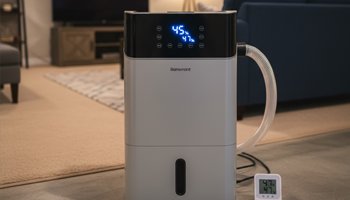
A hygrometer measures relative humidity—the most accurate method for assessing moisture levels and monitoring dehumidifier performance.
Digital hygrometer selection: Purchase an accurate digital hygrometer ($15-$40) rather than relying on cheap analog versions. Quality brands include AcuRite, ThermoPro, and Govee.
Measurement procedure:
- Place hygrometer in the center of the basement, away from walls and moisture sources
- Record readings at the same time daily for 5-7 days
- Calculate average humidity level
- Take readings in different basement areas to identify moisture variations
Interpreting results:
- 40-50% RH: Optimal basement humidity—healthy, mold-preventing range
- 50-60% RH: Acceptable but monitor closely
- 60-70% RH: Damp conditions requiring dehumidification
- 70-80% RH: Very damp—aggressive dehumidification needed
- 80%+ RH: Wet conditions—likely indicating water infiltration problems
Seasonal variations: Humidity fluctuates seasonally. Summer measurements (high humidity season) provide worst-case data for sizing, while winter readings (typically lower humidity) may underestimate needs.
Visual Moisture Indicators
When you don’t have hygrometer readings, visual indicators provide reasonable moisture level assessment:
Minor dampness signs:
- Musty odor noticeable when entering from outside
- Slight condensation on cold water pipes occasionally
- Cardboard boxes feel slightly damp to touch
- Relative humidity: approximately 60-65%
Moderate dampness signs:
- Persistent musty smell even when you’re acclimated
- Visible moisture stains on walls or floor (without active water)
- Condensation on windows or cold surfaces
- Fabrics feel damp, mildew visible on some items
- Relative humidity: approximately 65-75%
Heavy dampness signs:
- Strong musty or mildew odor
- Visible mold growth on walls, wood, or stored items
- Condensation running down walls
- Efflorescence (white mineral deposits) on concrete
- Wood framing showing moisture damage
- Relative humidity: approximately 75-85%
Moisture Level Categories and RH Ranges
Damp: musty smell, occasional dampness (60-70% RH):
The most common basement moisture condition—uncomfortable humidity causing musty odors and potential mold growth without visible water problems.
Characteristics:
- Musty smell upon entering
- Stored cardboard and fabric items feel damp
- Condensation on cold water pipes during humid weather
- No visible water infiltration or standing water
Dehumidification needs: Moderate capacity, standard operation cycling on/off daily.
Very damp: always musty (70-80% RH):
Persistent high humidity creating obvious mold/mildew problems and uncomfortable conditions.
Characteristics:
- Strong musty odor that never fully dissipates
- Visible mildew on stored items, walls, or ceiling
- Consistent condensation on cold surfaces
- Wood and paper items show moisture damage
- Persistent dampness without seasonal variation
Dehumidification needs: High capacity unit running extensively, potentially continuous operation until humidity controlled.
Wet: visible condensation on walls (80%+ RH):
Severe moisture conditions approaching or reaching saturation. This level suggests water infiltration problems beyond what dehumidification alone can solve.
Characteristics:
- Water droplets visible on walls, especially during humid weather
- Puddles forming without obvious water source
- Extensive mold growth on multiple surfaces
- Severe musty odor throughout house
- Stored items deteriorating rapidly
Dehumidification needs: Maximum capacity commercial-grade unit required, but dehumidification alone insufficient—water infiltration source must be addressed first.
Extremely wet: standing water concerns:
Water infiltration problems requiring drainage system installation before dehumidification can be effective.
Characteristics:
- Standing water after rain
- Visible water seeping through walls or floor
- Sump pump running frequently or continuously
- Severe structural water damage
Dehumidification approach: Address water infiltration through proper waterproofing and drainage systems first. Dehumidifiers supplement drainage solutions but cannot replace them. After waterproofing, high-capacity dehumidifiers maintain healthy humidity levels.
Dehumidifier Size Chart by Square Footage
This sizing chart provides baseline capacity recommendations adjusted for moisture levels. Remember the professional rule: size up one capacity level to account for cold basement temperatures and real-world performance reductions.
500 Sq Ft Basement: 30-Pint Dehumidifier
Baseline recommendation: 30-pint capacity under new DOE 2020 standards (equivalent to 50-60 pint under old standards).
Moisture level adjustments:
- Minor dampness (60-65% RH): 30-pint adequate
- Moderate dampness (65-75% RH): 30-40 pint recommended
- Heavy dampness (75-85% RH): 50-pint minimum
Cold basement adjustment: If temperature consistently below 65°F, increase to 40-50 pint capacity or select low-temperature model.
Practical recommendation: For most 500 sq ft basements with typical dampness, choose 40-50 pint capacity to ensure adequate performance in real-world conditions.
1000 Sq Ft Basement: 50-Pint Dehumidifier
Baseline recommendation: 50-pint capacity (new DOE standard).
Moisture level adjustments:
- Minor dampness: 40-50 pint
- Moderate dampness: 50-60 pint
- Heavy dampness: 70-pint minimum
Layout considerations:
- Open floor plan: Single 50-pint unit sufficient for moderate dampness
- Compartmentalized: Consider two 30-pint units in different areas
Cold basement adjustment: Increase to 60-70 pint for temperatures consistently 60-65°F.
Practical recommendation: 70-pint capacity provides comfortable margin for 1,000 sq ft basements with typical moisture, ensuring efficient cycling rather than continuous operation.
1500 Sq Ft Basement: 50-70 Pint Dehumidifier
Baseline recommendation: 50-70 pint depending on moisture severity.
Moisture level adjustments:
- Minor dampness: 50-pint adequate
- Moderate dampness: 60-70 pint recommended
- Heavy dampness: Two 50-pint units or one commercial-grade 95-pint unit
Multiple unit consideration: At 1,500 sq ft, compartmentalized basements often benefit from two 40-50 pint units rather than one large unit.
Cold basement adjustment: Select 70-pint minimum or commercial-grade low-temperature model.
Practical recommendation: For typical 1,500 sq ft basement with moderate dampness, 70-pint capacity ensures adequate performance without oversizing. Very damp conditions justify 95+ pint commercial models.
2000+ Sq Ft Basement: 70-Pint+ Dehumidifier
Baseline recommendation: Minimum 70-pint capacity, scaling up with square footage and moisture severity.
Large basement strategies:
Single large unit (2,000-2,500 sq ft):
- 70-95 pint commercial-grade dehumidifier
- Requires excellent air circulation or strategic fan placement
- Works best for open floor plans
Multiple unit approach (2,500+ sq ft):
- Two 50-70 pint units positioned in different zones
- Better humidity distribution in compartmentalized layouts
- Provides redundancy if one unit fails
Commercial-grade consideration: Basements over 2,000 sq ft with moderate-to-heavy dampness justify commercial dehumidifiers (Santa Fe, Anden, AprilAire brands) rated 95-135 pints. These units cost $1,200-$2,000 but provide superior performance, longevity, and efficiency compared to multiple consumer units.
Practical recommendation: For 2,000+ sq ft basements, invest in commercial-grade equipment or multiple quality consumer units rather than relying on a single consumer-grade dehumidifier operating at capacity limits.
Additional Factors Affecting Dehumidifier Size
Beyond square footage and visible moisture, several factors increase dehumidification demands, requiring capacity adjustments.
Cold Basement Temperatures (Below 65°F)
Temperature’s impact on dehumidifier performance cannot be overstated—it’s the most common cause of undersized unit selection.
Performance reduction by temperature:
- 75-80°F: 100% of rated capacity
- 70-75°F: 85-90% of rated capacity
- 65-70°F: 70-80% of rated capacity
- 60-65°F: 50-60% of rated capacity
- Below 60°F: Standard units frost up and become ineffective
Sizing adjustment: For basements consistently below 65°F, multiply recommended capacity by 1.3-1.5× to compensate for performance loss. A 50-pint recommendation becomes 65-75 pint actual requirement.
Low-temperature models: If basement stays below 65°F year-round, standard dehumidifiers prove inadequate. Specific recommendations:
- Consumer low-temp units: Frigidaire 70-pint with electronic controls ($300-$400) functions to ~62°F
- Commercial low-temp units: Santa Fe Compact70 ($1,400) operates effectively to 55°F
- Budget alternative: Place standard dehumidifier in warmest basement area and use fans to circulate air
Number of Windows and Doors
Windows and doors increase moisture infiltration from outside air, particularly during humid summer months.
Impact assessment:
- Few windows/doors (1-2 small windows): Minimal impact, no adjustment needed
- Moderate openings (3-4 windows, exterior door): Increase capacity by 10-15%
- Extensive openings (multiple windows, frequently used exterior door): Increase capacity by 20-30%
- Walkout basement (sliding door, frequent use): Increase capacity by 30-40%
Mitigation strategies:
- Seal windows and doors properly to reduce air infiltration
- Limit exterior door opening frequency
- Consider dehumidifier with higher capacity to handle infiltration load
Laundry Equipment Presence
Washing machines and especially dryers add significant moisture to basement air.
Moisture sources:
- Washing machine: Minimal impact if properly draining
- Gas dryer with interior vent: Adds 2-5 gallons of moisture per load
- Electric dryer with interior vent: Adds 2-5 gallons of moisture per load
- Proper exterior venting: Minimal impact
Sizing adjustment:
- Properly vented dryer: No adjustment needed
- Interior-vented dryer: Increase dehumidifier capacity by 30-50% or eliminate interior venting
Critical note: Dryers should always vent to building exterior. If your dryer currently vents into the basement, fixing this problem reduces dehumidification needs more effectively than buying larger capacity units.
High Water Table Areas
Properties with high water tables create persistent moisture infiltration through foundation walls and floors via hydrostatic pressure and vapor transmission.
Indicators of high water table:
- Sump pump runs frequently even during dry weather
- Visible efflorescence on foundation walls
- Persistent dampness despite dehumidifier operation
- Seasonal basement flooding
Sizing approach: High water table conditions require:
- Maximum capacity dehumidifiers (70-95+ pint)
- Continuous operation rather than cycling
- Possible multiple units for large basements
- Integration with proper waterproofing and drainage systems
System approach: Dehumidifiers cannot solve high water table problems alone. Proper solution includes:
- Interior drainage system with sump pump
- High-capacity dehumidifier (70-95+ pint)
- Possible exterior waterproofing
- Integrated approach managing both liquid water (drainage) and vapor (dehumidification)
Finished vs Unfinished Basement
Basement finish level affects moisture dynamics and dehumidification requirements.
Unfinished basements:
- Exposed concrete allows visible moisture assessment
- Air circulation typically better with open layout
- Storage items (cardboard, fabrics) absorb and release moisture, buffering humidity
- Standard sizing calculations apply
Finished basements:
- Drywall and insulation hide moisture problems until severe
- Compartmentalized rooms limit air circulation
- Organic materials (drywall paper, wood framing) provide mold food sources
- Moisture problems cause expensive damage to finishes
- Recommendation: Size dehumidifier 20-30% larger than standard calculations to protect investment in finishes
Partially finished basements: Treat as finished for sizing purposes—any drywall or finished areas justify increased capacity to protect those investments.
Basement-Specific Dehumidifier Features
Basement applications require specific features beyond basic moisture removal capacity. These features dramatically affect usability and long-term satisfaction.
Continuous drainage options (gravity vs pump):
Emptying dehumidifier buckets daily or multiple times daily becomes an unsustainable maintenance burden that leads to system abandonment. Continuous drainage is non-negotiable for basements.
Gravity drainage:
- Hose connection allowing water to drain continuously
- Requires floor drain positioned lower than dehumidifier
- Zero ongoing maintenance once set up
- Preferred solution when floor drain is available
Pump-equipped models:
- Built-in pump forces water upward 10-15 feet
- Necessary when no floor drain exists or drain is higher than unit
- Pumps water to utility sink, window discharge, or sump basin
- Adds $100-$200 to unit cost but essential for many installations
Bucket-only models: Avoid dehumidifiers without continuous drainage capability unless you’re committed to daily bucket emptying—unrealistic for most basement applications.
Auto shut-off and bucket capacity:
Units without continuous drainage must include auto shut-off preventing bucket overflow. Quality dehumidifiers shut down automatically when bucket fills and alert you via indicator light or alarm.
Bucket capacity considerations:
- Large capacity (12-16 pints): Reduces emptying frequency if continuous drainage unavailable
- Small capacity (6-8 pints): Requires frequent emptying, frustrating for high-capacity units
If continuous drainage isn’t possible, choose units with largest bucket capacity and reliable shut-off sensors to minimize maintenance burden.
Low-temperature operation capability:
Standard dehumidifiers stop functioning effectively below 65°F. Basements often operate at 60-65°F or colder, making low-temperature capability essential.
Feature indicators:
- Specifications stating operation to 41-50°F
- Auto-defrost functionality preventing coil ice buildup
- «Low-temperature» or «basement» marketing designation
Why it matters: Standard dehumidifiers without low-temperature features cycle on and off as coils frost up, removing minimal moisture and wasting energy. In consistently cold basements, they may not function at all.
Models with good low-temp performance:
- Commercial units (Santa Fe, Anden): Operate to 55-60°F reliably
- Frigidaire 70-pint models: Function to ~62°F with auto-defrost
- hOmeLabs and Vremi models: Advertised for low-temp basement use
Energy Star ratings and efficiency:
Energy Star certification indicates dehumidifiers meet efficiency standards—typically using 15-30% less electricity than non-certified models for equivalent moisture removal.
Energy factors (liters per kWh):
- Standard efficiency: 1.2-1.6 L/kWh
- Energy Star certified: 1.85-2.4 L/kWh
- Premium efficiency: 2.5-3.2 L/kWh
Higher energy factor means more moisture removed per unit of electricity consumed—directly reducing operating costs.
Annual cost impact: For a 70-pint unit running 6-8 hours daily:
- Standard efficiency: $40-$55 monthly operating cost
- Energy Star certified: $30-$40 monthly operating cost
- Premium efficiency: $25-$35 monthly operating cost
Over the 8-10 year expected lifespan, efficiency differences save $500-$1,000+ in electricity costs—justifying higher upfront investment in Energy Star models.
Built-in humidistat controls:
Quality dehumidifiers include built-in humidistats that measure air humidity and cycle the unit on/off automatically to maintain target levels.
Features to seek:
- Digital humidistat with 5% RH increments (better than 10% increments)
- Target humidity range: 30-80% RH adjustment
- Automatic operation maintaining set point
- Memory function retaining settings after power interruption
Why it matters: Without humidistat control, dehumidifiers run continuously, wasting energy and potentially over-drying basements below comfortable levels. Proper cycling extends compressor life and reduces electricity costs.
Manual vs automatic: Some budget models require manual on/off operation. Avoid these—automatic humidistat control is essential for effective, efficient basement humidity management.
Crawl Space Dehumidifiers vs Standard Units
Crawl spaces present unique challenges requiring specialized equipment. Standard basement dehumidifiers often fail in crawl space applications.
Why regular dehumidifiers fail in crawl spaces:
Height restrictions: Crawl spaces typically offer only 18-36 inches of clearance. Standard dehumidifiers measuring 20-24 inches tall don’t fit or leave inadequate service access.
Temperature extremes: Crawl spaces experience more dramatic temperature swings than basements, often dropping below 60°F where standard units frost up and stop functioning.
Moisture severity: Crawl spaces typically have higher moisture loads than basements due to exposed soil, limited ventilation, and proximity to ground moisture.
Air circulation challenges: Confined crawl space layouts limit air movement, reducing standard dehumidifier effectiveness designed for better circulation.
Drainage complications: Remote crawl space locations make bucket emptying impractical, while floor drains rarely exist. Built-in pumps become essential.
Commercial-grade basement units (70-130 PPD):
Crawl spaces require commercial-grade dehumidifiers specifically designed for challenging environments:
Recommended models:
Santa Fe Compact70 ($1,400-$1,600):
- 70-pint capacity (new DOE standard)
- Covers up to 1,800 sq ft
- Low-profile design (11.5 inches tall) fits tight spaces
- Operates to 55°F reliably
- Built-in condensate pump
- MERV-8 air filtration
Anden A70 ($1,200-$1,400):
- 70-pint capacity
- Compact footprint with excellent airflow
- Functions to 56°F
- Internal condensate pump included
- Commercial-grade construction
AprilAire 1850 ($1,300-$1,500):
- 95-pint capacity
- Ducted installation option for remote placement
- Operates to 56°F
- Professional installation recommended
Performance advantages: Commercial units provide:
- 2-3× longer lifespan (15-20 years vs 7-10 years consumer units)
- Superior moisture removal in cold, damp conditions
- Built-in pumps and professional-grade drainage
- Designed for continuous operation rather than intermittent use
Cost justification: While 3-4× more expensive than consumer dehumidifiers, commercial units prove cost-effective for crawl spaces through superior performance, longevity, and avoiding repeated consumer unit replacement.
Encapsulation considerations:
Crawl space encapsulation—sealing the space with vapor barriers—dramatically reduces dehumidification requirements.
Encapsulation benefits:
- Vapor barrier on floor prevents ground moisture infiltration
- Sealed vents eliminate humid outside air entry
- Insulated walls reduce temperature fluctuations
- Reduced moisture load allows smaller dehumidifier capacity
Dehumidifier sizing with encapsulation:
- Unencapsulated crawl space: 1 pint capacity per 50 sq ft
- Properly encapsulated crawl space: 1 pint capacity per 100-150 sq ft
Example: 1,500 sq ft crawl space
- Without encapsulation: 95-130 pint commercial unit required
- With encapsulation: 70-pint unit adequate
The investment in proper encapsulation ($3,000-$7,000) reduces dehumidifier requirements and operating costs while dramatically improving moisture control effectiveness—often the better long-term investment than relying on dehumidification alone.
Placement and Installation Best Practices
Dehumidifier placement dramatically affects performance—poor positioning reduces effectiveness regardless of capacity.
Central basement positioning:
Position dehumidifiers as centrally as possible within the space for optimal air circulation:
Benefits of central placement:
- Equal access to air from all basement areas
- Reduces humidity gradients (damp zones in distant corners)
- Maximizes coverage effectiveness
- Improves air circulation patterns
Practical limitations: Central placement must balance ideal positioning with:
- Proximity to drainage (floor drain or discharge point for pump)
- Electrical outlet availability
- Avoiding high-traffic areas where unit becomes obstacle
- Clearance requirements for air intake/exhaust
Compromise solution: Place unit as centrally as drainage and electrical allow, then use fans to circulate air if moisture concentration exists in distant areas.
6-inch clearance from walls:
Dehumidifiers require adequate clearance for proper airflow:
Minimum clearances:
- 6-12 inches from walls on air intake side
- 12-18 inches from walls on air discharge side
- 24 inches above unit (ceiling clearance) for top-discharge models
- No obstructions blocking air intake grilles
Why clearance matters: Blocked airflow reduces moisture removal capacity, causes compressor overheating, and dramatically shortens unit lifespan. Proper clearance ensures manufacturer-rated performance.
Common mistakes:
- Pushing unit against wall to save floor space
- Placing in corner with two walls restricting airflow
- Storing items on top of unit
- Positioning near curtains or other obstructions
Elevation considerations:
Dehumidifiers should sit on solid, level surfaces:
Ideal placement surfaces:
- Concrete floor (best—level and stable)
- Raised platform (2-6 inches) improving drainage and preventing minor floor water contact
- Rubber anti-vibration pads reducing noise transmission
Surfaces to avoid:
- Uneven floors causing water pooling in bucket (if not continuous drainage)
- Carpeted areas (moisture from dripping condensation damages carpet)
- Wooden platforms (moisture damage risk)
- Unstable surfaces (vibration during operation can cause movement)
Floor drain proximity:
When using gravity drainage, position dehumidifiers near floor drains:
Ideal setup:
- Dehumidifier within 10-15 feet of floor drain
- Drain lower than dehumidifier discharge port
- Drainage hose slopes continuously downward (minimum 1/4 inch per foot)
- Secure hose to prevent kinking or movement
Longer drainage runs: Hoses over 20 feet may restrict drainage and reduce effectiveness. If floor drain is distant:
- Use larger diameter hose (5/8 inch vs 3/8 inch) reducing flow restriction
- Ensure aggressive downward slope
- Consider pump-equipped model if gravity drainage becomes unreliable
Multiple unit strategies for large basements:
Basements exceeding 1,500-2,000 sq ft or highly compartmentalized layouts often benefit from multiple dehumidifiers:
Strategic positioning:
- Place units in different zones maximizing coverage
- One unit in finished areas, another in utility/storage areas
- Position units where moisture concentration is highest
Advantages:
- Better humidity distribution throughout large space
- Redundancy if one unit fails or requires maintenance
- Smaller units easier to move for maintenance
- Standard 120V outlets support multiple moderate-capacity units (large units may need 240V)
Coordination: Set all units to same target humidity (45-50% RH) for consistent basement-wide moisture control.
Energy Costs and Efficiency
Understanding operating costs enables informed purchasing decisions balancing upfront investment against long-term expenses.
Monthly operating costs by capacity:
Dehumidifier operating costs depend on capacity, efficiency, runtime, and local electricity rates. Calculations below assume $0.12/kWh electricity rate and 8 hours daily operation.
30-40 pint dehumidifiers:
- Power consumption: 280-350 watts
- Daily energy: 2.2-2.8 kWh
- Monthly cost: $8-$10
- Annual cost: $95-$125
50-60 pint dehumidifiers:
- Power consumption: 380-480 watts
- Daily energy: 3.0-3.8 kWh
- Monthly cost: $11-$14
- Annual cost: $130-$170
70-90 pint dehumidifiers:
- Power consumption: 520-680 watts
- Daily energy: 4.2-5.4 kWh
- Monthly cost: $15-$20
- Annual cost: $185-$240
Commercial units (70-135 pint):
- Power consumption: 590-1,000 watts
- Daily energy: 4.7-8.0 kWh
- Monthly cost: $17-$29
- Annual cost: $205-$350
Variables affecting actual costs:
- Electricity rates (range $0.08-$0.25/kWh regionally)
- Actual runtime (varies with basement moisture, season, and unit efficiency)
- Energy Star efficiency reducing consumption 15-30%
Energy Star savings calculations:
Energy Star certified dehumidifiers provide measurable cost savings over their lifespan:
Example comparison (70-pint capacity):
Standard efficiency unit:
- Power: 680 watts
- Annual energy: 1,985 kWh (8 hours/day)
- Annual cost: $238 (@$0.12/kWh)
- 10-year lifetime cost: $2,380
Energy Star unit:
- Power: 520 watts (23% reduction)
- Annual energy: 1,520 kWh
- Annual cost: $182
- 10-year lifetime cost: $1,820
Savings: $560 over unit lifetime
Payback period: Energy Star units typically cost $50-$100 more upfront. Savings pay back this premium in 1-2 years, providing net savings of $400-$500 over the unit’s lifespan.
Timer and smart controls:
Advanced controls reduce unnecessary operation:
Timer benefits:
- Limit operation to specific hours (avoid peak electricity rate periods if time-of-use billing)
- Prevent operation during sleep hours for noise reduction
- Reduce energy consumption by 20-40% depending on programming
Smart controls/WiFi connectivity:
- Monitor humidity remotely via smartphone
- Receive alerts when target humidity exceeded
- Adjust settings without basement visits
- Track energy consumption
- Schedule operation optimally
Cost-benefit: Smart features add $50-$150 to unit cost but provide convenience and potential energy savings through optimized operation.
Running costs vs mold remediation expenses:
The perspective shift that justifies dehumidifier investment:
Dehumidifier costs (10-year total):
- Unit purchase: $300-$1,500
- Electricity (70-pint, 8 hours/day): $1,800-$2,400
- Maintenance (filters, occasional service): $100-$200
- Total 10-year cost: $2,200-$4,100
Mold remediation costs (single event):
- Small area (<100 sq ft): $500-$1,500
- Medium area (100-500 sq ft): $2,000-$6,000
- Large area (500+ sq ft): $6,000-$15,000+
- Plus damage to belongings, furnishings, and structural elements
Water damage costs (single flooding event):
- Finished basement: $10,000-$30,000+
- Unfinished basement: $3,000-$8,000+
The perspective: Spending $300-$400 annually on dehumidification represents inexpensive insurance against mold remediation costing thousands or water damage costing tens of thousands. The investment proves cost-effective even accounting for decades of operation.
Maintenance Requirements
Proper maintenance ensures reliable performance and extends dehumidifier lifespan from potential 5-6 years (neglected units) to full 8-10 year expected service life.
Filter cleaning schedule (monthly):
Air filters trap dust, lint, and particles that would otherwise accumulate on internal components:
Monthly maintenance:
- Turn off and unplug dehumidifier
- Remove air filter (typically slides out from front or side)
- Vacuum filter or wash with mild soap and water
- Allow complete drying before reinstalling
- Reinstall filter and resume operation
Consequences of neglected filter cleaning:
- Reduced airflow decreasing moisture removal capacity
- Compressor overheating and potential failure
- Increased energy consumption for reduced performance
- Shortened unit lifespan
Filter cleaning frequency: Monthly cleaning suffices for most basements. Very dusty environments may require bi-weekly cleaning. Neglecting filter maintenance is the most common cause of premature dehumidifier failure.
Coil inspection:
Evaporator and condenser coils accumulate dust and debris over time:
Quarterly inspection:
- Visually inspect coils (visible through grilles or by removing cover)
- Look for dust buildup, blockage, or corrosion
- Vacuum accessible coil surfaces gently using soft brush attachment
- Professional cleaning every 2-3 years for heavy-use units
Signs of coil problems:
- Reduced moisture removal despite filter cleaning
- Unusual noises during operation
- Ice formation on coils (suggests airflow restriction or refrigerant issues)
- Longer runtime without achieving target humidity
Significant coil contamination or damage typically requires professional service or unit replacement depending on age and severity.
Drainage system checks:
Drainage system maintenance prevents water backup and auto-shutoff issues:
Continuous drainage inspection (quarterly):
- Verify drain hose secure and unkinked
- Check for flow restriction or clogging
- Ensure hose maintains downward slope throughout length
- Flush hose annually with water to remove accumulated sediment
Condensate pump maintenance (if equipped):
- Verify pump operation monthly (pour water in reservoir, confirm pumping)
- Check discharge hose for kinks or clogs
- Clean pump reservoir quarterly to remove sediment
- Replace pump if failing (typically $40-$80 for replacement pump)
Bucket maintenance (if used):
- Empty and clean bucket weekly
- Verify auto-shutoff sensor functioning (fill bucket, confirm unit stops)
- Check bucket seal preventing leaks
Expected lifespan (8-10 years):
Quality dehumidifiers with proper maintenance typically last 8-10 years:
Lifespan factors:
Extending lifespan:
- Monthly filter cleaning
- Proper clearance maintaining airflow
- Avoiding operation in extremely cold conditions (freezing coils)
- Using continuous drainage avoiding pump cycling
- Quality initial purchase (commercial units last 15-20 years)
Shortening lifespan:
- Neglected filter maintenance
- Operation in restricted spaces with poor airflow
- Frequent moving causing compressor damage
- Cheap units with inferior components
- Operating beyond capacity limits continuously
End-of-life signs:
- Compressor failure (most expensive repair, typically not economical)
- Refrigerant leaks (repair costs approach replacement cost)
- Control board failure in older units
- Persistent operational problems despite maintenance
- Age exceeding 10 years with declining performance
Replacement decision: When repair estimates exceed 50% of replacement cost or unit exceeds 8-10 years old, replacement proves more economical than repair. Modern units offer better efficiency, reducing operating costs enough to justify replacement even if older units remain marginally functional.
Recommended Dehumidifier Models by Size
Specific product recommendations based on capacity category and application.
30-50 pint category (brands and models):
hOmeLabs 50-Pint ($250-$300):
- Covers up to 1,500 sq ft (manufacturer claim, reduce by 30% for realistic coverage)
- Energy Star certified
- Built-in pump (rare in this price range)
- Auto-defrost for low-temperature operation
- Digital humidistat and 24-hour timer
- Good value for small-to-medium basements
Frigidaire 50-Pint ($280-$350):
- Energy Star certified
- Covers up to 1,200 sq ft realistically
- Continuous drain and auto-restart after power failure
- Washable filter and easy maintenance
- Reliable performance and widely available
GE 50-Pint ADEL50LZ ($300-$380):
- Energy Star certified
- Built-in pump feature
- Operates to 41°F (excellent for cold basements)
- Digital controls and programmable timer
- Premium build quality in consumer category
70 pint category recommendations:
Frigidaire 70-Pint FFAD7033R1 ($350-$420):
- Energy Star certified
- Realistic coverage: 1,400-1,600 sq ft
- Electronic controls with digital humidistat
- Continuous drain and auto-restart
- Operates effectively to ~62°F
- Excellent reliability track record
Honeywell 70-Pint TP70WK ($320-$400):
- Energy Star certified
- Anti-spill design and easy-roll casters
- Auto-shutoff and alarm
- Washable filter
- Good value in 70-pint category
Keystone KSTAD707PA ($380-$450):
- Energy Star certified
- Built-in pump (12-foot vertical lift)
- Operates to 41°F
- 1,500 sq ft realistic coverage
- Excellent for cold, damp basements requiring pump
Commercial-grade options (Santa Fe, Anden):
Santa Fe Compact70 ($1,400-$1,600):
- True 70-pint capacity (new DOE standard)
- Covers 1,800 sq ft effectively
- Operates reliably to 55°F
- Built-in condensate pump
- MERV-8 air filtration
- 15-20 year expected lifespan
- Best choice for crawl spaces and challenging basements
- Professional installation recommended
Anden A70 ($1,200-$1,400):
- 70-pint commercial capacity
- Functions to 56°F
- Internal pump included
- Compact footprint with powerful airflow
- Commercial-grade components
- Excellent reliability
Santa Fe Advance100 ($1,800-$2,100):
- 100-pint capacity
- Covers up to 2,600 sq ft
- Operates to 55°F
- Built-in pump and air filtration
- Ducted installation option for remote placement
- Premium commercial solution
AprilAire 1850 ($1,300-$1,500):
- 95-pint capacity
- Ducted installation for whole-home/basement integration
- Professional-grade construction
- Operates to 56°F
- Typically installed as part of HVAC system
Budget vs premium comparisons:
Budget approach ($250-$400):
- Consumer-grade 50-70 pint units
- 7-10 year expected lifespan
- Adequate for typical basement applications
- May struggle in cold or very damp conditions
- Requires replacement after 8-10 years
Premium approach ($1,200-$2,000):
- Commercial-grade equipment
- 15-20 year expected lifespan
- Superior performance in challenging conditions (cold, very damp)
- Higher efficiency reducing operating costs
- Better long-term value despite higher upfront cost
Cost-benefit analysis (10-year period):
Budget approach:
- Initial purchase: $350
- Replacement at year 8: $350
- Electricity (lower efficiency): $2,400
- Total: $3,100
Premium approach:
- Initial purchase: $1,500
- No replacement needed
- Electricity (higher efficiency): $2,000
- Total: $3,500
The premium approach costs $400 more over 10 years while providing superior performance, reliability, and continuing service beyond 10 years. For challenging basements or finished spaces where failure causes expensive damage, premium investment proves worthwhile.
FAQs
What size dehumidifier do I need for a 1000 square foot basement?
For a 1,000 square foot basement with moderate dampness, choose a 70-pint dehumidifier (new DOE 2020 standard). While sizing charts suggest 50-pint capacity, real-world conditions—cold basement temperatures (60-65°F), high humidity levels, and less-than-ideal circulation—reduce performance below manufacturer ratings. The 70-pint capacity ensures efficient cycling and comfortable humidity control rather than continuous operation without reaching target levels.
How do I know if my basement is damp, very damp, or wet?
Use a digital hygrometer to measure relative humidity: 60-70% indicates damp conditions (musty smell, occasional dampness), 70-80% is very damp (always musty, visible mildew), and 80%+ is wet (condensation on walls, potential standing water). Visual signs include musty odors, condensation, mold growth, and efflorescence (white mineral deposits). For accurate assessment, measure humidity in multiple basement locations over several days.
Do dehumidifiers work in cold basements?
Standard dehumidifiers lose significant capacity below 65°F and may stop working entirely below 60°F due to coil frosting. For cold basements, choose units specifically rated for low-temperature operation (functioning to 41-55°F) or invest in commercial-grade dehumidifiers designed for challenging conditions. Models like Santa Fe Compact70 or certain Frigidaire units with auto-defrost operate effectively in cold environments where standard units fail.
Should I run my basement dehumidifier all the time?
Properly sized dehumidifiers with built-in humidistats automatically cycle on and off, running only when needed to maintain target humidity (typically 45-50% RH). Continuous operation suggests undersizing—the unit cannot remove moisture fast enough to reach target levels. A correctly sized dehumidifier runs intermittently, cycling perhaps 6-12 hours daily depending on conditions rather than continuously. Set the humidistat to 45-50% and let automatic controls manage operation.
How much does it cost to run a basement dehumidifier?
A 70-pint Energy Star dehumidifier running 8 hours daily costs approximately $15-$20 monthly in electricity ($0.12/kWh rate). Annual operating costs run $180-$240. While this seems significant, compare it to mold remediation ($2,000-$6,000+) or water damage ($10,000+) from uncontrolled moisture. The modest ongoing cost represents affordable insurance against far more expensive problems caused by high basement humidity.
Proper basement dehumidifier sizing requires accounting for square footage, moisture severity, temperature, and layout rather than relying on simplified one-size-fits-all recommendations. The professional rule—size up one capacity level beyond basic calculations—compensates for real-world performance reductions in cold, damp basements. However, dehumidifiers complement rather than replace proper waterproofing and drainage systems. Address active water infiltration first through drainage solutions, then use appropriately sized dehumidifiers to maintain healthy humidity levels preventing mold growth and protecting your basement investment.
References
Currently viewing
Basement Dehumidifier Sizing

Foundation Inspection Checklist
Foundation Inspection Checklist: What to Look for Before Buying a Home Buying a home is…

Concrete Foundation vs Pier & Beam
Concrete Foundation vs Pier & Beam: Repair Cost Differences When foundation problems arise, one of…

Foundation Settlement Warning Signs
Foundation Settlement Warning Signs: When to Call a Structural Engineer You’ve noticed a crack in…

Bowing Basement Wall Repair
Bowing Basement Wall Repair: Carbon Fiber vs Steel I-Beams If you’ve noticed your basement walls…
Slabjacking vs Mudjacking
Slabjacking vs Mudjacking vs Polyurethane Foam Leveling Your concrete driveway has sunk three inches. The…

Foundation Repair Cost
Foundation Repair Cost By Problem Type & Home Size Foundation damage is one of the…
Push Piers vs Helical Piers
Push Piers vs Helical Piers: Foundation Underpinning When your home’s foundation starts settling, the choice…

Foundation Crack Repair
Foundation Crack Repair: Epoxy vs Polyurethane Injection Complete Guide Foundation problems strike fear into homeowners…