
Exterior Basement Waterproofing: Complete Excavation Cost & Membrane Installation Guide
Exterior basement waterproofing represents the most comprehensive—and most expensive—approach to foundation moisture protection. This method requires excavating around your home’s perimeter down to the footing level, applying waterproof membranes directly to foundation walls, installing drainage systems, and restoring all disturbed landscaping. The investment is substantial, typically $10,000-$15,000 for an average home, with costs potentially reaching $25,000+ when factoring in complete site restoration.
Here’s the reality most contractors won’t tell you upfront: exterior waterproofing is often overkill for existing homes with manageable water problems. Approximately 15-20% of basements genuinely require this aggressive intervention. However, when exterior waterproofing is necessary—foundation walls showing structural damage, extreme water table issues, or new construction—no alternative solution provides equivalent comprehensive protection.
This guide delivers transparent cost breakdowns, explains the excavation and membrane installation process, and most importantly, helps you determine whether exterior waterproofing represents the right investment for your specific situation or if less disruptive interior solutions would serve you better.
Exterior Basement Waterproofing: Complete Cost & Process Guide
What is exterior waterproofing:
Exterior waterproofing creates a complete moisture barrier on the outside of foundation walls, preventing water from ever contacting the concrete. The comprehensive system includes multiple integrated components:
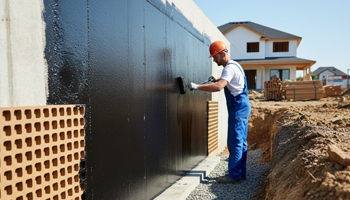
- Waterproof membrane application: Rubberized asphalt, sheet membranes, or bentonite clay systems applied directly to cleaned foundation walls
- Drainage board installation: Dimpled plastic sheets that create an air gap and drainage path between soil and membrane
- Perimeter drain system: French drain at footing level capturing groundwater before it creates pressure against walls
- Proper backfill: Free-draining soil or gravel that doesn’t retain moisture against the foundation
- Surface grading: Ensuring yard slopes away from foundation to direct surface water away
This multi-layered approach addresses both surface water and groundwater, creating comprehensive protection that manages water at every potential entry point.
When exterior methods are necessary:
Exterior waterproofing becomes essential rather than optional in specific scenarios:
Structural foundation issues: Foundation walls showing significant bowing, horizontal cracking, or displacement require exterior access for proper repair. These structural problems cannot be addressed from the interior—the damaged wall sections need excavation for reinforcement, replacement, or stabilization before waterproofing.
Extreme water pressure: Properties with springs, streams, or standing water against the foundation face pressure that interior systems cannot adequately manage. When water actively pools against your foundation rather than draining away, exterior excavation allows regrading and drainage installation to redirect water flow.
Very high water table: Water tables within 3 feet of the basement floor create persistent hydrostatic pressure. While interior drainage manages symptoms, exterior waterproofing combined with proper drainage systems addresses the root cause by intercepting water before it reaches foundation depth.
New construction: When foundations are already exposed during building, adding exterior waterproofing costs a fraction of future retrofit expenses—typically $3,000-$4,000 versus $10,000-$15,000 later. This represents the most cost-effective waterproofing opportunity.
Complete previous system failure: If exterior waterproofing was installed previously but has failed due to membrane degradation or drainage collapse, excavation becomes necessary to diagnose and correct the underlying failure.
Cost ranges and ROI expectations:
Exterior waterproofing requires substantial upfront investment:
- Base waterproofing work: $10,000-$15,000 for average 1,200-1,500 sq ft basement
- With complete restoration: $15,000-$25,000 including landscaping, hardscaping, and site repairs
- Per linear foot: $120-$220 depending on excavation depth, access, and membrane type
ROI considerations are nuanced. If your home has a finished basement (value of $20,000-$40,000) and faces genuine flooding risk, exterior waterproofing delivers clear ROI through asset protection. However, for unfinished basements with minor moisture issues, the investment often exceeds the value protected.
The system’s 20-30+ year lifespan with minimal maintenance provides long-term value when the work is genuinely necessary. But forcing this premium solution onto problems manageable with $6,000-$8,000 interior drainage systems represents poor financial decision-making.
Understanding Excavation Waterproofing
Why excavation is required:
Foundation walls sit below ground level—typically 6-8 feet for full basements—completely buried beneath landscaping, driveways, and soil. Accessing these walls requires removing everything above them: topsoil, subsoil, plantings, hardscaping, and potentially structural elements like decks or porches attached to the foundation.
Excavation must reach footing level—the concrete base supporting foundation walls—to properly install perimeter drainage and apply waterproofing membranes to the full wall height. Shallow excavation that exposes only upper wall sections leaves the most vulnerable areas (where water pressure concentrates) unprotected.
Access to foundation walls:
Creating safe working access around your foundation requires significant clearance. Excavation trenches typically measure 3-4 feet wide to provide workers adequate space for membrane application and drainage installation. This width requirement means disturbing a 3-4 foot perimeter band around your entire home.
Properties with limited side yard clearance face increased costs. Narrow spaces between homes (common in urban properties) may prevent heavy equipment access, forcing hand digging that dramatically increases labor costs and project timelines.
Corner access, basement walkouts, and foundation protrusions add complexity. Each angle change, window well, or architectural feature requires careful excavation to avoid undermining structural elements while ensuring complete waterproofing coverage.
Landscaping and hardscaping disruption:
The brutal reality contractors often downplay: excavation destroys everything in its path. Mature landscaping cultivated over decades—trees, shrubs, flowerbeds, lawn areas—gets removed or severely damaged. Tree roots extending under the excavation area may require tree removal even if the tree itself sits beyond the trench.
Hardscaping creates additional challenges. Patios, decks, sidewalks, and driveway sections abutting the foundation must be removed before excavation and reconstructed afterward. Irrigation systems buried in the excavation zone require removal and reinstallation. These restoration costs often equal or exceed the waterproofing work itself.
This disruption represents the primary reason exterior waterproofing works best during new construction or major renovations when site disturbance is already planned. Retrofitting waterproofing onto established properties with mature landscaping and extensive hardscaping makes a $12,000 quoted job balloon to $20,000-$25,000 total investment.
Excavation Process and Costs
Cost Per Cubic Yard ($50-$200)
Excavation costs vary dramatically based on soil conditions, access limitations, and disposal requirements. The industry quotes excavation in cubic yards—a cubic yard measures 3 feet × 3 feet × 3 feet of material.
Calculating cubic yards for foundation excavation:
A typical foundation perimeter excavation for a 1,200 sq ft basement (approximately 140 linear feet of foundation) excavated 7 feet deep and 3.5 feet wide requires roughly 360 cubic yards of soil removal.
Cost factors:
Easy conditions ($50-$80/cubic yard):
- Sandy or loamy soil that excavates easily
- Level property with good equipment access
- On-site soil disposal area available
- Dry conditions without groundwater
Average conditions ($80-$120/cubic yard):
- Clay or mixed soil requiring more equipment time
- Typical suburban lot with adequate access
- Soil must be hauled off-site
- Some groundwater management needed
Difficult conditions ($120-$200/cubic yard):
- Rocky soil requiring breaking or specialized equipment
- Tight urban lot with hand-digging requirements
- High water table requiring constant pumping
- Contaminated soil needing special disposal
- Underground utilities complicating work
For our 360 cubic yard example: $18,000-$43,000 for excavation alone under easy versus difficult conditions. This single cost component explains why exterior waterproofing pricing varies so dramatically between properties.
Excavation Depth Requirements (To Footing Level)
Proper exterior waterproofing demands excavation to the bottom of the foundation footing—the widened concrete base that distributes the building’s weight to soil. For most homes, this means 6-8 feet below grade, though homes with deeper basements require proportionally deeper excavation.
Stopping short of the footing leaves the critical floor-wall junction and lower foundation vulnerable. Water pressure concentrates at the deepest points—precisely where shallow excavation fails to protect. Contractors offering «budget» exterior waterproofing with 3-4 foot excavation depths deliver incomplete protection that doesn’t justify the disruption and expense.
The footing depth requirement explains why exterior waterproofing costs significantly more than interior drainage installation, which requires removing only 8-12 inches of basement floor along the perimeter.
Equipment Needed and Timeline (1-2 Weeks)
Equipment requirements:
Excavation phase:
- Backhoe or compact excavator for soil removal
- Dump trucks for soil hauling (if off-site disposal required)
- Dewatering pumps if groundwater encountered
- Shoring materials for trench safety if needed
Installation phase:
- Pressure washer for foundation wall cleaning
- Membrane application tools (brushes, rollers, spray equipment)
- Concrete mixer for crack repairs
- Compaction equipment for backfill
Restoration phase:
- Grading equipment for final soil placement
- Paving equipment if driveway/patio replacement needed
- Landscaping equipment for site restoration
Project timeline breakdown:
Week 1:
- Days 1-2: Site preparation, utility marking, access creation
- Days 3-5: Excavation to footing level
- Day 5: Foundation wall cleaning and crack repair
Week 2:
- Days 6-7: Membrane and drainage board installation
- Days 8-9: Perimeter drain installation with gravel bed
- Day 10: Backfilling and compaction
Week 3 (if extensive restoration):
- Days 11-13: Final grading and drainage refinement
- Days 14-15: Hardscaping reconstruction
- Days 16-21: Landscaping restoration
Weather significantly impacts timelines. Rain delays work, as excavation in wet conditions creates mud management problems and prevents proper membrane application. Summer projects generally progress faster than spring/fall work when precipitation is more likely.
Restoration Costs (Landscaping, Driveways, Patios)
This hidden cost component catches homeowners by surprise. Initial quotes often cover waterproofing work only, with restoration costs appearing as «additional» or «as-needed» line items that weren’t emphasized during sales presentations.
Landscaping restoration ($2,000-$8,000):
- Topsoil replacement: $40-$80 per cubic yard
- Sod or seed: $1-$2 per square foot
- Mature tree/shrub replacement: $200-$2,000 per plant
- Irrigation system repair/replacement: $1,000-$3,000
- Mulch, edging, and landscape bed reconstruction: $500-$1,500
Driveway sections ($4,000-$10,000):
- Concrete driveway removal and replacement: $8-$15 per square foot
- Asphalt driveway repair: $3-$7 per square foot
- Expansion joints and proper drainage integration: $500-$1,000
Patio/deck reconstruction ($3,000-$12,000):
- Concrete patio replacement: $6-$12 per square foot
- Paver patio reconstruction: $15-$30 per square foot
- Deck section rebuilding: $25-$50 per square foot including structural supports
- Stairs and transition areas: $1,000-$3,000
Additional restoration items:
- Fence sections: $1,000-$3,000
- Window wells: $200-$500 each
- Exterior stairs or entrances: $1,500-$4,000
- Underground utilities exposed/damaged: $500-$3,000
Total restoration costs for properties with extensive existing improvements can equal or exceed the waterproofing work itself. A $12,000 waterproofing quote becomes a $22,000-$28,000 total project when complete restoration is factored accurately.
Waterproof Membrane Types and Installation
Waterproof membranes create the primary moisture barrier, preventing water that has percolated through soil from contacting and penetrating foundation walls. Membrane selection involves balancing performance, cost, installation complexity, and longevity.
Rubberized Asphalt Membranes
The industry standard for foundation waterproofing combines rubberized polymers with asphalt to create flexible, adhesive membranes with excellent waterproofing properties. These membranes bond directly to properly prepared foundation walls, forming a continuous barrier.
Application process:
- Foundation walls are cleaned via pressure washing to remove dirt, efflorescence, and loose material
- Cracks and holes are filled with hydraulic cement or epoxy injection
- Primer coat is applied to enhance membrane adhesion
- Rubberized asphalt is applied via spray, roller, or trowel in two coats for proper thickness
- Membrane is allowed to cure before drainage board installation
Performance characteristics:
- Thickness: 60-80 mils (1.5-2mm) when properly applied
- Flexibility: Accommodates minor foundation movement without tearing
- Adhesion: Bonds mechanically and chemically to concrete
- Lifespan: 20-30 years under normal conditions
Cost: $5-$10 per square foot installed, including surface preparation, primer, and two-coat application.
The primary vulnerability: physical damage during backfilling or from sharp objects in soil. Proper installation requires protecting the membrane with drainage board before backfill, preventing punctures that would compromise waterproofing integrity.
Sheet Membrane Systems ($5-$8 Per Sq Ft)
Pre-manufactured sheet membranes come in rolls that are applied to foundation walls, creating a continuous waterproof layer. These systems offer quality control advantages over liquid-applied products since manufacturing occurs under controlled conditions rather than on-site mixing and application.
Common sheet membrane types:
Self-adhering modified bitumen: Rubberized asphalt sheets with peel-and-stick backing that bonds to prepared walls. Overlapping seams create continuous coverage. Cost: $5-$8 per square foot installed.
HDPE (High-Density Polyethylene): Thick plastic sheets mechanically fastened or adhered to walls. Excellent chemical resistance and durability. Cost: $6-$9 per square foot installed.
EPDM rubber: Single-ply synthetic rubber membrane with excellent flexibility and longevity. Common in commercial applications. Cost: $7-$12 per square foot installed.
Installation advantages:
- Consistent thickness throughout application
- Visible quality control—defects are obvious
- Faster installation than multiple liquid coats
- Less skill-dependent than liquid application
Installation challenges:
- Seam integrity is critical—improperly overlapped or sealed seams create leaks
- Difficult to conform to complex foundation shapes
- Requires smooth wall surface for proper adhesion
Liquid-Applied Membranes
Liquid membranes are spray- or roller-applied directly to foundation walls, curing to form seamless, monolithic waterproof coatings. The seamless application eliminates the weak points inherent in sheet membrane seam locations.
Types of liquid membranes:
Polymer-modified asphalt emulsions: Water-based formulations that cure through evaporation. Environmentally friendly, easy application, good performance. Cost: $4-$7 per square foot.
Two-part polyurethane: Chemical-cure systems offering superior adhesion and flexibility. More expensive but excellent for challenging conditions. Cost: $8-$15 per square foot.
Cementitious coatings: Portland cement-based products that cure to create crystalline waterproof barriers. Less flexible but good for specific applications. Cost: $3-$5 per square foot.
Application considerations:
- Multiple coats required to achieve proper mil thickness
- Weather-dependent—temperature and humidity affect curing
- Skill-intensive—uneven application creates weak spots
- Difficult to verify complete coverage until after curing
Liquid membranes excel at conforming to irregular foundation surfaces and complicated penetrations (pipes, protrusions) where sheet membranes struggle. However, quality depends heavily on applicator skill and proper curing conditions.
Bentonite Clay Systems ($3-$6 Per Sq Ft)
Bentonite clay waterproofing represents an innovative approach: panels containing sodium bentonite clay are installed against foundation walls. When water contacts the bentonite, it swells 10-15 times its dry volume, creating an impermeable barrier that actively seals against the foundation.
Installation process:
- Bentonite panels (typically 4×4 feet) are mechanically fastened to foundation walls
- Panels overlap at edges to ensure complete coverage
- Backfilling is completed—soil pressure holds panels against walls
- Water contact causes bentonite expansion, forming the waterproof seal
Unique advantages:
- Self-healing: If the foundation shifts slightly, bentonite expands to fill gaps—sheet and liquid membranes would tear or separate
- No curing time: System is functional immediately after backfilling
- Environmentally friendly: Natural material without VOCs or chemical concerns
- Forgiving installation: Less skill-intensive than membrane application
Limitations:
- Requires certain soil conditions (adequate moisture to activate bentonite)
- Not suitable for areas with high water tables (continuous saturation can oversaturate bentonite)
- Cannot be installed in freezing temperatures
- Requires professional expertise—DIY installation often fails due to improper panel overlap or fastening
Cost: $3-$6 per square foot installed—often the most affordable comprehensive waterproofing option.
Bentonite systems are underrated in residential waterproofing. While less common than rubberized membranes, their self-healing properties and lower cost make them excellent choices for appropriate conditions. The key is matching soil type and water conditions to bentonite’s requirements.
Drainage Board and Dimple Membrane Systems
Drainage boards install over waterproof membranes, creating a critical air gap and drainage path between soil and the waterproofing layer. This component dramatically improves system performance and protects the primary membrane.
Purpose and function:
Physical protection: The rigid or semi-rigid drainage board shields the waterproof membrane from punctures during backfilling. Sharp rocks, roots, and soil pressure can damage membranes without this protective layer.
Drainage path: Dimpled or channeled surfaces create air gaps where water can flow downward to the footing drain rather than pooling against the membrane. This drainage action reduces hydrostatic pressure and speeds water evacuation.
Ventilation: The air gap allows foundation walls to breathe, preventing moisture trapping that can occur when soil sits directly against waterproofing. This ventilation reduces condensation and improves system longevity.
Installation with membranes:
Drainage boards install directly over cured membranes, typically using the following methods:
Mechanical fastening: Plastic anchors or clips secure boards to foundation walls through the membrane. Fastener penetrations are sealed to maintain waterproofing integrity.
Adhesive bonding: Compatible adhesives bond boards to certain membrane types, eliminating fastener penetrations.
Gravity retention: Backfill pressure holds boards in place—works only with proper backfilling technique.
Boards overlap at seams, with filtered geotextile fabric covering the dimpled face to prevent soil infiltration while allowing water flow. The bottom edge of the drainage board integrates with the perimeter drain system, ensuring captured water reaches the drain rather than pooling at the footing.
Protection and drainage benefits:
Studies demonstrate that waterproofing systems with drainage boards outperform membrane-only installations. The drainage path reduces water contact time with the membrane, decreasing long-term degradation. Physical protection extends membrane service life by preventing the punctures and abrasions that cause premature failure.
The modest additional cost ($2-$4 per square foot installed) justifies itself through improved performance and extended system longevity. Professional exterior waterproofing should always include drainage board installation—omitting this component to reduce costs undermines the entire investment.
Foundation Drain Installation (Exterior French Drain)
Perimeter drainage completes the exterior waterproofing system, collecting groundwater at footing level and directing it away from the foundation before pressure can build. This component works synergistically with waterproof membranes—drainage reduces water volume contacting the membrane, while the membrane protects the foundation if drainage is temporarily overwhelmed.
Footing drain placement:
The drainage pipe installs alongside the exterior foundation footing—the widened concrete base at the bottom of foundation walls. Proper placement positions the pipe slightly lower than the footing bottom, ensuring water drains before rising to foundation wall level.
This positioning intercepts groundwater traveling horizontally toward the foundation and captures water that has percolated downward through soil. By removing water at the deepest point, the system prevents hydrostatic pressure buildup that forces moisture through concrete pores.
Perforated pipe specifications:
Pipe material: PVC or corrugated HDPE (High-Density Polyethylene) in 4-inch diameter represents the standard. Both materials resist corrosion and crushing, providing decades of service.
Perforation pattern: Holes or slots along the pipe (typically on the bottom half for PVC, throughout for corrugated) allow water entry while maintaining structural integrity.
Slope requirements: Minimum 1% grade (1 inch drop per 8 feet horizontal run) ensures gravity-driven flow toward the outlet. Steeper slopes (up to 2-3%) improve drainage but may not be achievable on level lots.
Connections: Solid pipe (non-perforated) connects the perimeter drainage to the final outlet—daylight discharge, storm sewer connection, or dry well.
Gravel bed requirements:
The perforated pipe sits in a gravel bed that facilitates water collection and flow:
Gravel specifications: Clean crushed stone in 3/4-inch to 1.5-inch diameter. This size range provides adequate pore space for water flow while preventing pipe perforation clogging.
Bed dimensions:
- 4-6 inches of gravel below the pipe
- 8-12 inches of gravel above and around the pipe
- Minimum 12 inches total width
Filter fabric wrapping: Geotextile fabric wraps the entire gravel bed, preventing soil infiltration that would gradually clog the system. High-quality non-woven geotextile allows water passage while blocking fine particles.
This gravel envelope creates a highly permeable zone where groundwater preferentially collects before entering the drainage pipe. Without adequate gravel, soil contact with the pipe leads to sediment infiltration and eventual clogging.
Connection to drainage outlet:
The perimeter drain requires a destination for collected water. Outlet options include:
Daylight discharge: If property slopes adequately, the drain pipe outlets above ground at a lower elevation 50+ feet from the foundation. This gravity-driven solution is most reliable but requires suitable topography.
Storm sewer connection: Municipal storm sewers may accept foundation drainage, subject to local code requirements. This solution works well but creates dependency on municipal infrastructure.
Dry well: A gravel-filled pit allows water to percolate into deeper soil layers. Effective only in free-draining soil with adequate capacity—clay soil or high water tables make dry wells ineffective.
Sump basin with pump: Where gravity drainage isn’t possible, the perimeter drain connects to an interior sump basin where a pump mechanically removes water. This adds ongoing maintenance (pump replacement, power dependency) but solves difficult drainage situations.
Proper outlet selection is critical—even perfectly installed drainage fails if collected water has nowhere to go. Properties without adequate outlet options may require creative solutions like multiple discharge points or pumped systems.
Additional Exterior Waterproofing Components
Comprehensive exterior waterproofing extends beyond membranes and drainage to address every potential water entry route and ensure long-term system performance.
Backfill Material Selection
The material used to refill the excavation dramatically impacts drainage performance and long-term foundation protection.
Poor backfill choices (retain water, create pressure):
- Native clay soil—holds moisture against foundation despite waterproofing
- Organic-rich topsoil—compresses unevenly, may retain moisture
- Construction debris or random fill—unpredictable drainage, potential membrane damage
Proper backfill materials:
Layers approach (recommended):
- Bottom layer (adjacent to drainage board): Clean gravel (3/4-1.5 inch) for 12-18 inches to facilitate water flow to perimeter drain
- Middle layer: Sandy loam or engineered fill providing adequate drainage while supporting surface loads
- Top layer (final 6-12 inches): Topsoil or amended soil for landscaping establishment
Compaction requirements: Backfill must be compacted in 8-12 inch lifts (layers) to prevent settling that would create depressions channeling water toward the foundation. Proper compaction requires mechanical equipment—hand tamping proves inadequate for foundation backfill.
The backfill selection affects long-term performance more than many homeowners realize. Cheap backfill that retains moisture undermines expensive waterproofing by creating persistent pressure against membranes.
Regrading and Slope Correction
Surface grading directs rainwater away from the foundation before it can infiltrate soil and reach foundation depth. Proper grading is so critical that building codes specify minimum slopes.
Code requirements: Minimum 6 inches of drop within the first 10 feet from the foundation (6% slope). Steeper slopes (8-10%) provide better protection.
Regrading process:
- Final backfill is placed and compacted
- Topsoil is added to create desired slope profile
- Grade is checked with level or transit to verify proper fall
- Surface is compacted and prepared for sod or seeding
Proper grading typically requires adding soil beyond the excavation area to create adequate slope. Properties with level or reverse-slope yards need extensive regrading—potentially adding $2,000-$5,000 to project costs.
Gutter and Downspout Integration
Even perfect exterior waterproofing fails if roof runoff discharges against the foundation. A single downspout emptying 50 feet of roof area can deliver 600+ gallons during a 1-inch rainstorm—overwhelming local drainage and saturating soil around the foundation.
Integration requirements:
Downspout extensions: Minimum 10 feet from foundation, preferably 20+ feet. Flexible extensions that homeowners can move defeat the purpose—permanent underground piping ensures reliable discharge.
Underground downspout drains: PVC piping connects downspouts to discharge points or storm sewers. This permanent solution removes surface water before it can infiltrate near the foundation.
Splash blocks and surface routing: For properties where underground piping isn’t feasible, splash blocks and surface swales direct water away from the foundation. Less reliable than underground systems but better than direct discharge at the foundation.
Many waterproofing contractors include gutter/downspout work as an add-on service. Skipping this component to save $1,000-$2,000 dramatically reduces overall system effectiveness.
Foundation Crack Repair Before Waterproofing
Existing foundation cracks must be addressed before waterproofing membrane application. Applying membrane over unrepaired cracks creates a false sense of security—the crack allows continued water infiltration beneath the membrane, potentially causing interior moisture problems and membrane debonding.
Crack repair methods:
Epoxy injection: For structural cracks, epoxy injection bonds the crack faces, restoring foundation strength. Cost: $300-$800 per crack depending on length.
Hydraulic cement: Non-structural cracks are filled with rapid-setting hydraulic cement that expands slightly during curing, creating a watertight seal. Cost: $100-$300 per crack.
Carbon fiber reinforcement: Severely cracked walls may require carbon fiber straps or fabric bonded to the wall surface for structural reinforcement before waterproofing. Cost: $200-$500 per linear foot of reinforcement.
Professional waterproofing estimates should include a foundation inspection with crack repair costs itemized separately. Be suspicious of quotes that don’t mention crack repair—either the inspection was inadequate or costs are hidden to make initial pricing appear competitive.
Complete Cost Breakdown: Exterior Waterproofing
Understanding total project costs prevents budget-busting surprises and enables realistic financial planning.
Average total cost: $10,000-$15,000:
This baseline range covers exterior waterproofing for a typical 1,200-1,500 sq ft basement (approximately 140-160 linear feet of foundation) with moderate excavation complexity and minimal site restoration requirements.
Detailed cost components:
Excavation ($4,000-$7,000):
- Soil removal to footing level (6-8 feet deep)
- Hauling and disposal of excavated material
- Dewatering if groundwater encountered
- Shoring if required for trench stability
Waterproofing membrane ($3,000-$5,000):
- Foundation wall cleaning and crack repair
- Primer application
- Membrane installation (rubberized asphalt or sheet membrane)
- Drainage board installation
Perimeter drainage ($2,000-$4,000):
- Perforated pipe and fittings
- Gravel bed and filter fabric
- Connection to outlet point
- Sump basin and pump if required
Backfilling and grading ($1,500-$3,000):
- Proper backfill material
- Layered compaction
- Final grading to proper slope
- Erosion control measures
Basic restoration ($1,500-$3,000):
- Topsoil replacement
- Seeding or sod installation
- Mulch and basic landscape restoration
Cost per linear foot: $120-$220:
This per-foot metric helps estimate costs for your specific foundation length:
- Basic installation ($120-$150/linear foot): Straightforward excavation, standard membrane, minimal restoration
- Standard project ($150-$180/linear foot): Typical residential work with moderate complexity
- Complex installation ($180-$220/linear foot): Difficult access, extensive crack repair, premium membranes, or complicated drainage routing
Example: 160 linear feet × $165/linear foot = $26,400 total project cost.
Regional variations:
Geographic location significantly impacts pricing:
Lower cost regions (rural Midwest, South): $90-$140/linear foot average Moderate cost regions (suburban areas, smaller metros): $120-$180/linear foot average Higher cost regions (Northeast, California, major metros): $160-$250/linear foot average
Labor costs drive regional variation—excavation and membrane installation require the same work regardless of location, but hourly rates vary dramatically.
Hidden costs and contingencies:
Budget an additional 20-30% beyond initial quotes for items frequently omitted or underestimated:
Extensive restoration ($3,000-$12,000):
- Patio reconstruction
- Driveway sections
- Deck rebuilding
- Mature landscaping replacement
- Irrigation system repair
Unexpected conditions ($1,000-$5,000):
- Contaminated soil requiring special disposal
- Underground utilities requiring relocation
- Deteriorated foundation requiring extensive repair
- Groundwater more severe than anticipated
Permit and inspection fees ($300-$1,000):
- Building permits
- Engineering reviews if required
- Inspection fees
Temporary relocation (variable):
- Some projects require vacating the home during excavation near living areas
- Hotel costs can add $1,000-$3,000 for multi-week projects
A realistic budget for exterior waterproofing with complete restoration: $15,000-$25,000 for most homes. Properties with extensive site improvements may exceed $30,000.
Exterior vs Interior Waterproofing: When Exterior is Worth It
The $10,000-$25,000 investment in exterior waterproofing makes sense only in specific circumstances. Here’s the honest assessment most contractors won’t provide because they profit more from exterior work.
Structural issues requiring exterior access:
Foundation wall damage: Horizontal cracks, significant bowing (over 1 inch deflection), or displaced wall sections require exterior excavation for repair. These structural issues cannot be addressed from the interior—the damaged wall needs external bracing, replacement, or reinforcement.
Deteriorating mortar joints: Block foundations with severely deteriorated mortar joints need repointing from the exterior. Interior waterproofing cannot address structural degradation of the wall itself.
Severe exterior wall cracks: Wide cracks (over 1/4 inch) running vertically or stepping through multiple block courses suggest foundation settlement or failure. Proper repair requires exterior access for structural reinforcement and waterproofing.
In these scenarios, exterior work becomes necessary regardless of cost. The alternative—ignoring structural issues—leads to progressive failure and eventually catastrophic foundation problems costing $20,000-$50,000+ to address.
Severe wall bowing and cracking:
Foundation walls bowing inward by more than 2 inches indicate serious structural compromise. This level of deformation typically results from excessive soil pressure, expansive soils, or inadequate drainage. Interior carbon fiber reinforcement can stabilize minor bowing, but severe cases require exterior excavation to:
- Remove pressure by improving drainage
- Install exterior bracing or tiebacks
- Replace severely compromised wall sections
- Apply proper waterproofing after structural repair
Don’t attempt interior-only solutions for severely bowed walls—the structural issue will progress despite interior cosmetic repairs.
High water table management:
Water tables within 3 feet of basement floor create persistent pressure that interior systems manage but don’t eliminate. For finished basements in high water table areas, exterior work provides superior protection by:
- Installing drainage systems that lower the effective water table around the foundation
- Reducing total water volume reaching the foundation
- Minimizing hydrostatic pressure against walls
However, even in high water table conditions, the decision hinges on basement finish level and flood risk. An unfinished basement used only for storage may not justify exterior excavation—interior drainage with a robust sump pump system manages the problem at 40% of exterior costs.
New construction vs retrofit:
New construction: Exterior waterproofing should always be included. When foundation walls are exposed during construction, adding comprehensive waterproofing costs $3,000-$5,000 versus $10,000-$15,000+ for later retrofit. This represents the most cost-effective waterproofing opportunity—take advantage of it.
Retrofit situations: For existing homes, the calculus changes dramatically:
Skip exterior work (choose interior drainage instead) when:
- Foundation is structurally sound
- Water infiltration is moderate and manageable
- Basement is unfinished or lightly finished
- Extensive landscaping or hardscaping would require removal
- Budget is limited ($6,000-$8,000 available vs $15,000-$25,000 needed)
Consider exterior work when:
- Structural foundation issues exist
- Basement is extensively finished (value $20,000-$40,000)
- Previous interior solutions have failed
- Severe water infiltration overwhelms interior systems
- New construction or major renovation already involves excavation
The controversial but honest opinion: If your basement doesn’t have structural issues and water infiltration is manageable, skip the $15,000 exterior excavation. Instead, invest in a comprehensive interior solution:
- Interior drainage system (WaterGuard or similar): $6,000
- High-capacity sump pump with battery backup: $2,000
- Whole-house dehumidifier: $1,500
- Remaining budget: $5,500 saved for peace of mind or future needs
This combination solves approximately 85% of basement water problems at 40% of exterior excavation costs while avoiding massive site disruption. Interior systems protect your basement effectively—they just do it by managing where water goes rather than preventing wall contact entirely.
The key insight: concrete is porous anyway. The goal isn’t preventing 100% moisture contact (impossible), but ensuring water never pools or causes damage. Interior systems accomplish this effectively for most situations.
Longevity and Warranty Considerations
Expected lifespan (20-30+ years):
Properly installed exterior waterproofing systems deliver exceptional longevity:
Waterproof membranes: 20-25 years typical service life. Premium membranes with protection board can exceed 30 years. Degradation occurs gradually from UV exposure (pre-backfill), soil chemicals, and physical stress from ground movement.
Perimeter drainage: 25-40 years if properly installed with adequate filter fabric. The primary failure mode is gradual silt infiltration that eventually clogs the system. Proper installation in clean gravel with complete geotextile wrapping maximizes lifespan.
Drainage boards: 30+ years typical. These protective layers experience minimal degradation and often outlast the primary waterproofing membrane.
The long service life justifies the high upfront investment—annual cost amortized over 25 years is $400-$600 for a $10,000-$15,000 system. However, this calculation assumes the system was necessary in the first place.
Warranty coverage typical terms:
Professional waterproofing contractors typically offer warranties covering both materials and workmanship:
Standard warranties (3-5 years):
- Covers waterproofing failure due to installation defects
- May include perimeter drainage functionality
- Typically excludes damage from foundation movement or settling
- Requires homeowner maintenance (gutters, grading)
Extended warranties (10-20 years):
- Available from some contractors for premium
- Often transferable to subsequent homeowners (valuable for resale)
- May include annual inspections
- Typically prorated after initial period
Warranty limitations:
Most warranties exclude:
- Foundation damage from causes unrelated to waterproofing
- Consequences of neglected maintenance (clogged gutters, altered grading)
- Damage from landscaping or excavation after warranty work
- Interior damage from water entry (covers only repair of waterproofing system itself)
Read warranty terms carefully before signing. Some contractors offer impressive-sounding warranties with such extensive exclusions that coverage proves nearly worthless when needed.
Maintenance requirements (minimal):
Exterior waterproofing requires remarkably little maintenance once installed:
Annual tasks:
- Verify proper grading (no depressions against foundation)
- Ensure gutters/downspouts discharge properly
- Inspect for settling that could affect drainage
As-needed tasks:
- Repair landscaping damage that exposes waterproofing
- Address any foundation cracks that develop post-installation
The maintenance-free nature of exterior systems contrasts with interior drainage systems requiring sump pump upkeep, battery replacement, and periodic drain flushing. This reduced maintenance burden represents one of exterior waterproofing’s few advantages over interior solutions.
DIY vs Professional Exterior Waterproofing
Equipment requirements (excavators, compactors):
DIY exterior waterproofing requires substantial equipment that most homeowners don’t own:
Excavation equipment:
- Backhoe or excavator rental: $300-$500 per day ($1,500-$2,500 for week-long project)
- Dump trailer or truck: $100-$200 per day for soil hauling
- Dewatering pump: $50-$100 per day if groundwater encountered
Installation equipment:
- Pressure washer: $50-$100 per day for foundation cleaning
- Pneumatic compactor: $75-$150 per day for proper backfill compaction
- Membrane application tools: $100-$300 purchase (spray equipment, rollers, trowels)
Safety equipment:
- Trench shoring or sloping: Critical for safety in deep excavations
- Personal protective equipment: $100-$200
Total equipment costs: $2,000-$4,000+ over the project duration. This reduces but doesn’t eliminate the cost advantage of DIY work.
Permit requirements:
Most jurisdictions require permits for exterior waterproofing:
Building permits ($150-$500): Required for foundation work and excavation over certain depths. Permit applications require:
- Site plans showing excavation areas
- Waterproofing specifications and materials
- Drainage system design
- Sometimes engineering stamps for drainage plans
Right-of-way permits (if applicable): Properties with excavation near public sidewalks or streets may require additional permits and inspections.
Permit inspections: Scheduled inspections at key milestones (pre-backfill waterproofing inspection is common). Failed inspections require corrections before proceeding.
DIY projects often tempt homeowners to skip permits—a mistake that creates liability if problems occur and may complicate future home sales when unpermitted work is discovered.
Safety considerations:
Excavation safety is life-threatening when ignored. Deep trenches can collapse, burying and killing workers in seconds. OSHA regulations require:
- Trench sloping: 1.5:1 (horizontal:vertical) ratio or steeper depending on soil type
- Trench shoring: Protective systems for trenches over 5 feet deep without adequate slope
- Competent person: Someone trained in trench safety monitoring the site
The average homeowner lacks this expertise. Fatalities from trench collapse are not rare—they occur regularly in construction. This safety risk alone argues strongly against DIY exterior waterproofing.
When DIY doesn’t make sense:
DIY exterior waterproofing fails to make financial or practical sense for most homeowners:
Financial reality: Professional installation costs $10,000-$15,000. DIY costs after equipment rental, materials, permits, and inevitable mistakes/delays: $5,000-$8,000. The $4,000-$7,000 savings must be weighed against:
- Weeks of hard physical labor
- Significant safety risks
- No warranty protection
- High probability of installation errors affecting long-term performance
- Permit compliance challenges
Skill requirements: Proper membrane application, drainage system installation, and backfill compaction require experience. First-time DIY attempts frequently result in inadequate installation that fails within 5-10 years rather than delivering the expected 20-30 year service life.
The verdict: Unless you’re an experienced contractor with equipment access and deep understanding of waterproofing systems, hire professionals for exterior work. The stakes are too high—failed exterior waterproofing requires re-excavation and complete system reinstallation at full cost again.
Hiring an Exterior Waterproofing Contractor
Credentials to verify:
Legitimate waterproofing contractors carry specific credentials:
Licensing: State contractor’s license for foundation/waterproofing work. Verify license status and check for violations or complaints through your state contractor licensing board.
Insurance:
- General liability: Minimum $1 million coverage
- Workers compensation: Protects you from liability if workers are injured on your property
- Request certificates of insurance and verify directly with insurance company
Bonding: Bonded contractors provide financial protection if they fail to complete work or damage your property.
Professional affiliations: Membership in organizations like Basement Health Association or NAWSRC (North American Waterproofing and Structural Repair Contractors) suggests commitment to industry standards.
References: Minimum 5 recent local references performing similar work. Actually contact references—don’t just accept a list.
Questions to ask:
Evaluate contractors through systematic questioning:
Experience inquiries:
- How many exterior waterproofing projects have you completed?
- How long have you been in business?
- Do you specialize in waterproofing or is it one of many services?
Technical questions:
- What membrane system do you recommend and why?
- How do you handle drainage outlet (where does collected water go)?
- What backfill material will you use and why?
- How do you ensure proper compaction?
Project-specific questions:
- Will you obtain necessary permits?
- Who supervises the daily work?
- What is the complete project timeline including restoration?
- How do you handle unexpected conditions (additional costs, timeline impacts)?
Warranty questions:
- What does your warranty cover specifically?
- What is excluded from warranty coverage?
- Is the warranty transferable if I sell the home?
- Who handles warranty claims if your company closes?
Red flags to watch for:
Walk away from contractors exhibiting these warning signs:
Pressure tactics: «Special pricing expires today» or «We have crew available only this week» are manipulation tactics designed to prevent you from getting competitive quotes.
Vague estimates: Legitimate quotes itemize costs—excavation, membrane, drainage, restoration. Beware single lump-sum numbers without detail.
No written contract: Professional contractors provide comprehensive written contracts specifying work scope, materials, timeline, payment schedule, and warranty terms.
Requests for full payment upfront: Normal payment schedules are 10-20% deposit, 40-50% at milestones, final 30-40% at completion. Contractors demanding full payment before starting work often disappear.
No physical business address: Contractors operating from cell phones without permanent offices are difficult to reach if problems arise.
Extremely low bids: Quotes significantly below others (30%+ lower) suggest the contractor plans to cut corners, use inferior materials, or will demand extras to reach viable pricing.
Getting multiple quotes:
Obtain minimum three competitive quotes from different contractors:
Request detailed written quotes including:
- Complete scope of work
- Specific materials and specifications
- Project timeline
- Payment schedule
- Warranty terms
Compare apples-to-apples: Different contractors may propose different membrane systems or drainage approaches. Ensure you understand what each quote includes and excludes.
Don’t automatically choose lowest price: The contractor offering the most comprehensive solution with best materials and strongest warranty often isn’t the cheapest. Evaluate total value, not just price.
References matter more than quotes: A contractor with excellent references and satisfied customers charging 10-15% more provides better value than a questionable contractor with the lowest bid.
Professional exterior waterproofing represents a major investment requiring careful contractor selection. Taking time to properly vet contractors prevents the disaster of paying for work that fails prematurely or damages your property.
FAQs
How long does exterior basement waterproofing last?
Properly installed exterior waterproofing systems typically last 20-30+ years. Waterproof membranes provide 20-25 years of service, while perimeter drainage systems can function for 25-40 years if installed correctly with proper filter fabric. The long service life makes exterior waterproofing a semi-permanent solution—but only when the substantial investment is justified by genuine need.
Is exterior waterproofing better than interior drainage?
«Better» depends on your specific situation. Exterior waterproofing provides more comprehensive protection by preventing water from reaching foundation walls, while interior drainage manages water after foundation contact. However, for 80-85% of existing homes, interior drainage systems solve water problems effectively at 40-60% of exterior costs while avoiding massive site disruption. Choose exterior waterproofing only when you have structural foundation issues, extreme water infiltration, or are building new construction.
Can I do exterior waterproofing myself?
DIY exterior waterproofing is technically possible but rarely advisable. The work requires heavy excavation equipment ($2,000-$4,000 rental costs), specialized waterproofing materials and application skills, permit compliance, and most critically, trench safety expertise. Deep excavation trenches collapse without warning, causing fatalities regularly in construction. Unless you’re an experienced contractor with proper equipment and deep knowledge of waterproofing systems, hire professionals for exterior work.
How much does it cost to excavate around a foundation for waterproofing?
Excavation costs range from $50-$200 per cubic yard depending on soil conditions, site access, and disposal requirements. For a typical 1,200 sq ft basement requiring approximately 350-400 cubic yards of excavation, costs run $4,000-$7,000. However, this covers only excavation—total exterior waterproofing costs including membrane, drainage, and restoration typically reach $10,000-$25,000.
What happens if I don’t waterproof my foundation?
Consequences depend on water infiltration severity. Minor moisture issues may cause only cosmetic problems—efflorescence, musty odors, and minor mold. Moderate infiltration leads to damaged belongings, deteriorating drywall in finished basements, and persistent humidity problems. Severe water infiltration causes structural damage—foundation cracking, wall bowing, floor heaving, and eventually foundation failure requiring repairs costing $20,000-$50,000+. However, most situations don’t require exterior waterproofing—interior drainage systems manage water effectively for the majority of basements.
Exterior basement waterproofing delivers comprehensive, long-lasting protection when genuinely needed—structural foundation issues, extreme water infiltration, or new construction. However, for most existing homes with manageable water problems and sound foundation structure, interior drainage solutions provide effective protection at fraction of the cost while avoiding massive site disruption. Evaluate your specific situation carefully against the criteria outlined here before committing to the substantial investment exterior waterproofing demands.
References
Currently viewing
Exterior Basement Waterproofing
Foundation Inspection Checklist
Foundation Inspection Checklist: What to Look for Before Buying a Home Buying a home is…
Concrete Foundation vs Pier & Beam
Concrete Foundation vs Pier & Beam: Repair Cost Differences When foundation problems arise, one of…

Foundation Settlement Warning Signs
Foundation Settlement Warning Signs: When to Call a Structural Engineer You’ve noticed a crack in…

Bowing Basement Wall Repair
Bowing Basement Wall Repair: Carbon Fiber vs Steel I-Beams If you’ve noticed your basement walls…
Slabjacking vs Mudjacking
Slabjacking vs Mudjacking vs Polyurethane Foam Leveling Your concrete driveway has sunk three inches. The…

Foundation Repair Cost
Foundation Repair Cost By Problem Type & Home Size Foundation damage is one of the…
Push Piers vs Helical Piers
Push Piers vs Helical Piers: Foundation Underpinning When your home’s foundation starts settling, the choice…

Foundation Crack Repair
Foundation Crack Repair: Epoxy vs Polyurethane Injection Complete Guide Foundation problems strike fear into homeowners…
