
Retaining Wall Drainage:
Weep Holes, Backfill & Filter Fabric
Drainage represents the single most critical factor determining retaining wall longevity and performance—more important than structural design, material quality, or construction craftsmanship. Proper drainage systems prevent hydrostatic pressure buildup that generates forces capable of destroying even perfectly engineered walls, while inadequate drainage guarantees eventual failure regardless of how well the wall was initially constructed.
The statistics prove sobering: after investigating dozens of retaining wall failures across residential and commercial projects, conservatively 80% resulted from inadequate drainage rather than structural design deficiencies. Hydrostatic pressure proves implacable—a mere 2 to 3 feet of saturated soil behind a wall generates forces exceeding most residential wall designs. The difference between a wall lasting 10 years versus 50+ years typically comes down to drainage system quality, not wall construction itself.
Understanding this critical relationship transforms drainage from optional upgrade to essential component. A comprehensive drainage system adds approximately $12 to $18 per linear foot to project costs but can triple wall lifespan—a compelling investment considering that rebuilding failed walls costs $80 to $150 per linear foot. The cost-benefit analysis couldn’t be clearer: spending 15% to 20% more initially on proper drainage prevents 100% replacement costs within a decade.
This comprehensive guide examines retaining wall drainage principles, explains hydrostatic pressure mechanics, provides detailed specifications for weep holes, backfill materials, filter fabric, and perforated drain pipes, and identifies common drainage mistakes that cause the majority of wall failures. Whether building new retaining walls or diagnosing existing problems, understanding proper drainage proves essential for successful outcomes.
Why Drainage Is Critical for Retaining Walls
Retaining walls resist lateral earth pressure from soil they retain, but water dramatically increases these forces while creating additional failure mechanisms that proper drainage prevents.
Hydrostatic Pressure Explained
Hydrostatic pressure develops when water accumulates behind retaining walls, creating fluid pressure that acts perpendicular to wall surfaces. Unlike soil pressure that depends on soil type and friction characteristics, water pressure follows simple physics: pressure increases linearly with depth at approximately 62.4 pounds per cubic foot of water.
A wall retaining 6 feet of saturated soil experiences approximately 1,900 pounds per square foot of hydrostatic pressure at the base—nearly double the lateral earth pressure from dry soil. This pressure acts uniformly across the wall surface without the friction and internal resistance that soil provides, making it far more destructive than equivalent soil pressure.
The critical distinction: retaining walls are designed to resist soil pressure, not combined soil plus water pressure. Adding significant hydrostatic pressure exceeds design capacity, causing walls to lean, crack, or collapse. Proper drainage eliminates hydrostatic pressure, ensuring walls only resist the soil forces they were designed to handle.
Consequences of Poor Drainage
Inadequate drainage creates multiple failure mechanisms beyond simple pressure overload. Walls without proper drainage experience increased lateral pressure exceeding design capacity, causing forward movement, tilting, or structural failure. Frost heave occurs in freezing climates when saturated soil freezes and expands, generating enormous forces capable of displacing properly designed walls.
Soil erosion behind walls removes support, creating voids that allow additional settlement and movement. Foundation undermining results when water flows along wall bases, eroding soil beneath footings and causing settlement. Surface deterioration accelerates as water infiltration causes efflorescence, spalling, and material degradation of wall surfaces.
These combined effects mean poorly drained walls typically fail within 5 to 15 years while properly drained walls routinely exceed 40 to 50-year lifespans—often outlasting other landscape features. The investment in drainage determines whether your wall becomes a permanent landscape element or an expensive recurring maintenance problem.
Hydrostatic Pressure Behind Retaining Walls
Understanding the forces generated by water accumulation helps explain why drainage proves so critical and informs proper system design.
How Water Pressure Builds
Water accumulates behind retaining walls from multiple sources including rainfall infiltrating the soil mass, groundwater rising during wet seasons or after heavy precipitation, snowmelt in spring that saturates soil rapidly, and runoff from upslope areas that concentrates behind walls.
Without drainage paths, this water collects in soil pores, creating saturated conditions where every void fills with water rather than air. The accumulated water seeks equilibrium, creating pressure that acts against any barrier—including retaining walls—preventing its movement.
The pressure magnitude depends on water depth (height of saturated zone), with pressure increasing linearly from zero at the water surface to maximum at the wall base. For a wall with 6 feet of standing water behind it, base pressure reaches approximately 375 pounds per square foot from water weight alone—before accounting for soil weight and any surface loads.
Force Calculations & Structural Impact
Engineers calculate lateral earth pressure using established formulas that consider soil type, friction angle, and cohesion characteristics. For typical backfill soils, active earth pressure (the pressure exerted on walls) ranges from 30 to 50 pounds per cubic foot of soil height.
Adding water dramatically changes the calculation. Saturated soil weighs approximately 120 to 130 pounds per cubic foot compared to 100 to 110 pounds per cubic foot for moist soil—a 15% to 20% increase. More significantly, the hydrostatic component adds direct water pressure of 62.4 pounds per cubic foot.
The combined effect: a 6-foot wall designed for 300 pounds per square foot of dry soil pressure might face 600+ pounds per square foot with saturated soil and hydrostatic pressure—double the design load. Few residential walls can withstand this overload without failure.
Seasonal Variations & Freeze-Thaw Cycles
Drainage demands vary seasonally, with spring snowmelt and wet seasons creating maximum water accumulation when frozen ground prevents infiltration and runoff concentrates behind walls. Summer typically brings lower drainage demands, though severe storms can generate temporary saturation.
In freeze-thaw climates like New England and the Upper Midwest, drainage becomes EVEN MORE critical. Saturated soil that freezes expands violently—water expanding approximately 9% upon freezing generates enormous pressures. I’ve witnessed perfectly engineered walls fail during their first winter due to inadequate drainage allowing soil saturation before freezing.
The ice pressure from frozen saturated soil can exceed 2,000 pounds per square foot—far beyond any wall’s design capacity. Proper drainage prevents saturation, eliminating freeze-thaw damage regardless of winter severity.
Weep Hole Design & Installation
Weep holes provide drainage outlets through retaining walls, allowing accumulated water to escape rather than building pressure behind walls.
Proper Spacing (4-6 feet typical)
Weep hole spacing determines drainage effectiveness by controlling the distance water must travel horizontally through backfill before reaching drainage outlets. Standard practice spaces weep holes 4 to 6 feet apart horizontally along the wall length.
Closer spacing (4 feet) proves advisable for taller walls, poor-draining soils like clay, or high water table situations where drainage demands increase. Wider spacing (6 feet) may suffice for shorter walls in well-draining soils with minimal groundwater.
The spacing ensures water anywhere behind the wall sits within 2 to 3 feet of a weep hole, allowing relatively easy drainage through the gravel backfill zone. Excessive spacing creates areas where water must travel long distances, potentially allowing pressure buildup before drainage occurs.
Sizing Requirements (3-4″ diameter)
Weep hole diameter affects drainage capacity and clogging resistance. Standard residential applications use 3 to 4-inch diameter openings providing adequate flow capacity without requiring excessive wall penetrations.
Three-inch weep holes work adequately for walls under 4 feet in height with modest drainage demands. Four-inch holes provide greater capacity for taller walls or situations with significant water accumulation. Larger diameters resist clogging better than smaller openings since insects, debris, and mineral deposits have more difficulty completely blocking larger passages.
Undersized weep holes (2 inches or less) prove prone to clogging and may lack capacity to evacuate water during heavy rain or snowmelt, defeating their purpose.
Vertical Placement (6-12″ above grade)
Weep hole height above finished grade in front of the wall affects both drainage effectiveness and appearance. Standard placement positions weep holes 6 to 12 inches above the finish grade in front of the wall—in my specifications, 8 inches above grade has proven optimal.
This elevation serves multiple purposes: keeping outlets above typical soil level prevents soil from blocking openings, positioning above grade allows visual inspection and maintenance access, and elevating outlets prevents backflow during flooding or heavy surface runoff.
Placing weep holes at or near the wall base (directly on footings) proves problematic—soil, vegetation, and debris easily block these low outlets, and water draining from weep holes may accumulate at wall base rather than flowing away.
PVC vs Cast Weep Hole Options
Weep holes can be created using various materials, each with distinct characteristics. PVC pipe sections (3 to 4-inch diameter) set during wall construction provide economical, durable weep holes. The pipe should extend through the wall thickness, with the interior end positioned in the drainage gravel and the exterior end projecting slightly beyond the wall face.
Cast-in weep hole forms create permanent openings in poured concrete walls, with various products available providing finished appearances and clog-resistant designs. These specialized forms cost more than simple PVC but offer refined aesthetics for visible walls.
For concrete block walls, omitting mortar in head joints of specific blocks creates weep holes at regular intervals. This approach works adequately but offers less control over exact placement and sizing compared to dedicated pipe installations.
Backfill Material Selection
The material placed directly behind retaining walls critically affects drainage performance, with proper specification preventing water accumulation while poor choices guarantee problems.
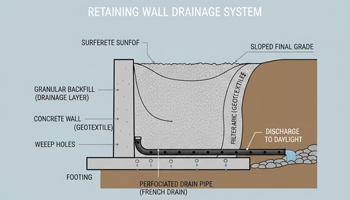
Drainage Gravel Specifications (3/4″ clean stone)
Proper drainage gravel consists of clean, angular crushed stone sized appropriately for drainage without allowing soil migration. The specification «3/4-inch clean stone» describes ideal material: predominantly 3/4-inch size stones (passing 1-inch screen, retained on 1/2-inch screen), «clean» meaning minimal fines or dust that would clog voids, and angular crushed stone providing stable structure with maximum void space.
This material creates approximately 35% to 40% void space between stones—far superior drainage compared to soil’s typical 5% to 15% interconnected pore space. Water flows freely through the gravel, collecting at the base where perforated drain pipes evacuate it from behind the wall.
Common mistakes include using «pea gravel»—too small, clogs easily, and doesn’t drain effectively despite being marketed for drainage. The small round stones compact tightly, reducing void space, and allow fine soil particles to infiltrate and clog the system. Using improperly sized or dirty stone with excessive fines that clog void spaces eliminates drainage effectiveness.
Backfill Zone Width (12-18″ minimum)
The drainage gravel zone should extend the full height of the wall and project at least 12 to 18 inches horizontally from the back of the wall into the retained soil mass. My standard specification calls for 18 inches of clean stone width providing adequate drainage zone thickness.
This width allows water infiltrating the soil mass to reach the drainage gravel quickly, providing sufficient gravel volume to handle peak water flows, and creating meaningful separation between the wall and water-retaining soil. Narrower zones (less than 12 inches) prove inadequate for taller walls or situations with significant water accumulation.
The gravel zone should extend from the base of the wall (where it surrounds the perforated drain pipe) to within 6 to 12 inches of final grade. The top portion can transition to decorative stone or be covered with landscaping fabric and topsoil to conceal the drainage gravel from view.
Compaction Requirements
Drainage gravel requires light compaction to settle the stone while preserving void space for drainage. Over-compaction crushes stones, generates fines that clog voids, and reduces drainage effectiveness.
Proper installation places gravel in lifts (layers) of 8 to 12 inches, compacting each lift with light mechanical compaction or hand tamping before placing the next lift. The goal: eliminating large voids and preventing later settlement without destroying the drainage characteristics.
This differs fundamentally from structural backfill compaction where maximum density is desired. For drainage gravel, preserving void space matters more than achieving maximum density.
Native Soil vs Engineered Fill
Behind the drainage gravel zone (beyond the 12 to 18-inch gravel width), backfill transitions to native soil or engineered fill. This portion can be compacted more aggressively since drainage occurs in the gravel zone adjacent to the wall rather than through this outer backfill.
Using excavated native soil for this outer zone proves economical if the soil is reasonably stable and free from organic material, large stones, or debris. However, engineered fill—properly graded and certified granular material—provides superior performance with predictable properties and reliable compaction characteristics.
The key principle: water must be able to migrate from this outer backfill into the drainage gravel zone. If native soil has very low permeability (heavy clay), consider extending the gravel zone further back or providing additional drainage measures to prevent water accumulation.
Filter Fabric (Geotextile) Installation
Filter fabric provides the critical interface between drainage gravel and surrounding soil, preventing soil migration while allowing water flow.
Fabric Types & Specifications
Geotextile filter fabrics come in woven and non-woven varieties, with non-woven fabrics generally preferred for drainage applications. The fabric should meet AASHTO M288 specifications or equivalent standards for filtration, soil retention, and drainage.
Key fabric properties include apparent opening size (AOS) that prevents soil particles from passing through while allowing water flow, permittivity providing adequate water flow rates through the fabric, and strength sufficient to withstand installation stresses without tearing. Typical specifications call for fabrics with AOS of 70 to 100 (indicating pore sizes) suited to the retained soil particle distribution.
Heavier-duty fabrics (6 to 8 ounce per square yard) provide greater durability and puncture resistance compared to lighter-weight options (3 to 4 ounce), though both work adequately when properly installed without excessive stress or damage.
Proper Wrapping Technique
Filter fabric installation creates an envelope around the drainage gravel, separating it from native soil on all sides except where the wall face itself provides separation. The fabric should be placed against the excavation face before installing drainage pipe and gravel, extending full height from footing level to near the top of the gravel zone.
As gravel placement proceeds upward, the fabric is folded over the top of the gravel, creating complete encapsulation. This wrapping prevents native soil from migrating into the gravel from above (settlement and surface water erosion) or from the sides and back (gradual infiltration over time).
The fabric should maintain several inches of overlap where edges meet, ensuring no gaps exist where soil could bypass the filter. Securing the fabric temporarily during backfilling prevents displacement that would create unprotected areas.
Overlap Requirements
Where fabric sections must be joined—due to limited fabric width or length—overlaps of at least 12 to 18 inches ensure adequate continuity. The overlap direction matters: upper fabric pieces should overlap lower pieces in shingle fashion, directing water flow downward without allowing it to penetrate behind the fabric layer.
Horizontal seams (where fabric rolls terminate at their ends) require careful attention since these represent potential soil intrusion points. Generous overlap and securing the joint area ensure no gaps develop during backfilling operations.
Preventing Soil Migration
The primary function of filter fabric: preventing fine soil particles from migrating into drainage gravel where they would gradually clog void spaces and eliminate drainage effectiveness. Without fabric, soil infiltration proves inevitable—fine particles wash into gravel during rain events, vibration from settling consolidates soil into gravel voids, and root growth carries soil particles into the gravel zone.
Over months to years, unfabric-wrapped gravel systems become soil-clogged masses with minimal drainage capacity. Fabric prevents this gradual degradation, maintaining drainage performance for decades rather than months.
Skipping filter fabric—one of the most common errors I observe—saves modest material costs ($0.50 to $1.00 per square foot) while virtually guaranteeing drainage system failure within 5 to 10 years as soil migration clogs the gravel.
Perforated Drain Pipe Systems
Perforated drain pipe collects water from the gravel backfill zone and conveys it away from the wall to appropriate discharge points.
4″ Perforated PVC Specifications
Standard residential retaining wall drainage uses 4-inch diameter perforated PVC pipe—the same type used for foundation drains and other subsurface drainage applications. The pipe features rows of holes (perforations) along its length that allow water to enter from the surrounding gravel.
The perforations should face downward or to the sides rather than upward, preventing soil and debris from entering directly through the holes. However, when wrapped in filter fabric (as recommended), perforation orientation becomes less critical since the fabric filters incoming water.
Solid (non-perforated) pipe sections connect the perforated portions to discharge points, ensuring collected water flows away rather than re-infiltrating through perforations once removed from the drainage zone.
Pipe Slope Requirements (1-2%)
Drainage pipe must slope continuously downward from its highest point to the discharge outlet, ensuring water flows by gravity rather than ponding in the pipe. Minimum slope of 1% (1 inch of drop per 100 feet of horizontal distance) allows adequate flow, while 2% slope (2 inches per 100 feet) provides more robust drainage.
For typical residential walls ranging from 20 to 100 feet in length, this slope requirement translates to 2 to 24 inches of elevation difference between pipe inlet and outlet. Site grading usually accommodates these modest drops without difficulty.
Inadequate pipe slope—a common error—allows water to stand in pipes rather than evacuating, defeating the drainage system purpose. Even slight back-slope (pipe sloping upward toward discharge) completely prevents drainage, creating hydrostatic pressure despite having drainage infrastructure.
Placement at Wall Base
The perforated drain pipe should be positioned at the lowest point of the drainage system—typically at or just above footing level—where water collecting in the gravel naturally accumulates. The pipe sits in a gravel bed 4 to 6 inches thick (below the pipe invert) with additional gravel covering the pipe by 4 to 6 inches.
This placement ensures all water draining down through the gravel reaches the pipe level where it enters through perforations and flows to the discharge outlet. Elevating the pipe significantly above the footing level allows water to pond below the pipe, reducing drainage effectiveness.
The pipe should run the full length of the wall, positioned 6 to 12 inches behind the wall back face (within the gravel drainage zone) rather than directly against the wall. This placement allows water from the full gravel width to reach the pipe.
Outlet Configuration
The drainage pipe must discharge to an appropriate location where water flows away from the wall and property without creating new problems. Suitable outlets include daylight discharge on downslope sites where the pipe can emerge above grade and discharge freely, connection to storm sewer systems where permitted by local codes, discharge to swales or drainage courses designed to carry water away, or connection to other site drainage systems.
The outlet must be protected from freezing in cold climates—pipes that freeze solid cannot drain, allowing hydrostatic pressure to build despite having drainage infrastructure. Outlets should be screened or protected from rodent intrusion while allowing free water discharge.
A perfect drainage system with nowhere for water to go proves useless—one of the most frustrating errors I encounter. Contractors install comprehensive drainage behind walls but provide no outlet, allowing water to collect in the system until it overflows back into the backfill or causes other problems.
Complete Drainage System Assembly
Understanding how individual components integrate creates effective drainage systems greater than the sum of their parts.
Layer-by-Layer Installation
Proper drainage system installation proceeds systematically from the wall base upward. Begin with excavation extending 12 to 18 inches (minimum) behind the wall back face and down to footing level. Place filter fabric against the excavation face, extending from below footing level to eventual top of gravel zone.
Install perforated drain pipe at base level, positioned on 4 to 6 inches of gravel bedding with appropriate slope toward discharge outlet. Begin placing drainage gravel in 8 to 12-inch lifts, compacting lightly after each lift. Continue gravel placement to full height (typically to within 6 to 12 inches of finish grade).
Fold filter fabric over the top of the gravel, overlapping generously (12+ inches) to encapsulate the gravel completely. Place structural backfill behind the fabric-wrapped gravel zone, compacting properly to provide stable support. The topmost 6 to 12 inches can transition to topsoil for landscaping.
Integration with Weep Holes
Weep holes must connect to the drainage gravel zone to function effectively. For walls with internal drainage gravel, weep holes provide the primary discharge mechanism, with spacing and sizing adequate to evacuate water collected in the gravel.
The perforated drain pipe at wall base provides secondary drainage, collecting water that doesn’t discharge through weep holes and conveying it to outlet points. This redundant system ensures drainage occurs even if some weep holes clog—a common occurrence despite best installation practices.
For walls over 6 feet in height, a technique that has worked exceptionally well based on extensive project experience: perforated pipe at TWO levels—one at base (standard) and a second at mid-height. This intercepts water table more effectively in situations with high groundwater, providing drainage at multiple elevations rather than only at the base.
Connection to Existing Drainage
Retaining wall drainage should integrate with existing site drainage systems—foundation drains, yard drainage, storm sewers—creating comprehensive water management rather than isolated systems. The wall drainage pipe can connect to foundation drainage systems if both drain to appropriate outlets, tie into French drains or other subsurface drainage, or discharge to storm sewers where permitted.
These connections ensure water removed from behind the wall flows away from the site rather than re-accumulating in other problematic locations. Coordination during design prevents conflicts and ensures all drainage systems work cooperatively.
Drainage for Different Wall Types
Different retaining wall construction methods require adapted drainage approaches while maintaining the same fundamental principles.
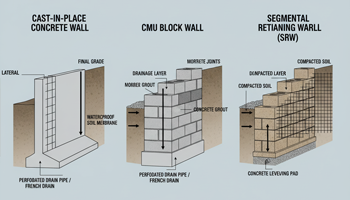
Poured Concrete Walls
Poured concrete retaining walls present solid, impermeable barriers requiring comprehensive external drainage systems. The drainage design includes perforated pipe at base within gravel backfill, filter fabric wrapping the gravel zone, and weep holes penetrating the wall at regular intervals.
The concrete provides no inherent drainage (unlike segmental blocks), making external drainage system particularly critical. Weep holes must be formed during concrete placement using PVC pipe sections or commercial weep hole forms, since cutting openings after curing proves difficult.
CMU Block Walls
Concrete masonry unit (CMU) walls can incorporate internal drainage through the hollow block cores, with water draining downward through cores and exiting at base level weep holes. However, this internal drainage should supplement—not replace—external gravel backfill and filter fabric systems.
The block cores provide vertical drainage paths reducing internal hydrostatic pressure, but external drainage gravel still proves necessary to prevent soil contact with the wall and allow water collection. Weep holes in CMU walls can be created by omitting mortar in vertical joints at regular intervals, providing simpler installation than forming openings in poured concrete.
Segmental Retaining Walls (SRW)
Segmental retaining wall blocks typically include built-in drainage features—cores and voids between blocks that allow water flow through the wall rather than requiring weep holes. This inherent drainage represents a significant advantage of SRW systems over solid walls.
However, SRW systems still require proper backfill gravel and drainage pipe at base. The block voids provide drainage through the wall face but don’t eliminate need for collecting and removing water from behind the wall. The gravel backfill zone and perforated pipe remain essential even with inherently draining SRW blocks.
The good news: modern SRW blocks with built-in drainage features simplify installation while providing excellent drainage performance. The blocks’ permeability allows water to escape freely without clogging concerns that affect conventional weep holes.
Regional Considerations
Local conditions affect drainage system design, requiring adaptations for specific challenges.
High Water Table Solutions
Sites with high water tables—where groundwater sits close to the surface—create maximum drainage challenges. The saturated soil behind walls generates continuous hydrostatic pressure requiring robust drainage systems.
Solutions for high water table situations include extending the gravel backfill zone wider (24 to 36 inches rather than 12 to 18 inches), providing additional drainage capacity, installing perforated pipe at multiple elevations rather than only at base, increasing weep hole density (3 to 4 feet spacing rather than 5 to 6 feet), and considering well point systems or other dewatering approaches for extreme cases.
Some situations prove so challenging that retaining walls become impractical without extensive dewatering systems. Geotechnical investigation helps identify these severe conditions during design rather than discovering them during construction or after wall failure.
Clay Soil Challenges
Clay soils present dual drainage challenges: very low permeability prevents water from draining naturally through the soil, and expansive characteristics mean volume changes with moisture content generate additional pressures. These soils make drainage absolutely critical since water cannot drain away naturally.
Clay soil adaptations include using wider gravel backfill zones (18 to 24 inches minimum) to compensate for clay’s poor drainage, placing drainage pipe at multiple elevations to intercept water before it saturates clay behind the wall, and considering soil modification or replacement with free-draining material in the immediate backfill zone.
Some designers recommend replacing all clay backfill within several feet of the wall with engineered granular fill, eliminating clay drainage problems entirely. While expensive, this approach provides reliable long-term performance in challenging clay conditions.
Freeze-Thaw Climate Adaptations
Cold climates with significant freeze-thaw cycles demand particular drainage attention since saturated soil that freezes generates enormous expansion forces. Drainage system reliability becomes even more critical when preventing saturation prevents catastrophic freeze-thaw damage.
Cold climate considerations include ensuring drainage pipe outlets don’t freeze solid (prevent water evacuation when most needed), providing adequate gravel depth below pipe to prevent ice dams, considering insulation for drainage pipes in extreme climates, and maintaining aggressive weep hole cleaning schedules to ensure winter drainage.
Weep holes should be inspected and cleared before winter when freezing would prevent maintenance access. Blocked weep holes during spring thaw allow catastrophic pressure buildup as snowmelt saturates soil that cannot drain through frozen or clogged outlets.
Common Drainage Mistakes
Certain errors appear repeatedly in retaining wall drainage, representing common misunderstandings that cause the majority of premature failures.
Inadequate Backfill Width
Using narrow gravel backfill zones—6 to 10 inches rather than 12 to 18 inches minimum—provides insufficient drainage capacity and allows retained soil to contact or nearly contact the wall. This mistake saves modest material costs while compromising the entire drainage system effectiveness.
The narrow zone cannot handle peak water flows during heavy rain or snowmelt, fills completely with water creating hydrostatic pressure, and provides minimal separation between wall and water-retaining soil. The false economy of skimping on gravel width costs far more when walls fail prematurely.
Wrong Gravel Type
Using inappropriate gravel types—pea gravel, crusher run, or dirty stone—eliminates drainage effectiveness despite having gravel present. Pea gravel’s small, rounded stones compact tightly and allow soil infiltration. Crusher run contains excessive fines that clog void spaces. Any dirty stone with dust and small particles gradually clogs, transforming from drainage gravel to impermeable mass.
This common error stems from not understanding that drainage requires specific clean, angular stone specifications. Simply using «gravel» without specifying type and cleanliness produces ineffective drainage systems despite superficially following recommendations to use gravel backfill.
No Filter Fabric
Omitting filter fabric between gravel and native soil—attempting to save $0.50 to $1.00 per square foot—virtually guarantees drainage failure within years as soil gradually migrates into gravel and clogs void spaces. This represents perhaps the single most common drainage error encountered across hundreds of projects.
The fabric cost remains minimal compared to total project expenses, yet its presence determines whether the drainage system maintains effectiveness for decades or fails within a few years. No component provides better cost-to-benefit ratio than filter fabric for ensuring long-term drainage performance.
Clogged Weep Holes
Weep holes clog from various causes including insect nests (particularly mud daubers and wasps), root intrusion from nearby vegetation, mineral deposits in hard water areas forming scale in openings, and soil migration when filter fabric fails or is improperly installed.
Clogged weep holes cannot drain, allowing pressure buildup behind walls despite having drainage infrastructure theoretically present. Regular inspection—annually recommended—allows cleaning before complete blockage occurs. Clearing methods include compressed air, pressure washers, or mechanical snaking depending on blockage type and severity.
Maintenance & Inspection
Ongoing maintenance ensures drainage systems continue functioning throughout the wall’s life rather than gradually degrading to ineffectiveness.
Checking Weep Hole Function
Annual inspection should verify weep holes remain open and functional. During wet periods or shortly after significant rainfall, water should drain freely from weep holes, indicating the drainage system is working. Dry weep holes during wet conditions suggest either very effective drainage (water evacuates faster than it accumulates) or blocked holes preventing drainage.
Visual inspection identifies obvious blockages—insect nests, vegetation growth, or debris visible in openings. Probing with stiff wire or compressed air tests for internal blockages not visible from outside. Any weep hole that cannot be cleared easily may require more extensive intervention.
Clearing Blockages
Compressed air blown into weep holes from outside can dislodge loose blockages including insect nests and accumulated debris. Pressure washers force water through openings, flushing blockages. For stubborn blockages, mechanical snaking using drain cleaning equipment may be necessary.
Severe blockages requiring extensive intervention suggest underlying problems—perhaps filter fabric failure allowing soil migration, or mineral deposits from very hard water. These situations may require professional assessment and potentially drainage system repairs.
Monitoring for Water Damage Signs
Beyond direct weep hole inspection, monitoring walls for water damage indicators provides early warning of drainage problems. Signs include efflorescence (white crystalline deposits) on wall faces indicating water infiltration, wall leaning or bulging suggesting increased pressure from water accumulation, wet areas or vegetation growth at wall base indicating poor drainage, and cracking or material deterioration possibly from freeze-thaw damage.
Any of these indicators warrant immediate drainage system inspection and corrective action before problems escalate to structural failure. Early intervention costs far less than rebuilding failed walls.
Cost Analysis: Drainage System Components
Understanding drainage system economics helps justify proper specifications despite their costs.
Material Costs Breakdown
Comprehensive drainage system materials cost approximately $12 to $18 per linear foot for typical residential retaining walls. This includes perforated drain pipe ($2 to $3 per linear foot), drainage gravel 3/4-inch clean stone ($4 to $7 per linear foot for 18-inch width full height), filter fabric ($1 to $2 per linear foot), weep hole materials (PVC pipe, forms) ($1 to $2 per linear foot), and fittings, connectors, and miscellaneous items ($2 to $4 per linear foot).
Total material costs range from $12 to $18 per linear foot depending on wall height, gravel zone width, and material prices. For a 40-foot retaining wall, drainage system materials cost $480 to $720—modest compared to total wall construction costs typically ranging from $40 to $80+ per linear foot.
Labor Considerations
Installation labor adds to material costs, typically requiring $8 to $15 per linear foot for proper drainage system installation including excavation of drainage zone, placement and wrapping of filter fabric, installation of perforated pipe with proper slope, placement and compaction of drainage gravel in lifts, and formation of weep holes during wall construction.
Total installed cost for comprehensive drainage systems ranges from $20 to $33 per linear foot—representing 20% to 30% of typical total wall costs. This significant percentage gives some contractors and homeowners pause, creating temptation to economize on drainage.
Long-Term Value of Proper Drainage
The cost-benefit analysis proves overwhelmingly favorable for comprehensive drainage. A wall costing $80 per linear foot to construct (40 feet = $3,200 total) plus $20 per linear foot for proper drainage ($800) creates $4,000 total investment. If poor drainage causes failure requiring wall replacement after 10 years, the homeowner spends another $3,200 for total $6,400 over 10 years.
Conversely, proper drainage extending wall life to 40+ years costs $4,000 once, saving the $3,200 rebuild cost entirely. The extra $800 drainage investment prevents $3,200 failure costs—a 400% return on investment beyond simply maintaining functionality and avoiding disruption.
The economic choice proves clear: spending 20% more on drainage prevents 100% replacement costs within a decade, making proper drainage the most valuable investment in retaining wall construction.
Need help designing a comprehensive drainage system for your retaining wall project? Share details about your wall type, height, soil conditions, and site characteristics for customized recommendations on drainage specifications that ensure long-term performance and prevent costly failures.
Currently viewing
Retaining Wall Drainage
Structural Engineer vs Foundation Contractor
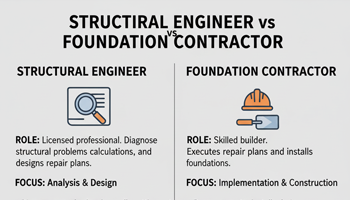
Structural Engineer vs Foundation Contractor: When You Need Each Understanding the distinction between structural engineers…
Basement Moisture Testing
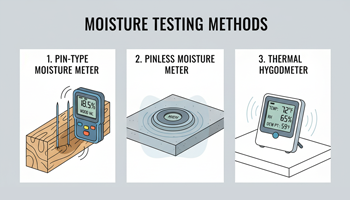
Basement Moisture Testing: Before Starting Renovation Projects Moisture testing represents the single most overlooked yet…

Basement Insulation
Basement Insulation: Rigid Foam vs Spray Foam for Concrete Walls Basement insulation strategy fundamentally affects…

Egress Window Requirements
Egress Window Requirements: Code Compliance & Installation Cost Egress windows represent one of the most…
Concrete Slab Repair
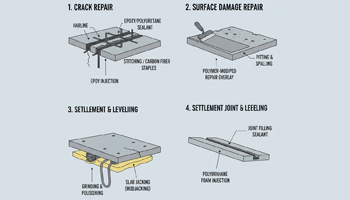
Concrete Slab Repair: Crack Injection vs Surface Patching Methods Concrete slabs develop cracks for numerous…
Basement Structural Framing
Basement Structural Framing: Load-Bearing Walls & Beam Sizing Understanding basement structural framing represents one of…

Basement Finishing Cost
Basement Finishing Cost: Framed Drywall vs Modular Panels Finishing a basement transforms unused square footage…
Retaining Wall Design
Retaining Wall Design: Concrete vs Block vs Segmental Systems Selecting the right retaining wall system…
Basement & Foundation Structural
Structural Solutions for Basements & Foundations: Complete Engineering Guide Foundation and basement structural engineering represents…