
Structural Engineer vs Foundation Contractor: When You Need Each
Understanding the distinction between structural engineers and foundation contractors represents one of the most common sources of confusion—and costly mistakes—in foundation work and basement renovation projects. These two professionals serve fundamentally different roles despite both working on structural issues, and knowing when you need each one determines whether your project proceeds legally, safely, and economically.
The confusion stems from overlapping areas of expertise and terminology. Both professionals work on foundations, both understand structural issues, and both can assess problems and recommend solutions. However, their education, legal authority, services, and appropriate project phases differ dramatically. Hiring the wrong professional or skipping a necessary expert creates problems ranging from code violations and voided insurance coverage to dangerous structural inadequacies and expensive reconstruction when improper work fails.
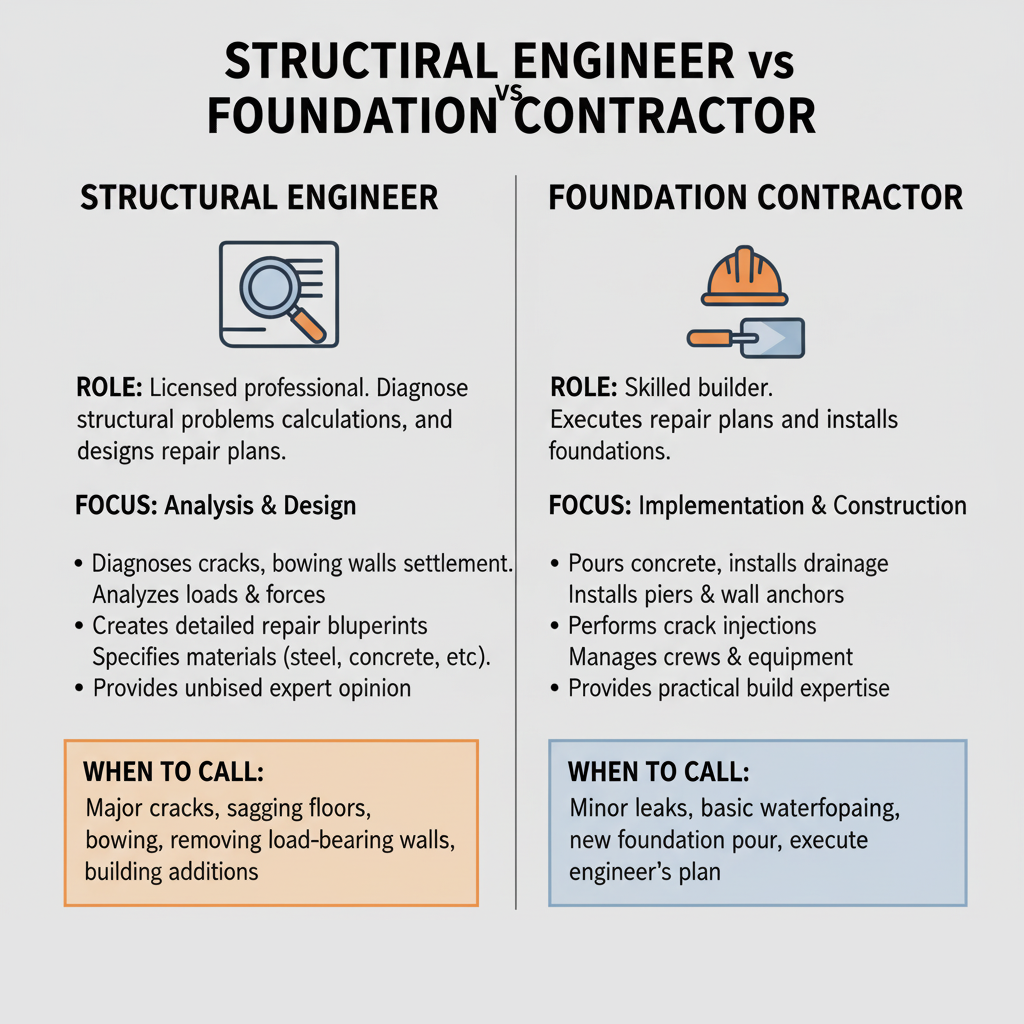
After mediating dozens of disputes between homeowners, contractors, and engineers with conflicting expectations about roles and responsibilities, I’ve learned that most conflicts arise from misunderstanding what each professional does and when their involvement becomes necessary or legally required. The fundamental distinction proves simple: structural engineers DESIGN—they calculate loads, specify materials, create plans, and stamp drawings with their professional seal—while foundation contractors BUILD—they execute the physical work based on plans (either their own for simple projects or engineer-provided plans for complex work).
This comprehensive guide clarifies professional roles, explains when each expert is legally required versus optionally beneficial, examines cost implications, and provides concrete scenarios helping homeowners make informed decisions about professional involvement. Whether planning basement renovations, addressing foundation problems, or modifying structural systems, understanding these professional distinctions proves essential for successful, compliant, and safe outcomes.
Understanding Professional Roles in Foundation Work
The construction industry includes numerous specialized professionals, with structural engineers and foundation contractors representing two distinct but complementary roles in foundation and structural work.
Common Confusion Between Roles
Homeowners frequently assume foundation contractors can handle all foundation-related decisions and design work, or conversely, that structural engineers perform actual construction and repairs. Neither assumption proves correct—each professional has specific expertise, legal authority, and appropriate project phases.
The confusion intensifies because foundation contractors often possess extensive practical knowledge about foundation problems and repairs, making their assessments seem equivalent to engineering analysis. However, contractors lack the legal authority to design structural systems, stamp plans for permit applications, or provide engineering certification that lenders and insurance companies require.
Similarly, structural engineers design solutions but typically don’t implement repairs themselves—they work with contractors who have equipment, personnel, and construction expertise to execute the designed solutions.
Why It Matters for Your Project
Understanding professional distinctions affects multiple project outcomes including legal compliance with building codes requiring engineered plans for certain work, lender requirements for engineering certification on homes with foundation issues, insurance coverage potentially voided by unpermitted or improperly designed work, and liability protection through professional engineering oversight.
Financial implications prove substantial. Projects proceeding without required engineering may need complete reconstruction when building departments discover code violations. Conversely, hiring engineers for simple repairs where contractor expertise suffices wastes money on unnecessary professional services.
The stakes increase with project complexity and home value. A $400,000 home with structural modifications needs proper engineering; cutting corners to save $3,000 in engineering fees risks far larger losses from improper work or reduced home value from undocumented structural modifications.
What Structural Engineers Do
Structural engineers bring specialized education, legal authority, and technical expertise that contractors cannot provide regardless of experience.
Education & Licensing Requirements (PE License)
Structural engineers hold bachelor’s degrees in civil or structural engineering (4 years), often pursue master’s degrees for specialized expertise (additional 1-2 years), pass the Fundamentals of Engineering (FE) exam, complete 4+ years of supervised professional experience, and pass the Professional Engineer (PE) exam specific to structural engineering.
The PE license represents legal authorization to stamp drawings and accept liability for engineering designs. This licensing creates legal distinction between engineers and contractors—only licensed engineers can provide engineering services including structural calculations, design specifications, and stamped plans.
State licensing boards regulate PE licenses, maintaining public databases for verification. The license requires continuing education, adherence to professional ethics codes, and maintenance of professional liability insurance.
Services Provided (Analysis, Calculations, Stamped Plans)
Structural engineers provide services including structural analysis calculating loads, stresses, and required capacities; design specifications determining member sizes, materials, and connection details; stamped drawings providing legal authorization for permit applications and construction; site inspections verifying existing conditions and monitoring construction compliance; and failure analysis investigating structural problems and determining causes and remedies.
The stamped drawings carry legal weight—the engineer’s seal certifies that designs meet building codes, account for all applicable loads, and provide adequate safety factors. This certification protects homeowners, satisfies lenders and insurance companies, and enables building permit issuance.
Typical Project Involvement
Engineers typically engage at specific project phases rather than providing continuous involvement. Initial consultation and site visit costs $800 to $1,500, with engineers assessing problems, identifying concerns, and recommending approaches. Design and stamped plans cost $2,000 to $5,000 for typical residential projects, with engineers creating construction documents specifying all structural requirements.
Construction observation involves periodic site visits during construction verifying compliance with engineered designs, typically adding $500 to $1,500 to project costs. Final certification provides stamped letters or reports confirming completed work meets engineered specifications, valuable for lenders and future home sales.
Legal Authority & Liability
Structural engineers accept professional liability for their designs—if engineered solutions fail due to design inadequacy (rather than construction defects), the engineer bears responsibility. This liability requires professional liability insurance and creates strong incentive for conservative, safe designs.
The legal authority to stamp drawings means engineers can authorize structural work that building departments won’t approve from contractor-provided plans alone. This authority becomes critical for projects requiring permits or lender approval.
What Foundation Contractors Do
Foundation contractors bring practical construction expertise, specialized equipment, and hands-on experience implementing foundation solutions.
Certifications & Experience
Foundation contractors typically don’t hold engineering degrees but accumulate practical knowledge through years of field experience. Industry certifications from organizations like the Foundation Supportworks Network or Basement Health Association provide training and standards though they don’t equal engineering licenses.
State contractor licenses (where required) demonstrate basic competency and financial responsibility but don’t authorize engineering services. The license requirements vary dramatically by state—some mandate comprehensive testing and insurance, while others require minimal documentation.
Services Provided (Installation, Repair, Waterproofing)
Contractors provide hands-on construction services including foundation repair implementation using piers, underpinning, or other stabilization methods; crack repair through injection, sealing, or structural reinforcement; waterproofing installation of drainage systems, sealants, and moisture barriers; basement excavation and underpinning; and concrete work including slab replacement, wall repairs, and structural modifications.
Many contractors also provide assessment services as part of generating repair proposals. These assessments utilize practical experience identifying common problems and effective solutions, though they lack the engineering calculations and stamped certification that engineers provide.
Equipment & Capabilities
Foundation contractors invest in specialized equipment including hydraulic lifting systems for foundation stabilization, concrete cutting and drilling tools, excavation equipment for drainage and underpinning work, and waterproofing installation tools.
This equipment investment and crew expertise enable contractors to efficiently execute work that would prove impractical for engineers or general contractors lacking foundation specialization.
Warranty & Workmanship Guarantees
Reputable foundation contractors provide warranties on completed work—typically 10 to 25 years for major repairs or lifetime warranties for certain stabilization systems. These warranties cover workmanship and material defects but don’t extend to design inadequacies if the contractor designed the solution themselves.
The warranty value depends on contractor longevity—a 25-year warranty from a company likely to remain in business provides more security than identical warranty terms from a newly formed company.
When You Need a Structural Engineer
Certain situations demand engineering expertise and legal authority that contractors cannot provide.
New Foundation Design
New construction or additions requiring foundation design need engineering for calculating soil bearing capacity requirements, determining foundation dimensions and reinforcement, designing structural connections to existing foundations, and providing stamped plans for permit applications.
No contractor can legally provide these engineering services regardless of experience. Building departments require PE-stamped plans for new foundation construction in virtually all jurisdictions.
Load-Bearing Wall Removal
Removing load-bearing walls represents perhaps the most common scenario where homeowners discover engineering requirements. The process requires analyzing loads being carried by the wall to be removed, designing beam and support systems to carry redistributed loads, calculating required beam sizes and support post specifications, and providing stamped plans for permit applications.
In most jurisdictions, building codes explicitly require engineering for load-bearing wall removal. Proceeding without engineering creates code violations, insurance problems, and potential structural failure risks.
Major Structural Modifications
Significant structural changes including adding stories to existing homes, converting crawl spaces to full basements, modifying rooflines or structural systems, and adding heavy loads (large aquariums, equipment) all require engineering analysis ensuring existing structures can support new loads.
These modifications affect structural systems beyond the immediate work area—engineers analyze how changes propagate through the structure and verify adequate capacity throughout the load path.
Foundation Failure Analysis
When foundations show distress—significant cracking, settlement, or movement—engineering analysis determines failure causes, assesses structural adequacy, designs repair solutions, and provides documentation for insurance claims or litigation.
Contractors can identify problems and suggest repairs, but only engineers can provide the forensic analysis and stamped certification that insurance companies and courts require. The investment in engineering analysis ($1,200 to $2,500 typically) provides critical documentation if foundation problems escalate to insurance claims or legal disputes.
Building Permit Requirements
Building departments determine when engineering is required for permits based on project scope, structural implications, and local code provisions. Common engineering triggers include structural modifications exceeding prescriptive code limits, work in high-seismic or high-wind zones, projects where structural adequacy isn’t obvious from standard details, and whenever building officials request engineering analysis for unusual situations.
Always verify permit requirements before beginning work—projects requiring permits virtually always need engineering for structural work.
Home Inspection Red Flags
Home inspectors identifying foundation concerns typically recommend structural engineering evaluation. These recommendations protect inspectors from liability while providing homeowners with expert assessment of problem severity and repair needs.
Lenders often require engineering evaluation before approving mortgages on homes with foundation concerns identified in inspections. The engineer’s stamped report provides lenders assurance that problems have been properly assessed and either don’t require immediate repair or have been addressed adequately.
When You Need a Foundation Contractor
Contractors become necessary for actual repair implementation and certain assessment services where engineering isn’t legally required.
Foundation Repair Implementation
Once engineering designs exist (if required), contractors implement the repairs including excavation and installation of support piers, underpinning walls to increase depth or capacity, installing steel reinforcement or carbon fiber strengthening, and executing crack repairs through injection or sealing.
Contractors convert engineering specifications into physical construction, bringing equipment, labor, and practical construction expertise to execute designed solutions.
Basement Waterproofing
Waterproofing projects generally don’t require engineering unless structural issues accompany moisture problems. Contractors assess and implement solutions including interior and exterior drainage systems, sump pump installation, crack sealing and waterproofing membranes, and grading improvements.
These improvements may proceed based on contractor expertise without engineering involvement, though complex situations benefit from engineering oversight.
Crack Repair
Minor crack repair—hairline cracks without structural displacement or ongoing movement—typically doesn’t require engineering. Contractors assess crack type and severity, recommend injection or surface sealing, and implement repairs using epoxy or polyurethane injection or surface patching compounds.
However, cracks showing structural movement, differential settlement, or ongoing progression should receive engineering evaluation before repair to ensure underlying structural issues are addressed.
Underpinning & Stabilization
Foundation underpinning and stabilization work often requires both engineering and contractor involvement—engineers design systems specifying pier types, depths, and spacing, while contractors install the physical systems using specialized equipment and techniques.
Some straightforward stabilization work proceeds based on contractor assessment alone, particularly when using pre-engineered proprietary systems with established design guidelines. However, complex situations benefit from independent engineering analysis.
Drainage System Installation
Exterior and interior drainage system installation generally falls within contractor expertise without engineering requirements. These systems prevent water accumulation causing foundation problems, addressing moisture sources before they create structural damage.
Projects Requiring Both Professionals
Complex projects benefit from collaborative involvement of both engineers and contractors, with each contributing specialized expertise.
Basement Expansions
Expanding basements through dig-outs or underpinning requires engineering to design underpinning systems, analyze load distributions on modified foundations, specify excavation sequences preventing collapse, and provide stamped plans for permits; plus contractors to execute excavation safely, install underpinning systems per engineered specifications, and waterproof expanded spaces.
The collaboration ensures designs prove buildable while construction follows engineered specifications.
Major Foundation Repairs
Significant foundation repairs benefit from engineering analysis determining failure causes and appropriate solutions, designing comprehensive repair systems, providing stamped plans and specifications, and inspecting completed work; plus contractor implementation executing repairs per engineered designs, providing warranty coverage on workmanship, and offering maintenance guidance.
Adding Stories to Existing Homes
Adding stories to homes requires engineering to analyze existing foundation capacity for increased loads, design foundation modifications if needed, specify structural connections between new and existing construction, and provide stamped plans; plus contractors to implement foundation improvements, excavate and install additional support as needed, and coordinate with framing contractors.
Converting Crawl Spaces to Basements
Converting crawl spaces to full basements represents complex work requiring both professionals. Engineers design underpinning systems to increase depth, analyze structural implications of excavation, specify excavation sequences and support systems, and provide stamped plans. Contractors execute excavation in stages, install underpinning and support systems, waterproof converted spaces, and coordinate utility relocations.
These projects prove too complex for contractor-only approaches yet require contractor expertise to implement engineered designs practically.
Cost Comparison
Understanding cost structures for each professional helps budget appropriately and recognize value propositions.
Structural Engineer Fees ($1,500-$5,000 typical)
Engineering costs for residential foundation work typically range from $800 to $1,500 for site visit and assessment report providing professional evaluation and recommendations; $2,000 to $5,000 for design and stamped plans for typical residential projects; $500 to $1,500 for construction observation including site visits during work; and $1,000 to $2,000 for certification letters documenting structural adequacy.
Total engineering costs for comprehensive involvement (assessment, design, observation, certification) typically run $3,500 to $7,500 for residential projects—substantial but small percentages of total project costs typically ranging from $15,000 to $100,000+ depending on repair scope.
Foundation Contractor Costs (Project-Dependent)
Contractor costs vary enormously based on work scope: minor crack repair costs $500 to $2,000, waterproofing systems cost $3,000 to $15,000, foundation stabilization with piers costs $10,000 to $30,000, and basement underpinning or conversion costs $30,000 to $100,000+.
Initial contractor assessments and proposals are typically free—contractors provide quotes as part of business development. However, comprehensive assessments beyond simple quoting may incur fees.
When Engineering Saves Money Long-Term
The engineering investment upfront ($2,000 to $5,000) can save tens of thousands in several ways including identifying minimum adequate solutions rather than over-building, preventing improper repairs requiring complete reconstruction, providing documentation enabling permit approval without delays, and protecting against contractor disputes through clear specifications.
A common scenario from extensive project experience: engineers design comprehensive solutions costing $40,000 while contractors offer «value-engineered» approaches for $8,000. Sometimes contractors have valid points—over-engineering occurs. However, deviating significantly from engineered plans can void warranties and create liability issues. The engineer’s conservative design may prove more expensive initially but prevents catastrophic failures that would cost far more.
Verification & Credentials
Protecting yourself requires verifying professional credentials before engaging services or signing contracts.
How to Verify PE License
Structural engineer PE licenses are publicly verifiable through state licensing boards maintaining online databases. Search «[State Name] Professional Engineer License Verification» to find your state’s licensing board website. Enter the engineer’s name or license number to verify active, valid licensing with no disciplinary actions.
Red flags include engineers unable or unwilling to provide license numbers, licenses from other states (each state requires its own license for work in that state), or licenses with expired dates or disciplinary actions.
Contractor Licensing by State
Contractor licensing requirements vary dramatically by state. Some states mandate comprehensive contractor licensing with testing, experience documentation, and insurance requirements. Others require only business registration with minimal verification.
Verify contractor licenses through your state’s contractor licensing board or Department of Consumer Affairs. Check for active licenses, adequate bonding amounts, and absence of major complaints or disciplinary actions.
Insurance Requirements
Both engineers and contractors should carry substantial liability insurance protecting clients from professional errors or accidents. Structural engineers need professional liability (errors and omissions) insurance covering design errors—typically $1 million to $2 million minimum coverage. Foundation contractors need general liability insurance covering property damage and injuries during construction—typically $1 million minimum per occurrence.
Request certificates of insurance before engaging services. Verify coverage is current and adequate for project scope.
Red Flags to Watch For
Warning signs include professionals unable to provide clear licensing information, unusually low pricing compared to other quotes (suggesting inadequate insurance, poor quality, or failure to account for necessary work), pressure to proceed immediately without time for verification, unwillingness to provide written contracts or warranties, and resistance to having work inspected or permitted.
Trust instincts when something seems wrong—legitimate professionals welcome verification and operate transparently.
Working Relationship Between Engineer & Contractor
Effective projects involve clear collaboration between engineers and contractors with understood roles and communication.
Design-Build Approach
Design-build arrangements combine engineering and construction under single contracts, streamlining communication and potentially reducing costs through efficient collaboration. Some foundation companies employ staff engineers or maintain relationships with engineering firms, offering integrated services.
However, verify that engineers involved in design-build arrangements are independent professionals rather than employees whose objectivity might be compromised by contractor employment relationships.
Engineer Inspections During Construction
Engineers should inspect work periodically during construction verifying compliance with engineered designs, identifying any field conditions requiring design modifications, and documenting proper execution for certification purposes.
These inspections protect homeowners by ensuring contractors follow specifications and provide engineers opportunities to address unexpected conditions before they become problems.
Change Orders & Field Modifications
Construction occasionally reveals conditions requiring design changes. Proper protocols involve contractors documenting changed conditions and stopping work, engineers assessing situations and modifying designs if needed with revised stamped drawings, and proceeding only after revised engineering is complete.
Never allow contractors to make significant design changes without engineering approval—these modifications void engineering certifications and create liability issues.
Common Scenarios Explained
Understanding typical scenarios helps navigate real-world situations with clarity about professional requirements.
«My Contractor Says I Don’t Need an Engineer»
This statement raises red flags if the contractor is dismissing obvious structural concerns. Good contractors recognize limits of their expertise and suggest engineering when appropriate. However, for straightforward repairs like simple crack injection, contractor assessment may suffice.
Evaluate the statement context: Is structural integrity uncertain? Does the work require permits? Would you want engineering certification for resale or refinancing? If yes to any, get engineering despite contractor claims it’s unnecessary.
«The Bank Requires Engineering Certification»
This represents a legitimate lender requirement providing assurance that foundations are structurally sound. Engineers provide stamped letters certifying foundation conditions—typically costing $1,200 to $2,000 for assessment and certification.
Don’t resist this requirement—it protects both lender and homeowner by ensuring foundation problems have been properly evaluated.
«Home Inspector Recommended Structural Evaluation»
Home inspectors recommend engineering evaluation when they identify concerning conditions but lack expertise to assess severity or determine appropriate repairs. The recommendation protects the inspector from liability while providing you with expert assessment.
Take these recommendations seriously. The engineering evaluation ($800 to $1,500 typically) clarifies whether problems require immediate attention or can be monitored, what repairs are needed, and what realistic costs might be.
DIY vs Professional Assessment
Some situations allow homeowner assessment while others mandate professional involvement.
When to Skip Both (Minor Cosmetic Repairs)
Purely cosmetic issues like hairline cracks without structural movement, minor surface spalling from freeze-thaw cycles, or cosmetic waterproofing for slightly damp conditions that don’t threaten structures may proceed with homeowner research and execution.
These situations involve no structural concerns, don’t require permits, and use readily available materials and techniques. DIY approaches save money without compromising safety or performance.
When Professional Assessment Is Mandatory
Professional assessment becomes mandatory when structural integrity is uncertain, projects require building permits, lenders demand professional certification, or when contemplating major investments in repairs without professional guidance.
The assessment costs ($800 to $1,500 for engineering or free to minimal for contractor quotes) prove modest compared to risks of proceeding without professional input on complex problems.
Legal & Insurance Implications
Unpermitted work requiring permits creates problems during home sales when inspection reveals code violations requiring expensive corrections before closing. Insurance companies may deny claims for damage related to unpermitted or improperly designed work. Structural failures from inadequate repairs create liability exposure if injuries or major damage result.
Professional involvement provides documentation protecting against these scenarios—the modest cost brings substantial legal and insurance benefits.
Getting Quotes & Making Decisions
Informed decision-making requires asking appropriate questions and evaluating responses critically.
Questions to Ask Engineers
Essential engineer questions include: What is your PE license number in this state? What is your experience with projects similar to mine? What services do you provide and what are associated costs? What is your typical timeline for design completion? Will you provide construction observation services? What documentation will I receive at project completion?
Evaluate responses for professionalism, clarity, and confidence. Engineers should explain approaches clearly and demonstrate relevant experience.
Questions to Ask Contractors
Critical contractor questions include: What is your contractor license number and bonding amount? How long have you been in business and how many similar projects have you completed? What is your approach to this specific problem? Do you have references I can contact? What warranty do you provide on completed work? What insurance coverage do you carry?
Assess whether contractors acknowledge limitations honestly—good contractors admit when engineering input would benefit projects rather than claiming ability to handle everything regardless of complexity.
How to Evaluate Proposals
Compare proposals systematically by verifying all professionals are properly licensed and insured, understanding scope differences explaining price variations, assessing warranty terms and their realistic value, checking references from past clients, and evaluating professionalism in proposal presentation and communication.
The lowest bid frequently proves most expensive long-term through poor workmanship, inadequate solutions, or contractors disappearing before warranty obligations are met. Evaluate value and professional competence rather than price alone.
Recommended Decision Framework
My standard advice for homeowners based on extensive project experience:
ALWAYS get structural engineer for:
- Load-bearing wall removal
- Foundation showing signs of failure (major cracks, settlement, bowing)
- Projects requiring permits
- Situations where structural adequacy is uncertain
Contractor assessment may be sufficient for:
- Minor crack repair (hairline, non-structural)
- Waterproofing projects without structural concerns
- Routine maintenance repairs
- Situations where structural integrity is clearly adequate
Best approach: Engineer designs, contractor implements, engineer inspects. This design-build-inspect model provides maximum accountability and documentation.
The investment in structural engineering upfront ($2,000 to $5,000) can save tens of thousands by avoiding improper repairs and identifying issues early when they’re cheaper to fix.
Need help determining whether your foundation project requires a structural engineer, foundation contractor, or both? Share details about your specific situation—foundation symptoms, planned work, and permit requirements—for guidance on professional involvement that ensures code compliance, structural safety, and optimal value.
References
Currently viewing
Structural Engineer vs Foundation Contractor
Basement Moisture Testing
Basement Moisture Testing: Before Starting Renovation Projects Moisture testing represents the single most overlooked yet…
Retaining Wall Drainage
Retaining Wall Drainage: Weep Holes, Backfill & Filter Fabric Drainage represents the single most critical…

Basement Insulation
Basement Insulation: Rigid Foam vs Spray Foam for Concrete Walls Basement insulation strategy fundamentally affects…

Egress Window Requirements
Egress Window Requirements: Code Compliance & Installation Cost Egress windows represent one of the most…
Concrete Slab Repair
Concrete Slab Repair: Crack Injection vs Surface Patching Methods Concrete slabs develop cracks for numerous…
Basement Structural Framing
Basement Structural Framing: Load-Bearing Walls & Beam Sizing Understanding basement structural framing represents one of…

Basement Finishing Cost
Basement Finishing Cost: Framed Drywall vs Modular Panels Finishing a basement transforms unused square footage…
Retaining Wall Design
Retaining Wall Design: Concrete vs Block vs Segmental Systems Selecting the right retaining wall system…
Basement & Foundation Structural
Structural Solutions for Basements & Foundations: Complete Engineering Guide Foundation and basement structural engineering represents…